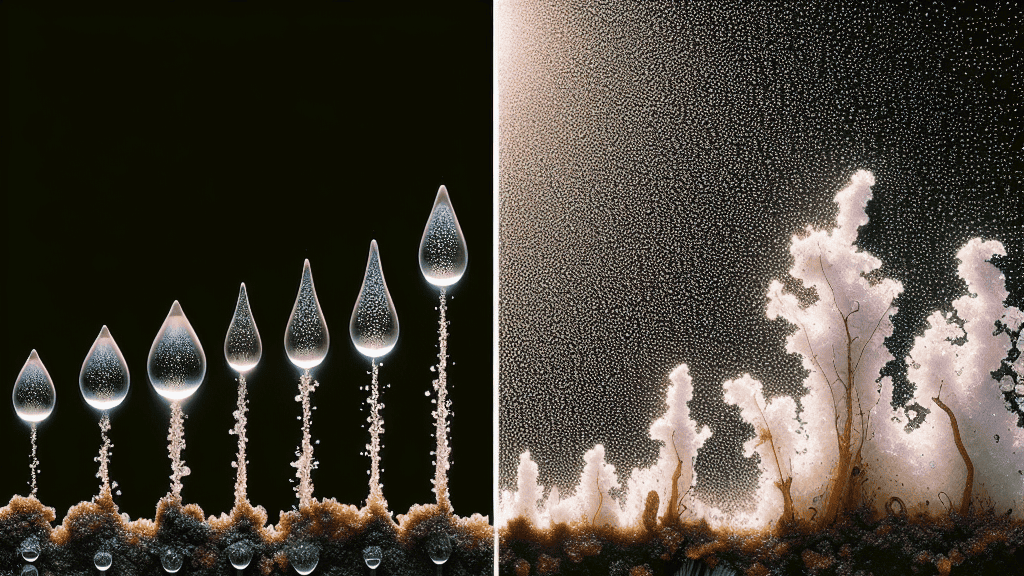
Imagine watching a droplet slowly evaporate on a surface and expecting the familiar coffee-stain ring to appear. Instead, what forms is a mesmerizing, intricate maze-like design, as if following some hidden blueprint. This isn’t a magic trick, but an amazing display of nature’s complexity in the small world of drying droplets.
Scientists recently found that when particle-laden droplets are allowed to evaporate very slowly while confined in a narrow space, they don’t form the usual stain rings. Instead, they create patterns that look like circular mazes. These aren’t just random squiggles; they’re structured, consistent, and remarkably beautiful. The study delved into how the rate of evaporation and the shape of the confinement could influence the outcome, suggesting that other natural and untapped examples of these patterns could exist.
Think about how this could change our everyday experiences. Artists might use these findings to create new styles of liquid-based art. Engineers could apply this understanding to design new materials with unique properties, possibly leading to better paints or coatings. It’s another reminder of how observing even the smallest details can lead to big discoveries and transformations in technology and art.
Did you know? The patterns formed by drying droplets in a confined space can resemble ancient labyrinth designs!
FAQs
What is the coffee-stain effect in droplets?
The coffee-stain effect happens when a droplet dries, leaving a ring of particles around its edge. This occurs because the liquid evaporates faster at the edges, dragging particles outward. It’s like when you spill coffee and find a ring once it dries.
How do maze patterns form in evaporating droplets?
Maze patterns form when droplets with particles are allowed to evaporate very slowly in a confined space like a slit. This slow evaporation creates intricate circular designs instead of the typical coffee rings. The process involves careful balance of drying speed and particle movement.
Why do scientists care about droplet drying patterns?
Understanding droplet drying patterns helps scientists learn how particles move in fluids, which can influence material science, art, and even manufacturing. It could lead to innovative ways to use and manipulate liquid and solid interactions.
What are some potential applications for this droplet research?
This research could inspire new art forms by manipulating drying patterns, revolutionize how we design paints and coatings, or lead to advanced technologies that control particle distribution in various materials.
Have these maze-like patterns been seen in nature before?
Currently, there are no known natural examples of these patterns, but researchers believe they likely exist and are awaiting discovery. The phenomenon opens a new area of exploration in nature’s designs.
Background
The coffee-stain effect is a well-known phenomenon where drying droplets, commonly like spilled coffee, leave a ring-like deposit of particles at their edges. This happens because the edges of the droplet dry faster, causing liquid from the center to flow outward, dragging particles along. The recently discovered maze pattern phenomenon occurs when these droplets evaporate very slowly in a confined space, allowing particles to arrange into complex forms instead of rings.
History
The study of drying droplet patterns began with the coffee-stain effect discovery in the late 1990s. Initial research focused on understanding the physics behind the migration of particles to the droplet’s edge. Since then, researchers have been exploring how variations in drying conditions, such as speed and environment, can lead to different patterns. This new finding of intricate patterns under confined conditions builds on our understanding of particle dynamics and opens new avenues for exploring other potential designs.
Based on “Confined colloidal droplets dry to form circular mazes” by Ilaria Beechey-Newman, Natalia Kizilova, Andreas Andersen Hennig, Eirik Grude Flekkøy, Erika Eiser, available on arXiv (arxiv.org/abs/2502.19604), used under CC BY 4.0 (creativecommons.org/licenses/by/4.0/).