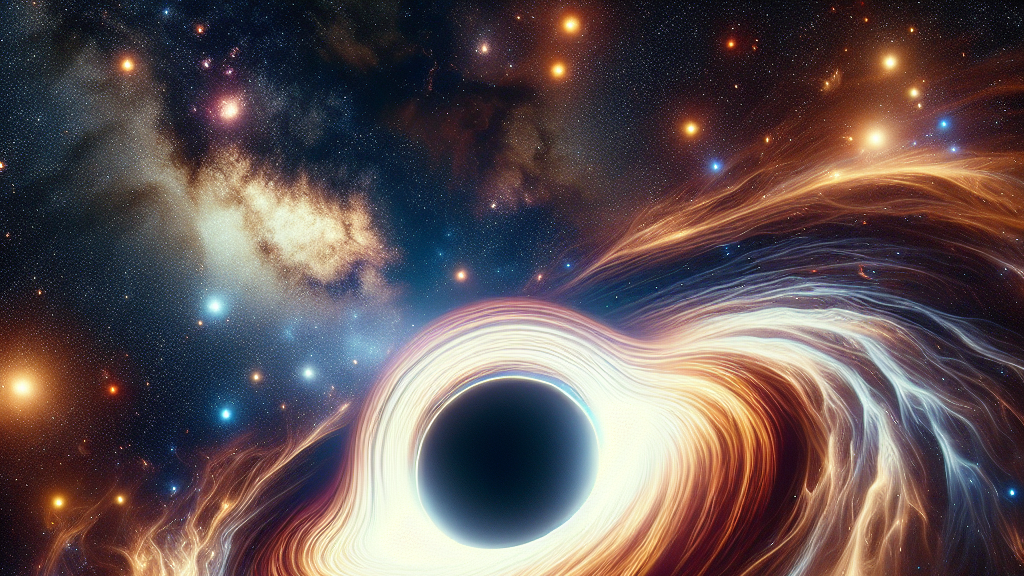
Imagine if the most ravenous cosmic monsters, black holes, suddenly developed a conscience and decided to stop gulping down stars at an alarming rate. Well, researchers have found that this might be closer to reality than we thought! They’ve discovered that black holes can grow something akin to ‘quantum hair,’ which slows down their appetite for surrounding material, providing a twist worthy of a space thriller.
This ‘quantum hair’ might sound like a bizarre sci-fi concept, but it’s actually rooted in serious science. The idea is that when a black hole gobbles up particles, it grows a kind of quantum fuzz that influences its behavior. This fuzz or ‘hair’ changes how the black hole evaporates and loses mass, particularly affecting black holes formed with dark matter inside neutron stars. What this means is that our previous theories about certain properties of dark matter, like how it scatters off atoms, might need a serious update.
Thinking about the future, this research paints an exciting picture of how we might control or predict the growth of black holes. Imagine if we could understand and perhaps manipulate this ‘quantum hair’ to prevent black holes from devouring their starry companions. This would not only rewrite our understanding of the universe but could also help in the search for elusive dark matter, potentially unlocking new realms of technology and physics.
Did you know that black holes can grow ‘quantum hair,’ which might slow down their consumption of stars?
FAQs
What is the memory burden effect related to black holes?
The memory burden effect refers to a new understanding where black holes develop ‘quantum hair,’ which impacts how they lose mass and interact with nearby stars.
How does ‘quantum hair’ influence black holes?
‘Quantum hair’ seems to slow down the rate at which black holes lose mass, affecting their ability to consume other celestial bodies like stars.
Why does this matter for dark matter research?
This discovery could change our understanding of dark matter, particularly in neutron stars where black holes grow, leading to new possibilities in cosmic research and exploration.
Could ‘quantum hair’ lead to new technologies?
If we understand how to manipulate ‘quantum hair,’ it might lead to breakthroughs in space travel, energy, and our understanding of the universe.
What are the implications for neutron stars?
The research suggests that neutron stars might behave differently when they host dark matter, affecting the entire star system’s dynamic.
Background
Black holes are mysterious cosmic objects known for their powerful gravitational pull, which makes them consume everything, even light. They’re formed when massive stars collapse under their own gravity. According to Einstein’s theory, nothing can escape a black hole’s pull. However, physics at the quantum level introduces complexities like Hawking radiation, which describes how black holes can actually emit particles and lose mass over time.
History
The idea of black holes consuming stars isn’t new; it dates back to when scientists tried to explain how these dark objects interact with the universe. Stephen Hawking introduced the concept of Hawking radiation to explain how black holes can lose mass over time, but the debate continued about the ‘information paradox’—the question of what happens to information swallowed by black holes. This new research offers a fresh perspective by suggesting that ‘quantum hair’ might play a role in solving these longstanding mysteries.
Based on “Beyond Hawking evaporation of black holes formed by dark matter in compact stars” by Ujjwal Basumatary, Nirmal Raj, Anupam Ray, available on arXiv (arxiv.org/abs/2410.22702), used under CC BY 4.0 (creativecommons.org/licenses/by/4.0/).