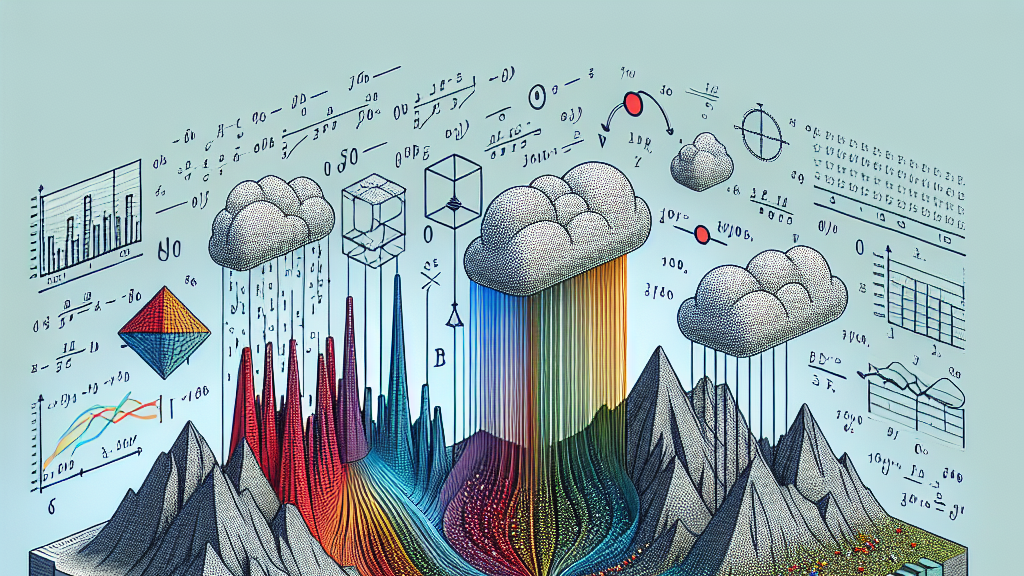
Imagine you’re predicting how a new movie will perform using past box office hits. You have all the factors—what makes a blockbuster, what flops—but suddenly, the formula breaks. That’s what happened to scientists who discovered that sometimes the rules we trust to predict outcomes, like in disease spread, just crumble.
Researchers have been using complex mathematics called Bayesian inference to predict things like how diseases spread. They often make assumptions based on known patterns (called Nishimori conditions), believing they hold steady. However, this study shows that these conditions can lead to unexpected twists, breaking the ‘symmetry’ of predictions. This phenomenon is like when a kaleidoscope’s symmetry shatters into brilliant chaos.
So, what does this mean for us? In real life, it could change how we understand disease outbreaks. Imagine tracking a virus, thinking you know how it spreads—and then it behaves unpredictably. This research could lead to better models that anticipate such surprises, helping prepare for and contain outbreaks more effectively.
Did you know? Symmetry breaking is why snowflakes have unique patterns but never look chaotic!
FAQs
What is Bayesian inference and why is it important for disease prediction?
Bayesian inference is a method of statistical analysis that uses prior knowledge combined with new data to make predictions. It’s crucial for understanding how diseases might spread and how outbreaks can be controlled, by continuously updating our predictions with fresh information.
What are the Nishimori conditions in mathematical modeling?
Nishimori conditions are assumed parameters that simplify the predictions in Bayesian models by using known prior and likelihood distributions. They often help ensure that the mathematical models run smoothly, but this study shows they can occasionally lead to unexpected outcomes.
How does replica symmetry breaking impact disease modeling?
Replica symmetry breaking introduces an element of unpredictability in mathematical models, similar to how a pattern breaks down into chaos. This impacts disease modeling by potentially revealing new, unanticipated patterns in how diseases spread, which could be vital for managing epidemics.
What exactly is ‘replica symmetry breaking’ in simple terms?
In mathematics, replica symmetry refers to a kind of balance or predictability in equations. When it’s broken, the system behaves unpredictably, leading to surprising results. It’s like expecting a beautifully symmetrical snowflake and getting an unexpected zigzag instead.
How could this research improve future epidemic responses?
Understanding where and why predictions break can help scientists create more robust models that anticipate unexpected behaviors in disease spread. This could lead to quicker, more effective responses to containment efforts, ultimately saving lives.
Background
Bayesian inference is a statistical method that uses existing data to continuously update predictions as more information becomes available. Replica symmetry in mathematical modeling refers to the assumption that large systems behave predictably and consistently, like how a snowflake has symmetrical properties. When this symmetry breaks, it introduces an element of chaos or unpredictability, much like how identical patterns can suddenly differ.
History
The study of Bayesian inference goes back to Thomas Bayes in the 18th century, who introduced a method for updating probabilities based on new data. Over time, it became a cornerstone for predictive modeling. Replica symmetry breaking, rooted in statistical physics, presented a theoretical framework in the 20th century for understanding complex systems like spin glasses and now offers new insights into data-driven fields such as epidemiology.
Based on “Evidence of Replica Symmetry Breaking under the Nishimori conditions in epidemic inference on graphs” by Alfredo Braunstein, Louise Budzynski, Matteo Mariani, Federico Ricci-Tersenghi, available on arXiv (arxiv.org/abs/2502.13249), used under CC BY 4.0 (creativecommons.org/licenses/by/4.0/).