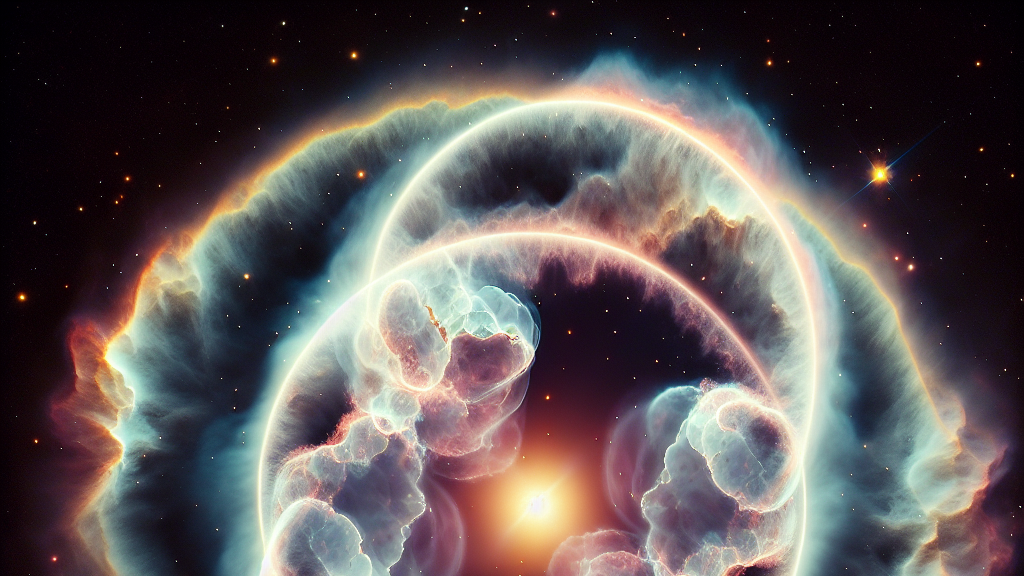
Ever looked up at the night sky and wondered what cosmic secrets are hidden beyond the stars? Well, scientists have just used the James Webb Space Telescope to peek into a planetary nebula called NGC 1514, and what they found was quite surprising: a pair of glowing, infrared ‘rings of fire’ circling its faint outer shell. This nebula, a stellar ghost, is giving us clues about how stars like our Sun shed parts of themselves over time.
In a recent study, scientists used special filters on the telescope to capture different wavelengths of infrared light from these fascinating rings. The intricate structures revealed themselves to be made of tiny, hot dust grains rather than the usual atomic or molecular gases we might expect. This means that these rings could be the remnants of a massive period of shedding from the star that originally formed the nebula, sculpted by high-speed winds from a hidden pair of stars at the core.
Now, why does this matter to us back home on Earth? Well, these kinds of cosmic events help scientists understand the life cycle of stars, including the one that powers our solar system. By learning more about how stars evolve and eventually die, we can better understand the history and future of the universe, including our own tiny place within it. Imagine future space missions focusing on these enigmatic rings to unlock even more starry secrets.
Did you know? The mysterious rings of NGC 1514 were only discovered during an all-sky infrared survey—a space project that essentially maps out the heavens in heat vision!
FAQs
What did scientists discover about NGC 1514’s infrared rings?
Scientists observed that the rings are made up of tiny, hot dust grains and they are products of older star material, sculpted by fast winds from a central star system.
Why are the rings in the nebula so bright in infrared light?
The brightness in infrared light is due to the thermal emission from the small dust grains, rather than gas emissions like hydrogen or molecular hydrogen.
How do these infrared rings help us understand star life cycles?
The infrared rings offer insight into the processes of stellar mass loss and the shaping effects of stellar winds, key to understanding the life and death of stars.
What tools did the scientists use to study the nebula?
Scientists used the James Webb Space Telescope’s mid-infrared imaging and spectroscopy capabilities, specifically the MIRI Imager and Medium Resolution Spectrometer, to study the nebula’s rings.
How could this research impact our view of the universe?
This research enhances our understanding of stellar evolution and mass loss, contributing to a broader comprehension of the cosmos and our place in it.
Background
Planetary nebulas are fascinating celestial objects that form when a star, like our Sun, reaches the end of its life and expels its outer layers. This shedding process releases clouds of gas and dust, creating spectacular shapes and colors as they interact with surrounding space. The structure and composition of these nebulas provide valuable information about how stars evolve and die.
History
The study of planetary nebulas has come a long way; early astronomers mistook them for planets due to their round shapes. Over time, scientists have used increasingly advanced telescopes to reveal these objects as remnants of dying stars. Discoveries, such as the infrared rings around NGC 1514, build on this rich history and help refine our understanding of stellar life cycles.
Based on “JWST/MIRI Study of the Enigmatic Mid-Infrared Rings in the Planetary Nebula NGC 1514” by Michael E. Ressler, Alba Aller, David Jones, Ryan M. Lau, Luis F. Miranda, Karen Willacy, available on arXiv (arxiv.org/abs/2502.21281), used under CC BY 4.0 (creativecommons.org/licenses/by/4.0/).