Connect with us

Search by keyword

Space

Can Planets Ring Like Bells?

This study explores how smashing a space rock into a giant planet makes it ring like a bell, creating waves that could last millions of years and be visible even with the James Webb Space Telescope.

Can Planets Ring Like Bells
✨Researched by humans. Explained by robots. Learn more.

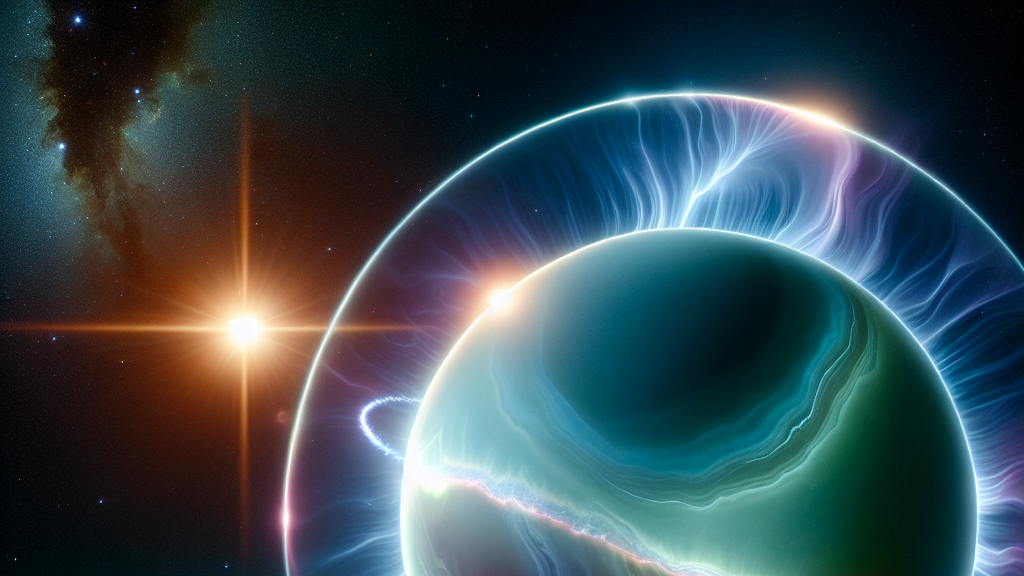
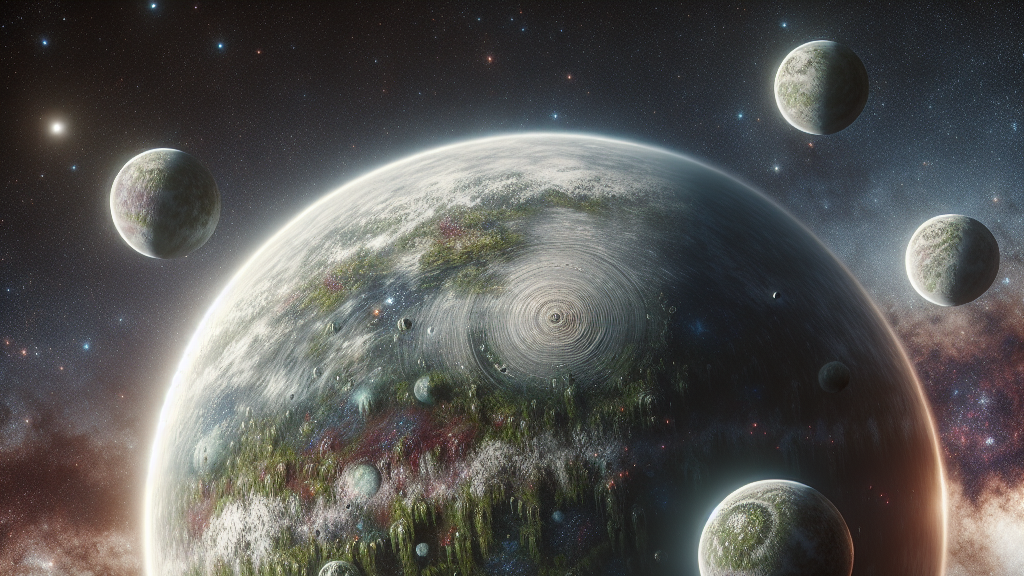
Did you know that planets can ring like bells? Imagine if a space rock the size of Neptune slammed into a giant planet. Such a colossal impact could send waves throughout the planet, making it oscillate for millions of years. A young super-Jupiter like Beta Pictoris b might still be ringing today, creating light variations visible from Earth!

Researchers have delved into this phenomenon using advanced modeling. They found that when a young gas giant gets walloped by large rocky bodies, it sets off long-lasting seismic waves. These waves are like a planet’s version of ringing, continuing for a significant fraction of its age. For Beta Pictoris b, if a sizable collision occurred in the last 9 to 18 million years, these oscillations could still be detected today with our cutting-edge telescopes.

In the future, the James Webb Space Telescope could catch glimpses of these celestial tunes. By measuring the light variations caused by these waves, scientists might uncover more secrets about the early solar systems. This research takes us one step closer to understanding the grand cosmic concerts that play out in the universe, and who knows? Maybe one day, we’ll listen to a cosmic symphony live from outer space!

Beta Pictoris b might still be ringing from a cosmic impact that happened millions of years ago!

FAQs

Can planets really ring like bells after a giant impact?

Yes, when a large solid body impacts a giant planet, it generates seismic waves that cause the planet to oscillate, like ringing a bell. These oscillations can last for millions of years, depending on the size and energy of the impact.

How can we detect the oscillations of planets like Beta Pictoris b?

Scientists can detect these oscillations by observing changes in the planet’s brightness, known as photometric variability. The James Webb Space Telescope is capable of measuring these subtle changes.

What makes Beta Pictoris b an interesting target for this research?

Beta Pictoris b is a young, massive planet known to have a high metal content, making it a likely candidate to have experienced massive collisions in its past. These collisions would still cause detectable oscillations.

What kind of bodies could impact a giant planet to cause these rings?

The research suggests that collisions with bodies around the size of Neptune, roughly 17 times the mass of Earth, could cause these noticeable oscillations in giant planets like Beta Pictoris b.

Why is observing these planetary oscillations important?

Observing these oscillations helps scientists learn about the history and formation of giant planets. It can give insights into their internal structure and the roles that cosmic impacts play in shaping them.

Background

Understanding giant exoplanets requires knowing about their cores, which are thought to be made of heavy metals. When a giant planet forms, it might merge with other massive solid bodies, generating seismic waves that ripple through the planet. These waves are detectable as variations in the planet’s brightness, which telescopes on Earth or in space can capture.

History

The study of exoplanets has grown rapidly with advancements in telescope technology, leading to discoveries of planets that are unlike anything in our solar system. Prior research has focused on their composition and the role of heavy metals. This study builds on the discovery of Beta Pictoris b, hypothesizing about past cosmic impacts that could have caused long-lasting oscillations.

Based on “Seismic Oscillations Excited by Giant Impacts in Directly-Imaged Giant Planets” by J. J. Zanazzi, Eugene Chiang, Yifan Zhou, available on arXiv (arxiv.org/abs/2505.01496), used under CC BY 4.0 (creativecommons.org/licenses/by/4.0/).

Trending

Latest

Can AI Save Water Discover How

Computers

AI is transforming the tech world, but it uses lots of water! A new tool, SCARF, helps us measure and reduce AI's water footprint,...

Whats a Forbush Decrease and Why Should We Care Whats a Forbush Decrease and Why Should We Care

Space

Scientists just observed the biggest solar storm event in years, revealing unexpected cosmic ray patterns. Understanding these changes could help us protect our technology...

Can Cars Spot Danger Faster Than Humans Can Cars Spot Danger Faster Than Humans

Computers

Think about how quickly you react when something unexpected happens on the road. This research brings us closer to creating self-driving cars that can...

Can Fear of the Other Stop Social Harmony Can Fear of the Other Stop Social Harmony

Physics

Fear of the unknown might make it harder for people to agree and get along. This study shows that when people have strong xenophobic...

Can AI Revolutionize Breast Cancer Diagnosis Can AI Revolutionize Breast Cancer Diagnosis

Electricity

This research introduces a groundbreaking AI model that can accurately assess HER2-positive breast cancer using widely accessible staining methods, potentially revolutionizing how we diagnose...

Can AI Transform Your Singing into a Choir Can AI Transform Your Singing into a Choir

Computers

Imagine singing solo and having AI turn you into a choir. This research unveils a groundbreaking AI tool that transforms your voice into rich...

You May Also Like

Space

Scientists have discovered a new way that tiny early-universe structures might grow into massive black holes, potentially changing our understanding of cosmic evolution! This...

Space

Discovering planets orbiting two stars is like finding a new chapter in a cosmic fairytale. These findings can change what we think about planet...

Space

Scientists searched for alien radio signals from distant planets, but found none, giving us a peek into the universe's mysteries and possibly sparking more...

Space

Scientists have discovered a new way to check for volcanic activity on planets outside our solar system, opening the door to understanding how these...

Space

This research helps us understand how planets and stars line up in space, which can reveal secrets about the universe's past and future. Knowing...

Space

Researchers explore the possibility of habitable moons around distant gas giants, suggesting that these moons could extend the habitable zones beyond what they've traditionally...

Space

Scientists are exploring the potential for moons of giant planets to host life, finding that nearly a third could be habitable. This research suggests...

Space

We've discovered that exoplanet skies, like on WASP-94A b, can change dramatically between day and night due to cloud movements—similar to weather on Earth,...

Space

Discover how clouds on distant planets might change daily, much like Earth's weather, revealing new insights into their atmospheres.

Copyright © 2024 8ig8rain.

Disclaimer: The content on 8ig8rain.com consists of AI-generated summaries of scientific abstracts from arXiv. Please note that most arXiv abstracts are preprints and may not have undergone formal peer review. While these summaries aim to convey key ideas and potential applications, they are provided for informational purposes only and should not be interpreted as validated scientific findings or professional advice. The summaries are intended to educate, spark curiosity, and inspire further exploration of science.