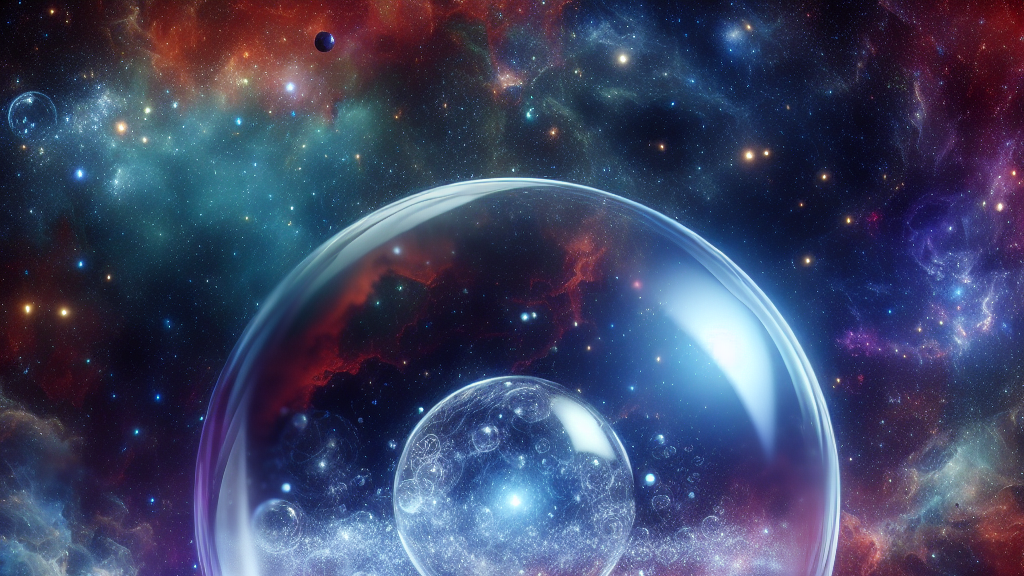
What if the universe didn’t start with a Big Bang, but instead popped into existence like a bubble in a bathtub? That’s the mind-bending concept scientists are exploring, suggesting that our cosmos may have begun as a vacuum fluctuation. If true, this model implies a need for cosmic acceleration, altering our grasp on how the universe has grown since its inception.
According to this research, rather than a singular explosive event, the universe could have emerged smoothly, akin to a bubble forming and expanding over time. This shift in perspective involves complex math, specifically something called a ‘cosmological sum rule,’ which suggests that this cosmic bubble would eventually require a boost of acceleration. This nuance offers a fresh angle on how we see the universe unfolding.
This fascinating insight not only reframes our view of cosmic history but also holds profound implications for future space exploration and understanding cosmology. Imagine being able to predict the universe’s future movements more accurately, aiding scientists in unlocking secrets of space-time, potentially leading to technological advancements and deeper cosmic journeys.
Did you know? Instead of a Big Bang, our universe might have expanded like a bubble from a vacuum fluctuation!
FAQs
What is a vacuum fluctuation in the context of the universe’s origin?
A vacuum fluctuation suggests that the universe might have started as a bubble-like formation rather than a singular explosive event, potentially changing our understanding of cosmic beginnings.
How does this research redefine our concept of the Big Bang?
It challenges the traditional Big Bang theory by proposing that the universe emerged from a vacuum fluctuation, requiring cosmic acceleration, thus presenting a new narrative of cosmic evolution.
What is the cosmological sum rule and its significance?
The cosmological sum rule is a mathematical framework used in this study, supporting the idea that a universe starting as a vacuum fluctuation must eventually experience acceleration, reshaping our cosmological models.
What practical impact could this theory have on future cosmology?
Understanding this model could refine our predictions of cosmic dynamics and influence technology and exploration strategies, potentially leading to breakthroughs in space travel and energy utilization.
How does this research align with current cosmic data?
Current cosmic data aligns with the theory’s predictions about cosmic acceleration, offering a promising alternative to the conventional understanding of our universe’s development.
Background
The Big Bang is the leading explanation for the universe’s origin, proposing an initial singular event that expanded into our current universe. However, scientific models like vacuum fluctuations suggest an alternative, where cosmic emergence is a smooth transition from a state of empty space. The Friedmann equations describe how the universe expands, and the introduction of the Schwarzian form helps account for potential cosmic accelerations within this framework.
History
For decades, the Big Bang theory has been the cornerstone of cosmological studies. However, observations of accelerating cosmos have led to exploring new models. Vacuum fluctuation theories stem from quantum mechanics, where energy can spontaneously appear and disappear, creating bubbles in space-time. This research integrates such concepts with cosmic mathematics, suggesting a refined narrative that aligns with observed cosmic behaviors.
Based on “Cosmic Acceleration from Nothing” by Michael R. R. Good, Eric V. Linder, available on arXiv (arxiv.org/abs/2503.02380), used under CC BY 4.0 (creativecommons.org/licenses/by/4.0/).