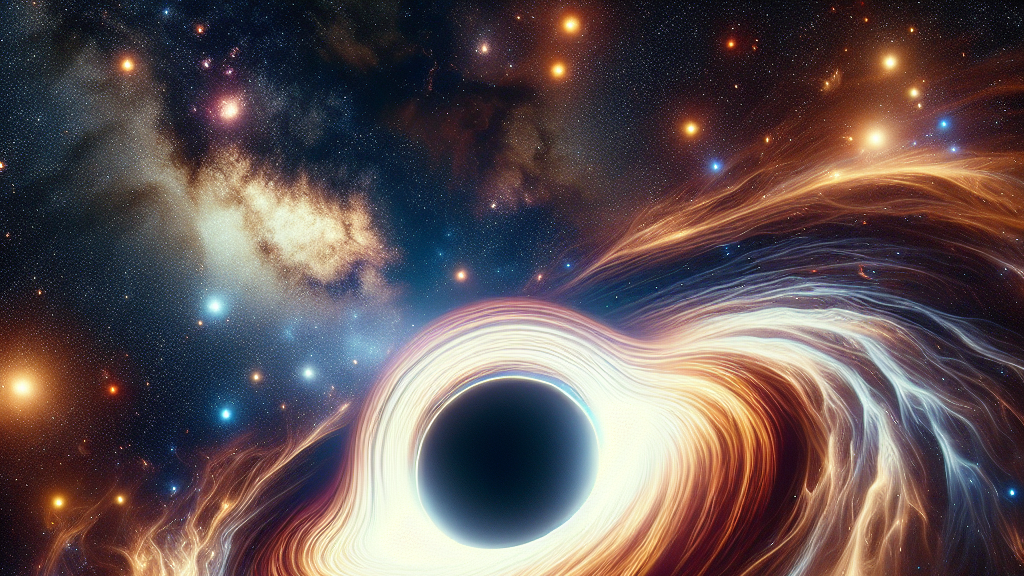
Imagine if black holes, those mysterious cosmic vacuums, could actually shine a light on some of the universe’s biggest mysteries! That’s exactly what might happen if we can catch gamma-ray signals from primordial black holes (PBHs). These signals could help us understand dark matter, that invisible stuff making up most of the universe, by detecting particles called dark photons that might be hidden in these signals.
In simple terms, gamma rays are powerful explosions of light in the universe, and when they come from black holes, they might carry clues about dark matter. Researchers are excited about the potential for future observatories to detect signals from tiny black holes, where these dark photons might be produced. These hypothetical particles decay into regular photons, making them easier to spot when they reach Earth. By analyzing these unique signals, scientists aim to uncover secrets about the so-called ‘dark sectors’ of the universe.
So, what does all this mean for us? If this research pans out, it could transform our understanding of the universe’s components and origins. We might be witnessing the dawn of a new era in astrophysics, one where gamma-ray observatories help us ‘see’ invisible matter. Imagine how different our science books might look if these black holes help us solve the puzzle of what makes up dark matter. The findings could pave the way for new technologies and deeper cosmic insights!
Dark matter makes up about 27% of the universe, yet we have never directly observed it.
FAQs
What is the connection between black holes and dark matter?
Primordial black holes (PBHs) are tiny black holes from the early universe that might act as dark matter candidates. Researchers think gamma-ray signals from PBHs could contain clues about dark matter’s nature.
Why are gamma-rays important in this research?
Gamma-rays are high-energy light signals emitted by objects like PBHs. By detecting these rays, scientists hope to identify features like dark photons, which could help reveal the nature of dark matter.
What are dark photons and why are they significant?
Dark photons are a hypothetical type of particle that may interact with dark matter. If detected, they could provide crucial insights into the ‘dark sectors’ of the universe, helping to solve mysteries about dark matter.
How could this research change our understanding of the universe?
This research could uncover the makeup and properties of dark matter, which is still one of the biggest mysteries of modern astrophysics. Such discoveries could reshape our understanding of cosmic origins and fundamental physics.
What role do future observatories play in this research?
Future gamma-ray observatories will be equipped with advanced technologies to detect signals from PBHs, enabling the possibility of identifying new particles like dark photons and exploring previously inaccessible areas of the dark matter puzzle.
Background
Primordial black holes are remnants from the early universe that might contain information about dark matter. They emit high-energy gamma rays through a process known as Hawking radiation. This research investigates whether gamma rays from these black holes could include signals from dark photons, hypothetical particles that might help solve the dark matter mystery.
History
The concept of primordial black holes dates back to the 1970s, when scientists proposed them as remnants from the Big Bang. Over the years, researchers have considered PBHs as possible dark matter candidates. Recent advances in gamma-ray astronomy have opened new avenues for studying these mysterious objects and exploring related particles like dark photons.
Based on “Searching for Dark Photon Tridents Through Primordial Black Hole Signatures” by Kingman Cheung, C. J. Ouseph, Po-Yan Tseng, Sin Kyu Kang, available on arXiv (arxiv.org/abs/2503.04175), used under CC BY 4.0 (creativecommons.org/licenses/by/4.0/).