





































































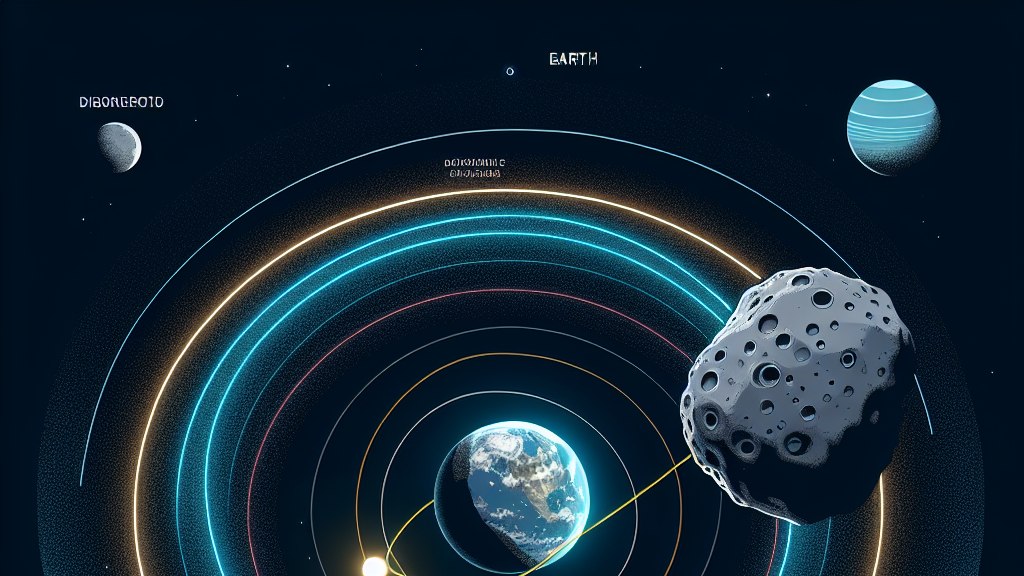
Ever wondered if space probes, thought lost decades ago, might still be floating around near Earth? There’s an intriguing hypothesis about a near-Earth object, 2005 VL1, potentially being the long-lost Soviet probe Venera 2. Imagine the excitement if one of humanity’s early attempts to explore space had found its way back to our cosmic neighborhood! But is it really possible?
To figure out if 2005 VL1 could be Venera 2, a researcher revisited the path of this space rock. This involved crunching numbers and considering extra forces that might affect its orbit. By comparing its position with when Venera 2 was launched and passed Venus, the study found it couldn’t be the missing probe. Even though the mystery remains unsolved, the methods used could help in understanding other cosmic artifacts floating in space.
So why does this matter to us? This study highlights how space exploration is full of surprises and how our nearest cosmic neighbors might hold clues to our adventurous past. Imagine if one day we could recover lost probes; it could open a treasure trove of historical and scientific data. And who knows, one of these objects might just lead us to some extraordinary discovery about our spacefaring history!
Asteroids and space probes can sometimes share similar orbits, sparking fascinating mysteries!
FAQs
Why are space probes like Venera 2 significant?
Space probes such as Venera 2 are significant because they represent humanity’s early attempts to explore other planets and gather data from places we can’t visit in person. Discovering lost probes could provide valuable historical and scientific insights into these missions.
How was 2005 VL1 identified as a potential space probe?
Scientists suggested that 2005 VL1, a near-Earth object, could be the lost Soviet probe Venera 2 due to its orbit and proximity to Earth. Researchers analyzed its path using astrometric data to test this theory.
What is non-gravitational acceleration, and why is it important?
Non-gravitational acceleration refers to forces other than gravity affecting an object’s motion, like solar radiation or thermal effects. Understanding these forces is crucial for accurately predicting the orbits of objects like space probes.
What does this research mean for future space discoveries?
This research suggests new methods for tracking near-Earth objects and verifying if they could be artifacts of human space exploration, potentially helping identify other lost or unidentified space probes in the future.
How does this research relate to astrometric observations?
Astrometric observations involve tracking the precise positions and movements of celestial objects. They were essential in this research to determine the orbit of 2005 VL1 and compare it to the expected path of Venera 2.
Background
Astrometric observations involve measuring positions and movements of objects in space, helping scientists piece together their trajectories. Non-gravitational acceleration, like the push from sunlight, can affect these paths, making tracing things like lost probes challenging but exciting. It’s like solving a cosmic crime mystery!
History
The idea of space probes being mistaken for asteroids isn’t new. Probes from the early space race, like the Soviet Venera series, have been lost in space, their final trajectories unknown. Current research tries to match known near-Earth objects with these historical missions to see if we’ve overlooked anything.
Based on “’Dark comet’ 2005 VL₁ is unlikely to be the lost Soviet-era probe Venera 2” by Federico Spada, available on arXiv (arxiv.org/abs/2503.09137), used under CC BY 4.0 (creativecommons.org/licenses/by/4.0/).

