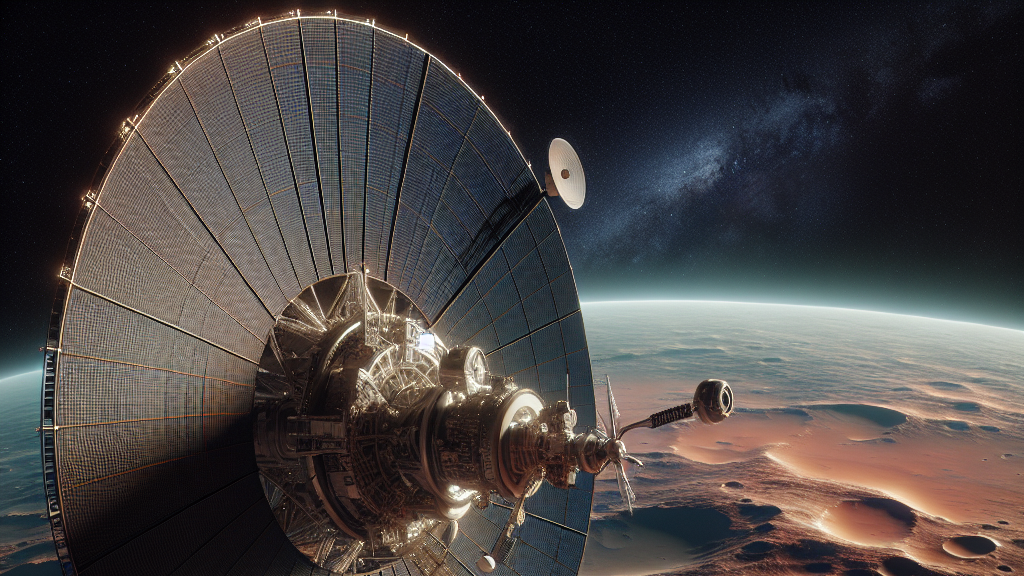
Imagine learning there’s been a ghost in space—a dark comet that turns out to be a sneaky spacecraft! This is not a plot from a science fiction movie but a thrilling real-life discovery. Scientists have identified near-Earth objects, dubbed dark comets, that behave in strange ways. But one of them, named 2005 VL1, might actually be an old spacecraft—Venera 2, launched way back in 1965 to explore Venus.
The researchers discovered that 2005 VL1 showed up at the same time and place as the Venera 2 did on its mission to Venus. What’s even more astonishing is that they found the object’s shiny surface matched that of Venera 2, including its solar panels. The object also followed a path that was suspiciously similar to Venera 2’s journey. This alignment was so perfect, it had less than a 1% chance of happening by accident.
This discovery isn’t just an intriguing mystery, it could totally transform our understanding of near-Earth objects and space exploration. Imagine revisiting other objects we thought were space debris, only to find they’re historical artifacts or even dormant spacecraft waiting to be discovered. This could spark a whole new era of space archaeology, hunting for lost missions and learning from our past adventures among the stars.
Did you know that the Venera 2 spacecraft might have been hiding in plain sight as a ‘dark comet’ for decades?
FAQs
What are dark comets?
Dark comets are a type of near-Earth objects that show unusual behavior, like having non-gravitational accelerations without visible comas, which makes them stand out from typical comets.
How was the dark comet 2005 VL1 linked to Venera 2?
Researchers found that 2005 VL1 shared very similar orbital paths and reflective surface properties with Venera 2, suggesting it might actually be this Soviet spacecraft.
Why is the discovery of 2005 VL1 significant?
Identifying 2005 VL1 as a spacecraft, not just a dark comet, challenges our understanding of space debris and inspires new ways to explore and interpret near-Earth objects.
Could there be other spacecrafts mistaken as dark comets?
Yes, this discovery opens the possibility that other objects we classify as space debris may actually be relics of historical space missions, waiting to be identified.
What impact could this have on future space exploration?
This could lead to renewed interest in tracking and identifying objects in space, unveiling historical missions and contributing to space archaeology.
Background
Dark comets defy typical expectations for comets by not having a visible coma, which is a fuzzy cloud of gas and dust that is usually associated with comets when they are close to the sun. These unique objects still experience forces that cause them to accelerate differently than what gravity alone would predict, suggesting other forces like solar radiation pressure might be at play. Solar radiation pressure occurs when the sun’s light pushes on an object, especially important for objects with a large area relative to their mass, like spacecraft with solar panels.
History
The study of near-Earth objects has evolved as we try to understand bodies that come close to Earth, from potential threats to historical relics. Discovering that what we thought were dark comets could be old spacecraft builds on prior discoveries of artificial satellites and space debris. This finding ties back to the era of space exploration when the Venera 2 spacecraft was sent to explore Venus, representing the curiosity and ambition of early space endeavors.
Based on “Is the ‘Dark Comet’ 2005 VL1 the Venera 2 Spacecraft?” by Abraham Loeb (Harvard), Richard Cloete (Harvard), available on arXiv (arxiv.org/abs/2503.03552), used under CC BY 4.0 (creativecommons.org/licenses/by/4.0/).