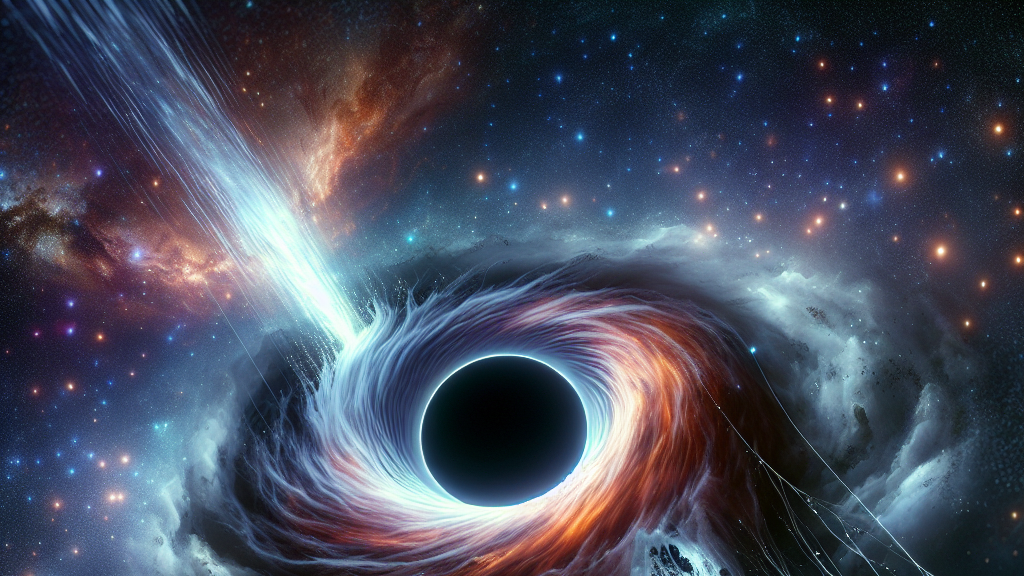
Imagine the universe as a huge cosmic puzzle. Until now, scientists thought they had a pretty good picture of how galaxies formed from clouds of gas coalescing under gravity. But new research suggests that massive black holes, lurking since the dawn of the universe, might have been sneaky puzzle pieces that helped shape galaxies right from the start. These black holes may have attracted matter and sped up the creation of stars and galaxies, painting a different picture than we thought.
This research dives into the cosmic past using supercomputers to simulate the early universe. Researchers found that these ancient, massive black holes were like cosmic gardeners—planting seeds for galaxies by pulling in gas and helping create the first star nurseries. But there’s a twist: strong feedback from these black holes could also hold back star formation by preventing gas from cooling down enough to form stars. This tug-of-war might explain why the early universe is filled with strange, massive black holes that have puzzled scientists for years.
The ramifications of this research are enormous. By shedding light on these ancient cosmic events, we might better understand the universe we see today. Imagine if telescopes like the James Webb and Roman Space Telescope could peer far enough back in time to catch these events in action. One day, we might even be able to predict how galaxies form in the most distant corners of the universe. So next time you look up at the night sky, remember that black holes might have been the cosmic architects of everything you see.
Did you know some black holes are as old as the universe itself? They’re like cosmic time capsules, holding secrets from the dawn of time.
FAQs
What are primordial black holes and why are they important in this research?
Primordial black holes are ancient black holes formed soon after the Big Bang. In this research, they play a crucial role in shaping the early universe by influencing how stars and galaxies were created.
How do black holes accelerate star formation in the early universe?
Massive black holes can gravitationally attract gas, seeding the formation of dark matter halos that help form stars and galaxies faster than in a universe without them.
What challenges do primordial black holes present to current galaxy formation theories?
They introduce a twist in our understanding by suggesting these black holes might have been responsible for some of the earliest and biggest galaxies, challenging traditional views of galaxy formation.
How will new telescopes help explore the role of primordial black holes?
Future telescopes like the James Webb and Roman Space Telescope will provide deeper insights and images of the early universe, allowing scientists to directly observe how these black holes affected galaxy formation.
Could primordial black holes explain the existence of overmassive black holes in the universe?
Yes, the presence of primordial black holes could naturally explain some of the massive black holes that exist without needing to resort to more complex formation theories.
Background
Primordial black holes are theorized to have formed right after the Big Bang, unlike black holes formed by collapsing stars. These cosmic relics can have masses much larger than typical stellar black holes and are thought to have influenced the structure of the early universe significantly. The interaction between dark matter, gas, and these black holes could have triggered the formation of stars and galaxies faster than previously expected.
History
Black holes have fascinated scientists for decades. Early theories postulated that black holes form from collapsing massive stars. However, the concept of primordial black holes emerged as a possible explanation for mysterious cosmic phenomena, including gravitational anomalies and the fast formation of early galaxies. Recent simulations and observational advances, such as those from the Hubble Space Telescope, provide new opportunities to test these theories and further our understanding of cosmic evolution.
Based on “How do Massive Primordial Black Holes Impact the Formation of the First Stars and Galaxies?” by Saiyang Zhang, Boyuan Liu, Volker Bromm, Junehyoung Jeon, Michael Boylan-Kolchin, Florian Kühnel, available on arXiv (arxiv.org/abs/2503.17585), used under CC BY 4.0 (creativecommons.org/licenses/by/4.0/).