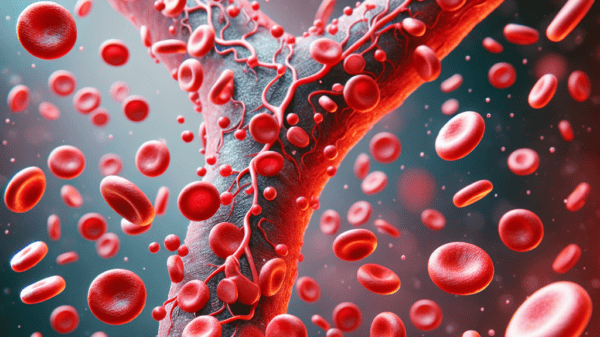
Imagine if understanding blood flow could transform the way we approach heart health. Recently, scientists have made a breakthrough by studying how blood travels through vessels under different conditions. It’s like unlocking a new level of insight into how our bodies work, right from the beating heart.
So, what’s the big deal? Researchers used a special method to uncover hidden patterns in blood flow that were overlooked before. Think of it as discovering a secret dance happening in our veins and arteries. They explored how blood flow changes when influenced by outside forces and rhythmic patterns, rather than just assuming everything flows evenly. This could mean a big leap in understanding circulation beyond the usual heart rhythm.
Now, picture this: in the future, we might use this knowledge to develop new treatments for blood flow-related issues. Whether it’s managing high blood pressure or increasing athletic endurance, this research holds the potential for groundbreaking health advancements. It’s like having a roadmap to optimize our body’s inner highways, making us healthier and more resilient.
Did you know the human body contains around 100,000 miles of blood vessels?
FAQs
How does the study of blood flow periodic solutions impact our health?
Investigating blood flow periodic solutions helps us understand how blood moves through vessels under different conditions, which may lead to better treatment options for circulation-related health issues.
What is harmonic vorticity and why is it important?
Harmonic vorticity refers to the rhythmic swirling in fluid dynamics, like in blood flow. Understanding it can reveal new blood flow patterns and enhance our knowledge of cardiovascular health.
What makes this research different from previous studies on blood flow?
This research focuses on periodic solutions under varying conditions rather than assuming constant vorticity, offering a deeper insight into blood flow dynamics and potential medical applications.
How could this research change the way we approach heart health?
The insights from this research could lead to new ways to address cardiovascular conditions by revealing how different forces affect blood circulation, potentially guiding more effective therapies.
What practical applications might result from understanding blood flow dynamics better?
Better understanding of blood flow dynamics could lead to improved strategies for managing conditions like hypertension or enhancing athletic performance through tailored interventions.
Background
Blood flow through vessels is crucial for delivering oxygen and nutrients throughout the body. The Crandall-Rabinowitz bifurcation theorem is a mathematical tool used to analyze how solutions evolve under changing conditions. In this context, bifurcation helps study how periodic solutions in blood flow emerge given certain forces, offering insights into complex fluid dynamics like the swirling and pulsating action of blood under harmonic vorticity influences.
History
Historically, blood flow research has focused on constant vorticity, treating the blood as a steady stream. The Crandall-Rabinowitz theorem, established decades ago, has been used to understand how small changes in parameters can cause significant shifts in solutions. This study diverges by examining periodic solutions influenced by variable conditions, adding a new dimension to the understanding of cardiovascular dynamics.
Based on “Bifurcating periodic solution from a blood flow with variable body force: via Crandall-Rabinowitz bifurcation theorem” by Yuchao He, Yongli Song, Yonghui Xia, available on arXiv (arxiv.org/abs/2308.07328), used under CC BY 4.0 (creativecommons.org/licenses/by/4.0/).