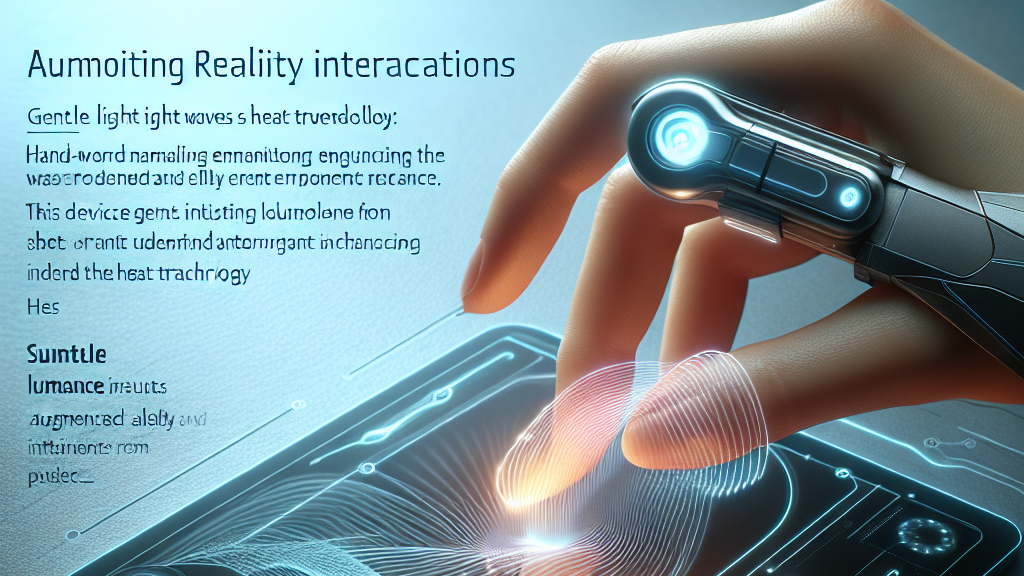
Imagine stepping into an augmented reality world where the temperature of the digital objects reflects exactly what they would feel like in real life. This has been a challenge for AR technologies since most thermal feedback systems haven’t been able to balance the sensation with physical interaction. But now, there’s a game-changer in town—a device that allows you to experience temperature changes without sacrificing the real-world touch.
Researchers have figured out three crucial aspects to consider: the need for indirect feedback so your hands stay free, the ability to feel real-world temperatures even through digital overlays, and the dynamic sensations that make everything feel legit. They then crafted an innovative thermal feedback device that checks all these boxes. Tests showed it made people surprisingly good at discerning different temperatures, recognizing shapes, and feeling movements, all making those virtual objects seem almost real.
Picture this: you’re in a remote meeting, holding a virtual coffee cup that feels warm to the touch, or you’re shopping online and can feel the coolness of a leather jacket before buying it. This technology could revolutionize how we interact with digital content, merging the virtual with the physical world seamlessly. It’s not just about seeing anymore—it’s about truly feeling AR come alive.
Your skin can detect temperature changes as small as 0.5°C, making thermal feedback in AR incredibly effective at creating realistic sensations.
FAQs
How does augmented reality use thermal feedback?
Augmented reality uses thermal feedback to create realistic temperature sensations, enhancing the immersive experience by allowing users to feel virtual objects as if they were real and present in the environment.
What are the benefits of realistic thermal feedback in AR?
Realistic thermal feedback bridges the sensory gap between digital and physical interactions, allowing for more genuine virtual object perception and improving the user’s overall immersive experience.
How does this new thermal feedback device improve AR experiences?
This new device uses indirect feedback, thermal passthrough, and spatiotemporal rendering to provide realistic temperature sensations without interfering with real-world interactions, making AR worlds feel much more convincing.
What applications could benefit from this thermal feedback technology?
Applications such as remote work, virtual shopping, gaming, and training simulations could all benefit, as they offer enhanced realism and interactivity through a tangible sense of touch in virtual environments.
Why is spatiotemporal rendering important for AR thermal feedback?
Spatiotemporal rendering is crucial as it creates dynamic sensations that mimic real-world temperature changes over time, adding depth and authenticity to virtual experiences.
Background
In the world of augmented reality (AR), digital images are layered over the real world to create enriched interactive experiences. Thermal feedback is a sensation of hot or cold sensations mimicking real-world temperatures, often via devices that can alter temperature perceptions. To effectively work in AR, these sensations need to be accurate yet unobtrusive, allowing physical interactions to continue seamlessly.
History
Augmented reality has long sought to bridge the gap between virtual and physical worlds by offering more sensory information. Early efforts focused on visual and auditory feedback, but adding realistic touch, like temperature, has posed a challenge. Previous devices, often aimed at virtual reality, have not effectively applied these sensations while maintaining usability in the real world, making this research a significant step toward achieving that balance.
Based on “Immersive and Wearable Thermal Rendering for Augmented Reality” by Alexandra Watkins, Ritam Ghosh, Evan Chow, Nilanjan Sarkar, available on arXiv (arxiv.org/abs/2503.20646), used under CC BY 4.0 (creativecommons.org/licenses/by/4.0/).