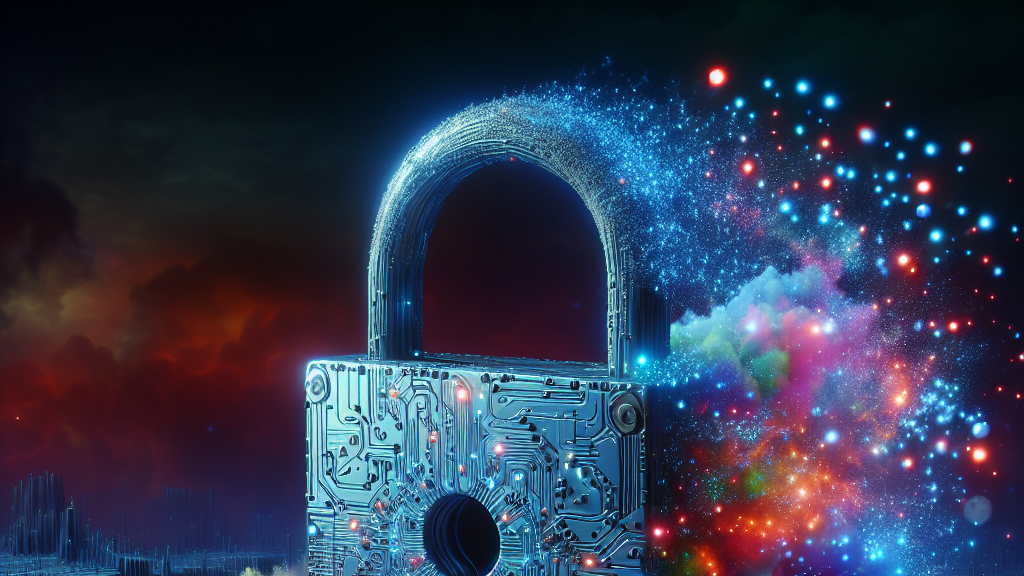
Imagine a world where digital locks and keys, the very foundation of our online security, could crumble. This vivid scenario is not from a sci-fi movie, but a real possibility explored by scientists. They’re investigating what happens when you mix the mysterious world of quantum physics with our current understanding of spacetime.
The study delves into how the superposition of spacetimes—a baffling idea from quantum physics—could transform the way we solve complex problems. Essentially, it’s like saying that two or more versions of reality can exist simultaneously. With this concept in mind, scientists found that problems we thought were secure, like the Graph Isomorphism and ones related to digital cryptography, might actually be a lot easier to crack with the help of quantum superpowers.
Now, picture this: in the future, what if our digital world has to be rebuilt, not stone by stone, but qubit by qubit, because quantum physics gave us the key to all those unbreakable codes? This research could pave the way for an entirely new dimension of cryptography, ensuring our digital communication stays safe and sound in a world where the old rules no longer apply.
Quantum superposition allows particles to exist in multiple states at once, which could mean our current security systems are just an illusion of protection.
FAQs
What is the superposition of spacetimes in quantum physics?
Superposition of spacetimes is a mind-boggling concept in quantum physics where it is assumed that multiple versions of spacetime can exist simultaneously. This idea challenges our traditional understanding of reality and is being explored for its potential computational applications.
How does quantum physics impact digital cryptography?
Quantum physics introduces new computational methods that can solve problems believed to be hard for classical computers. This could make existing cryptographic systems, like those relying on lattice-based schemes, more vulnerable if quantum computing is fully realized.
What is the significance of the complexity class BQP with Order Interference?
The complexity class BQP with Order Interference is related to quantum computing’s ability to solve problems using specific computational techniques. Recent research suggests that many complex problems, traditionally difficult to solve, might be tackled more efficiently using this class.
Can quantum computing really change our digital world?
Yes, quantum computing holds the potential to revolutionize how we approach complex calculations and data security. It could lead to breakthroughs in fields like cryptography, where current systems might become obsolete or need significant advancements to maintain security.
Are there any real-world examples of quantum superposition affecting technology?
While quantum superposition is still mostly theoretical for large-scale applications, it has begun impacting fields such as quantum cryptography, offering new methods to enhance security and data transmission.
Background
Superposition is a fundamental principle of quantum mechanics where a system can exist in multiple states at once. In this context, combining this principle with spacetime suggests that these ‘multiple realities’ can lead to new computational possibilities. If harnessed, this could unlock solutions to problems that are currently beyond our capabilities.
History
This research builds on earlier quantum theories that have long fascinated scientists. The concept of quantum superposition dates back to the early 20th century, with famous thought experiments like Schrödinger’s cat illustrating its potential weirdness. This study extends the narrative by examining its computational implications and how it might redefine fields like cryptography.
Based on “Lattice Based Crypto breaks in a Superposition of Spacetimes” by Divesh Aggarwal, Shashwat Agrawal, Rajendra Kumar, available on arXiv (arxiv.org/abs/2503.21400), used under CC BY 4.0 (creativecommons.org/licenses/by/4.0/).