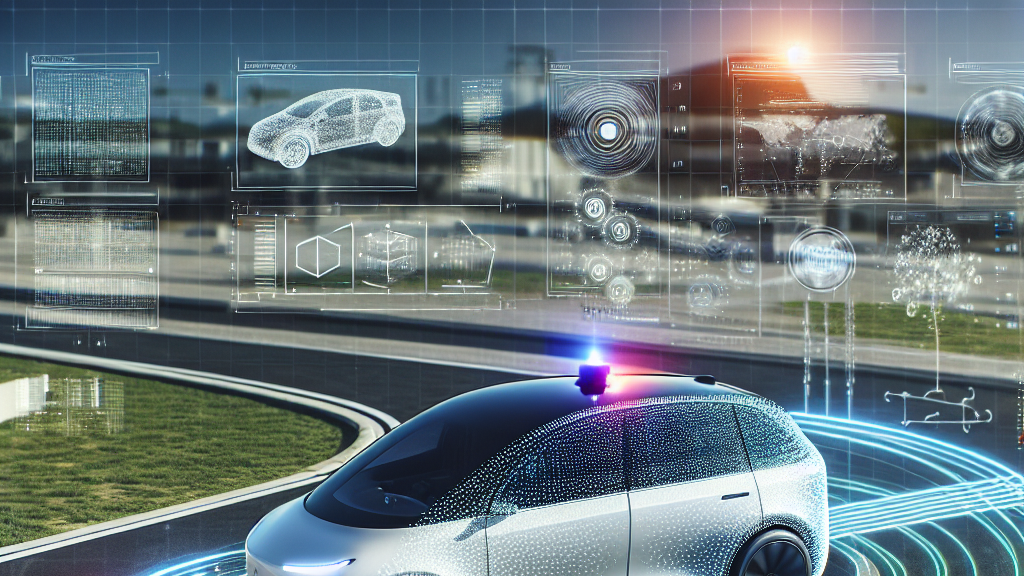
Imagine a world where cars drive themselves perfectly, navigating smoothly through traffic without a hitch. With the Scenario Dreamer, this dream is closer to reality. This AI-powered simulator creates virtual traffic scenarios that are incredibly lifelike and diverse, allowing self-driving cars to practice and learn like never before. Think of it like a practice ground where cars can make mistakes without causing real-world chaos.
The magic of Scenario Dreamer lies in its unique approach. Unlike older methods that relied on heavy data and simplistic rules, this simulator uses a smart blend of vector-based models and clever algorithms to create detailed, realistic simulations from scratch. It achieves all this with less computational load, making it faster and more efficient. The AI doesn’t just create a fixed world; it evolves, providing endless possibilities for testing how cars react in different situations.
In the future, this technology could be a game-changer. Autonomous vehicles can train in these virtual worlds, learning to handle everything from smooth cruising down the highway to tricky and unexpected urban situations. This means safer roads, fewer accidents, and even smarter urban planning as we get to understand traffic flows like never before. It’s like giving your car a safety net to practice and become the best driver it can be before hitting the actual road.
Scenario Dreamer can simulate complex traffic environments up to 10 times faster than older models.
FAQs
What makes Scenario Dreamer better for autonomous vehicle simulation?
Scenario Dreamer uses advanced AI models to create more realistic and diverse traffic scenarios, allowing autonomous vehicles to train more effectively and safely with less computational power.
How does Scenario Dreamer create such lifelike simulations?
By employing a unique blend of vector-based models and intelligent algorithms, Scenario Dreamer generates detailed and ever-changing virtual environments that mimic real-life traffic conditions.
Why is Scenario Dreamer important for future road safety?
By providing a virtual training ground for autonomous vehicles to learn and adapt, Scenario Dreamer helps reduce the risk of accidents, leading to safer and more efficient roads.
How does this technology save time and resources in vehicle training?
Scenario Dreamer’s simulations require fewer parameters and training hours, leading to a more efficient process that speeds up the development of safer autonomous vehicles.
What are the potential real-world applications of Scenario Dreamer?
Beyond vehicle training, Scenario Dreamer could revolutionize urban planning and traffic management by providing deep insights into traffic dynamics, helping create smarter, more efficient cities.
Background
Autonomous vehicles need to understand complex traffic scenarios to drive safely and efficiently. Traditional methods of simulating these scenarios often use image-based models, which are computationally heavy and don’t handle empty spaces well. Scenario Dreamer innovates by using vector-based models, focusing computation only on relevant scene elements, making the simulation both lighter and faster.
History
The quest for creating realistic environments for autonomous vehicle training has been ongoing for years. Traditional simulators have relied on rasterized images and simple rule-based behaviors, but these methods lacked the nuance and flexibility needed for advanced vehicle planning. Scenario Dreamer builds on these foundations by introducing data-driven, vectorized models, marking a significant shift towards more efficient and realistic simulation techniques.
Based on “Scenario Dreamer: Vectorized Latent Diffusion for Generating Driving Simulation Environments” by Luke Rowe, Roger Girgis, Anthony Gosselin, Liam Paull, Christopher Pal, Felix Heide, available on arXiv (arxiv.org/abs/2503.22496), used under CC BY 4.0 (creativecommons.org/licenses/by/4.0/).