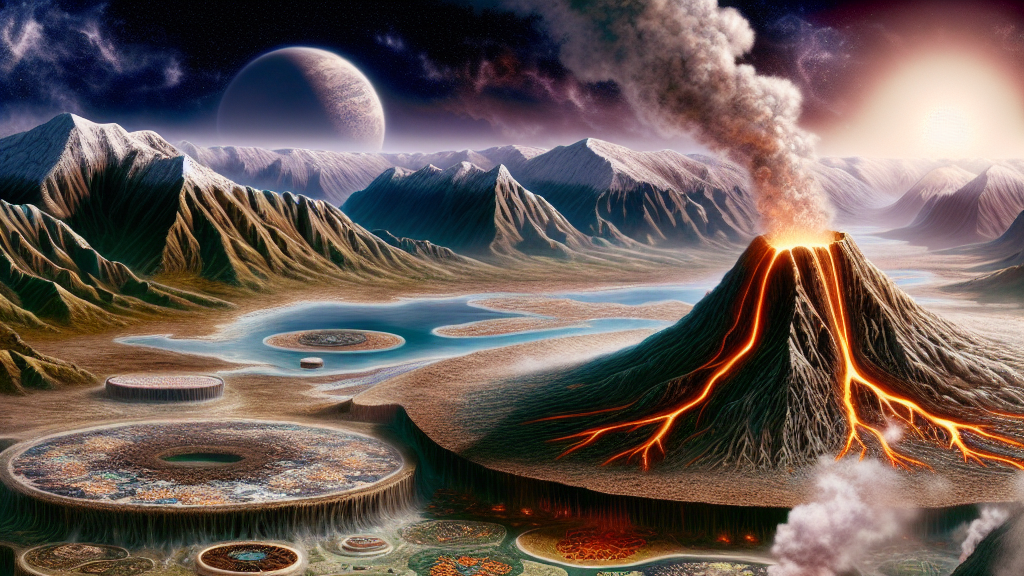
Picture this: millions of years ago, ancient microbes were busy interacting with key carbon compounds like carbon dioxide and methane, playing a pivotal role in forming Earth’s early climate. These tiny organisms were not just surviving but were actively shaping the planet’s atmosphere, setting the stage for the world we know today.
The fascinating part of this research focuses on methane, a gas that was crucial in the ancient biogeochemical cycle. In those early days, Earth was filled with natural processes that produced and consumed methane. This was along with the help of innovative microbes performing actions like methanogenesis—producing methane, and methanotrophy—consuming it. These processes were tightly linked to the planet’s redox state, affecting how elements were cycled through the environment and ultimately influencing life’s development.
This isn’t just ancient history; understanding these early interactions provides incredible insights into how life could form on other planets. If methane cycling was a sign of life on Earth, it might also be a hint of life elsewhere. As we look to planets beyond our own, this knowledge could guide our search for living and breathing ecosystems, painting a picture of what alien life could be like.
Did you know? Methane, the same gas that gives cows a bad rap for burping, was a vital player in Earth’s early climate system!
FAQs
What is the significance of methane in Earth’s early atmosphere?
Methane played a crucial role in shaping Earth’s early climate by interacting with the planet’s carbon cycle and creating a greenhouse effect that helped moderate temperatures.
How do ancient microbes influence the present search for extraterrestrial life?
By studying how early microbes interacted with methane on Earth, we gain vital clues that can point to similar signs of life on other planets, potentially indicating the presence of extraterrestrial ecosystems.
What is methanogenesis and why does it matter?
Methanogenesis is the production of methane by ancient microbes, and it was essential for early Earth’s methane cycle and climate. Understanding this process helps us comprehend how life forms might adapt in different environments, including those beyond Earth.
Could methane cycling provide evidence for life on other planets?
Yes, detecting similar methane cycling processes might suggest biological activity and the presence of life, making methane an important focus in the search for extraterrestrial life.
Background
The Archean Era, over 2.5 billion years ago, was a crucial period in Earth’s history. At its core, the carbon cycle involved the movement of carbon dioxide and methane, which are potent greenhouse gases. Microbial life forms like methanogens were significant, as they produced methane, while methanotrophs consumed it. These microbial processes were critical in shaping Earth’s early atmosphere and climate, impacting its redox state, which refers to the balance of oxidized and reduced chemical species, influencing the chemical reactions that could occur.
History
Research on Earth’s early atmosphere has been evolving for decades. Scientists have been piecing together how early Earth’s atmosphere was different from today’s and what role greenhouse gases like methane played. Earlier studies have suggested that ancient microbes significantly influenced the planet’s climate and atmospheric conditions. This research builds on that by detailing the interactions between carbon compounds and microbial life, providing insights that extend to understanding life on other planets.
Based on “Archean Methane Cycling and Life’s Co-Evolution: Intertwining Early Biogeochemical Processes and Ancient Microbial Metabolism” by Saleheh Ebadirad, Timothy W. Lyons, Gregory P. Fournier, available on arXiv (arxiv.org/abs/2503.21919), used under CC BY 4.0 (creativecommons.org/licenses/by/4.0/).