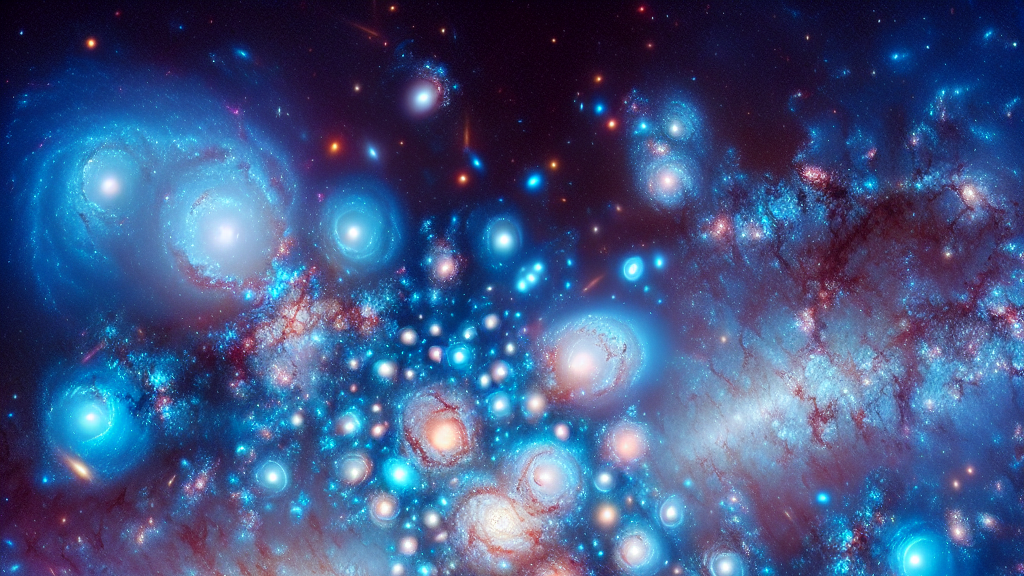
Imagine the smallest galaxies in the universe, barely visible to the naked eye, holding the key to some of the biggest mysteries in space. That’s exactly what this research is diving into! Scientists have discovered that these tiny, isolated, and seemingly unimportant galaxies are actually clustering together in ways that defy our current understanding of the universe and dark matter.
The key discovery here is that these small, blue, and diffuse dwarf galaxies are clustering as strongly as much larger galaxy groups. Normally, you’d expect smaller objects to be scattered and less connected, but this is not what the researchers found. In trying to make sense of this unexpected behavior, the analysis points toward something known as halo assembly bias. This suggests that these dwarf galaxies might have formed in older, low-mass groups, a scenario not fully explained by existing models of galaxy formation that rely on cold dark matter.
What it means for the future is captivating. If these dwarf galaxies are indeed exhibiting a strong clustering pattern because of something like self-interacting dark matter, then we might need to redefine how we think about the universe and the forces that shape it. This could lead to developments in our understanding of dark matter, a crucial element of the cosmos that impacts everything from galaxy formation to the universe’s evolution. A better understanding of these mechanisms could translate into new technologies or insights into space exploration and future cosmic discoveries.
Dwarf galaxies are like cosmic understudies, small but potentially pivotal in unraveling dark matter mysteries!
FAQs
What is the galaxy correlation function?
The galaxy correlation function is a statistical tool used to measure how galaxies are distributed in space. It helps scientists understand patterns in the universe, giving insights into cosmology, galaxy formation, and dark matter.
Why is the discovery of strong clustering in dwarf galaxies surprising?
It’s surprising because such small, isolated galaxies typically cluster weakly. However, their strong clustering challenges existing models of galaxy formation that rely on traditional dark matter theories.
What does this research suggest about dark matter?
This research suggests that self-interacting dark matter might be a better explanation for the observed clustering in dwarf galaxies. It implies the need for new models to understand how dark matter influences galaxy formation.
How could this research affect future studies in cosmology?
By pointing to potential flaws in existing models, this research encourages the scientific community to explore new theories, such as self-interacting dark matter, to better understand the universe’s evolution.
Why should we care about dwarf galaxies?
Despite their size, dwarf galaxies might hold crucial clues to unraveling the mysteries of dark matter and the universe’s makeup, impacting our overall understanding of cosmology and potentially leading to significant scientific breakthroughs.
Background
To grasp this study, it’s essential to understand that scientists use something called the galaxy correlation function to map how galaxies are spread across the universe. This method gives clues about what might be pulling galaxies together or pushing them apart. Dark matter, an invisible substance that we can’t see or touch, is thought to play a crucial role in these patterns, acting like cosmic glue that binds galaxies together.
History
Scientists have long studied galaxy clustering as a way to understand dark matter and galaxy formation. Traditionally, models relying on cold dark matter have explained these phenomena well. However, with new observations that defy these models, like the unexpected clustering of dwarf galaxies, researchers are now prompted to explore alternative theories like self-interacting dark matter, which could offer fresh insights.
Based on “Unexpected clustering pattern in dwarf galaxies challenges formation models” by Ziwen Zhang, Yangyao Chen, Yu Rong, Huiyuan Wang, Houjun Mo, Xiong Luo, Hao Li, available on arXiv (arxiv.org/abs/2504.03305), used under CC BY 4.0 (creativecommons.org/licenses/by/4.0/).