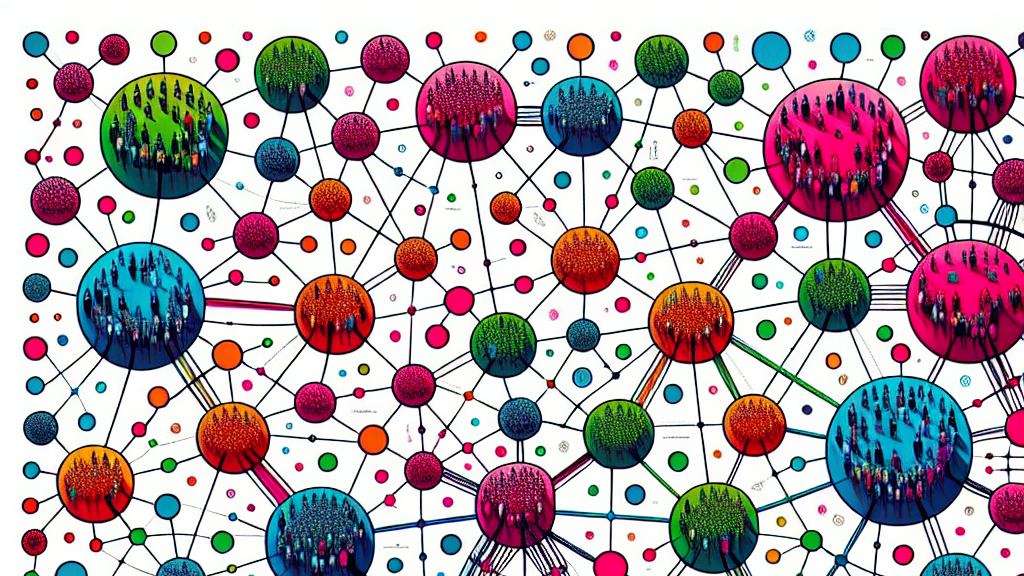
Ever wondered why some people choose to vaccinate while others don’t? It turns out our social circles play a huge role in these decisions! Whether we like it or not, the people we interact with can influence how we perceive the risk of diseases and vaccines. This intriguing idea is explored in recent research that models vaccination decisions using an evolutionary game theory approach, where individuals assess the risks of getting vaccinated against getting infected.
Scientists used a model called the SIR (Susceptible-Infectious-Recovered) to simulate how vaccination decisions evolve in a network of people. In this model, each person weighs the risk of possibly getting sick from a vaccine against the risk of catching the actual disease. What’s fascinating is that the results showed vaccination coverage varies depending on the network’s structure. In simpler terms, whether you’re in a tightly-knit community or a more scattered one influences whether you’re more likely to find people vaccinating.
Why does this matter in real life? Imagine your community has a nice balance of people who get vaccinated. This is generally good for keeping diseases in check. But, if suddenly vaccines seem riskier than the diseases, fewer people might vaccinate, even if the disease is spreading. By understanding how our networks impact vaccination choices, health officials can tailor strategies to encourage vaccination, ensuring overall community protection. This could mean designing campaigns targeted not just at individuals, but considering their social groups as well.
Our social networks can subtly influence our health decisions, including whether or not we choose to get vaccinated.
FAQs
Why do social networks affect vaccination choices?
Social networks influence how individuals perceive the risks of diseases and vaccines, which affects their vaccination decisions. People often rely on the opinions and actions of those they trust or see regularly, leading to varying vaccination levels across different network structures.
How does network variability impact vaccination levels?
In more homogeneous networks with low variability, fewer vaccinations may be needed to control disease spread compared to heterogeneous networks. However, if the perceived risk of vaccination increases, uptake can decrease more dramatically in heterogeneous networks.
What role does evolutionary game theory play in vaccination research?
Evolutionary game theory helps researchers model how individuals make vaccination decisions based on perceived risks, taking into account the influence of their social connections. This approach provides insights into how vaccination strategies might be optimized in different network settings.
Background
This study uses the concept of an evolutionary game, where individuals make decisions based on perceived benefits and costs, applied to vaccination choices. The SIR model, a common tool in epidemiology, helps simulate how diseases spread through populations. By modeling social networks, researchers examine how different structures affect people’s vaccination choices.
History
Historically, vaccination studies have focused on individual risk assessment and public health benefits. However, recent research has begun to consider how social interactions and network structures influence these decisions. This study builds on such research, incorporating network variability into models to predict vaccination behavior more accurately.
Based on “The Vaccination Game on Networks” by Kausutua Tjikundi, Mark Broom, available on arXiv (arxiv.org/abs/2504.03489), used under CC BY 4.0 (creativecommons.org/licenses/by/4.0/).