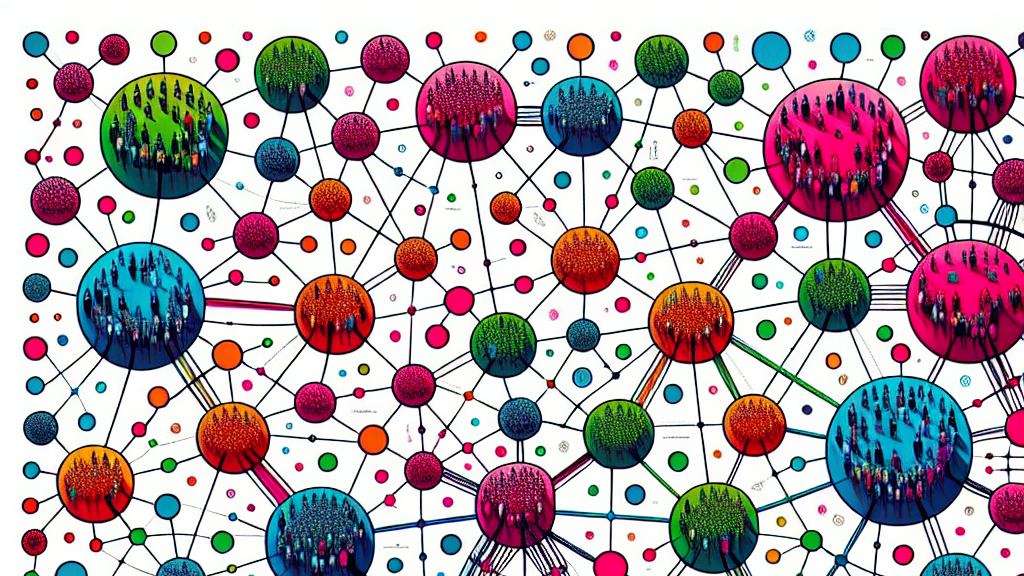
Ever wondered why some communities have higher vaccination rates than others? It’s not just because of personal choices—it’s about how we’re all connected in our social networks. This research dives into the fascinating world of network science to discover how the structure of our communities impacts vaccination decisions.
Researchers used a concept called an evolutionary game, where they looked at how people decide to vaccinate based on the risks of getting sick from a disease versus the vaccine itself. By using models that represent people as nodes in a network, they found that communities with different connection patterns have unique vaccination levels. Specifically, communities with more varied connections tend to have higher vaccination rates at lower vaccine costs. However, as the perceived cost of vaccines increases, people in these communities are quicker to stop vaccinating compared to more homogeneously connected groups.
This could revolutionize public health strategies! Imagine being able to tailor vaccination campaigns based on how people are connected in a city or neighborhood. By understanding these patterns, health experts could predict how well a vaccination program might work in different areas and adjust their strategies to improve public health while being cost-effective.
Did you know? The web of connections in your neighborhood can predict how many of your neighbors might choose to get vaccinated.
FAQs
How does network structure influence vaccination decisions?
Network structures determine how individuals are connected, affecting how information and perceptions about vaccines spread. This influences who chooses to vaccinate based on their personal risk assessments and the risks perceived in their social circles.
What does it mean for vaccination to be modeled as an evolutionary game?
It means individuals make vaccination decisions by weighing risks, similar to strategies in a game, where they aim to maximize their personal benefit while responding to others’ choices. This reflects real-world behavior by modeling personal and peer influences on vaccination uptake.
Why do different network types exhibit varying vaccination levels?
Different network types, with varying connection patterns, lead to different dynamics in how vaccinations spread through a community. More varied networks may require fewer vaccines to achieve community-wide disease prevention, while more uniform ones might need higher coverage to achieve the same effect.
How might this research impact future vaccination campaigns?
This research can help public health officials design smarter, targeted vaccination strategies that can be tailored to different communities based on their social connection patterns, making vaccination efforts more effective.
Why is understanding network heterogeneity important in vaccination strategies?
Network heterogeneity, or diversity in connection patterns, affects how rapidly information and diseases spread, and thus is crucial in predicting and enhancing the success of vaccination strategies.
Background
Network science studies how nodes (people) are interconnected in a system, much like how social networks like Facebook connect individuals. This is crucial in understanding the spread of information or diseases. Evolutionary game theory models decision-making processes, explaining how individuals in a network might choose to get vaccinated based on risks. An SIR model refers to how diseases spread through populations: Susceptible, Infected, and Recovered. By combining these ideas, researchers can predict vaccination behaviors.
History
The study of network science began with mathematicians exploring random graphs and has evolved into a robust field analyzing complex networks such as the internet, social networks, and even biological systems. Game theory, traditionally used in economics to understand strategic decisions, has been paired with network science to better understand public health dynamics. This research builds on previous studies that modeled disease spread and vaccination uptake in structured populations, now adding the element of network heterogeneity to refine these models.
Based on “The Vaccination Game on Networks” by Kausutua Tjikundi, Mark Broom, available on arXiv (arxiv.org/abs/2504.03489), used under CC BY 4.0 (creativecommons.org/licenses/by/4.0/).