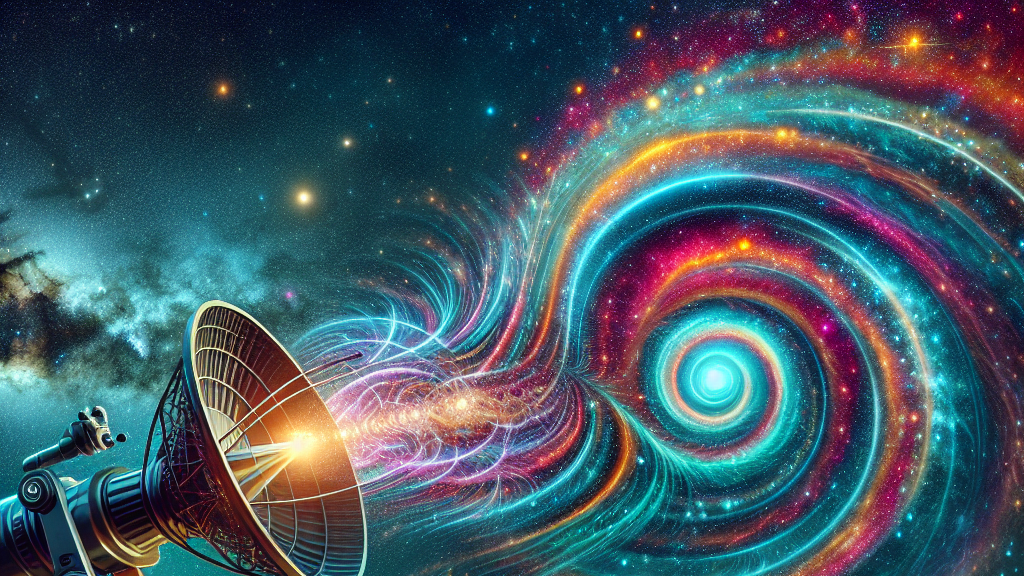
What if the mysteries of the universe could be unraveled by listening to the cosmos? Scientists are on a groundbreaking mission to understand the elusive dark matter that makes up a significant portion of our universe. This research focuses on the cosmic filaments—vast, thread-like structures forming a cosmic web—and their potential to reveal dark matter’s secrets through radio signals. Imagine these filaments as the backbone of the universe, teaming with potential clues waiting to be discovered.
The study uses advanced simulations to explore how dark matter particles could decay into pairs of electrons and positrons, creating detectable radio emissions. By analyzing radio data from these cosmic filaments, researchers can set new, tighter limits on how long dark matter particles can exist before decaying. This research doesn’t just add to our understanding but pushes the boundaries, offering a clearer picture than ever before of how the cosmic web—and the universe itself—is structured.
Picture a future where this research could lead to vast networks of radio telescopes capturing whispers from the cosmos, detailing the dance of dark matter and cosmic filaments. Such insights could lead to breakthroughs in understanding the universe’s creation and its fundamental components, potentially impacting everything from the technology we use to the existential questions we ask about our place in the cosmos.
Cosmic filaments are so vast that if they were visible to the naked eye, they’d look like a gigantic spider web spanning the entire sky!
FAQs
What are cosmic filaments?
Cosmic filaments are massive, thread-like structures in the universe that form the ‘skeleton’ of the cosmic web. They are regions of enhanced density that link galaxies and clusters together.
How do cosmic filaments relate to dark matter?
Cosmic filaments are thought to contain a significant amount of dark matter. Studying these structures helps scientists understand the properties and behavior of dark matter, which cannot be directly observed.
What is the significance of detecting radio signals from cosmic filaments?
Detecting radio signals from cosmic filaments can provide indirect evidence of dark matter decay. This could improve our understanding of dark matter properties, such as its decay lifetime, which has implications for the fundamental physics of the universe.
Why is this research important for our understanding of the universe?
This research enhances our knowledge of the universe’s structure and the role of dark matter within it. By setting stricter limits on dark matter’s decay, we can refine models of cosmic evolution and the universe’s overall composition.
How could this research impact future technological developments?
Understanding the properties of dark matter and cosmic structures could lead to advancements in fields like cosmology and technology. These insights could inspire innovations in data processing, quantum technologies, and even space exploration.
Background
Cosmic filaments are vast, interconnected threads of matter that form the backbone of the large-scale structure of the universe, known as the cosmic web. This web is composed of galaxies, clusters, and dark matter. Dark matter is the invisible substance that makes up about 27% of the universe’s mass and energy. Though we can’t see it directly, we know it’s there because of its gravitational effects on visible matter.
History
The concept of dark matter dates back to the 1930s when astronomers noted discrepancies in the mass of galaxy clusters based on visible matter alone. Over time, various observations, such as galaxy rotation curves and gravitational lensing, reinforced the idea that a large portion of the universe was made up of this mysterious matter. In recent decades, simulations like EAGLE have been used to model the cosmic web and explore how dark matter and visible matter interact.
Based on “Dark matter decay signals in cosmic filaments” by Elena Pinetti, Evan Vienneau, Nassim Bozorgnia, available on arXiv (arxiv.org/abs/2504.08025), used under CC BY 4.0 (creativecommons.org/licenses/by/4.0/).