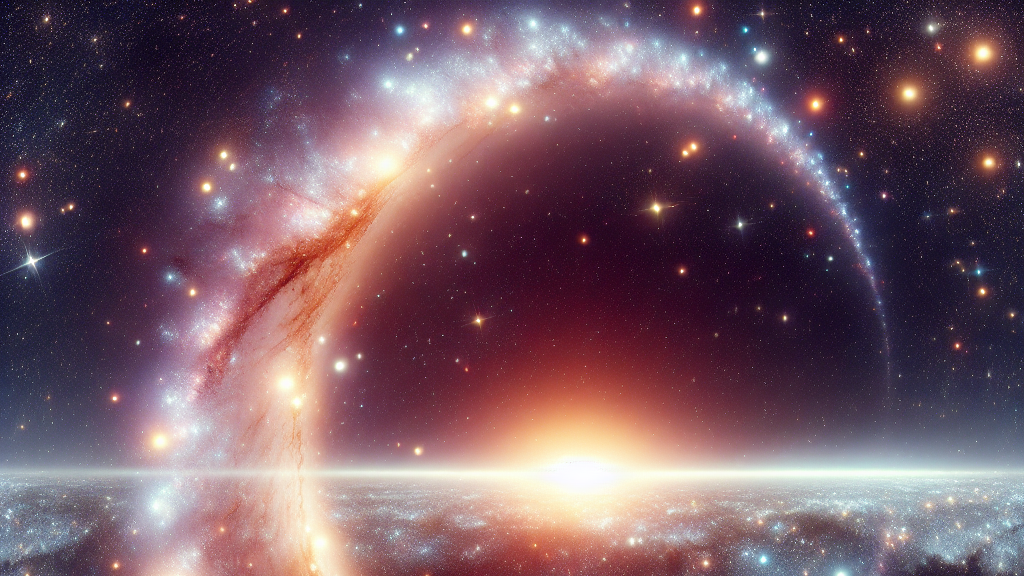
Imagine discovering the most distant star ever seen, only to find out that your telescope might be playing tricks on you. That’s the tantalizing mystery with Earendel, a potential star that breaks records by sitting incredibly far away from Earth. But new research using high-tech tools like the James Webb Space Telescope (JWST) suggests that this star might not be as brilliant as once thought because its light is being twisted and amplified by another galaxy cluster in front of it, much like a funhouse mirror.
Astronomers have been puzzled by Earendel because it’s thought to be part of a strong-lensing phenomenon known as the Sunrise Arc. This is when the light of objects behind a massive body, like a galaxy cluster, gets bent around the cluster, making it look much brighter or bigger than it really is. Using JWST data, scientists have reviewed previous studies and added more detailed images and data to better understand how much this cosmic magnifying glass is affecting what we see. They found the magnification is less than earlier believed, meaning Earendel’s true nature is still shrouded in mystery.
In practical terms, this research shows that our methods of looking at the universe can sometimes make things appear quite different from reality. It’s a reminder that even the most advanced science needs constant updates and checks. Knowing exactly how bright or powerful a star like Earendel is can change how we understand the formation and age of stars at the very edge of the universe. As we continue to peer deeper into space, refining our techniques could lead to more accurate cosmic maps and a clearer picture of our universe’s history.
Earendel might not be a single star but could be a system of multiple stars, adding more mystery to its nature.
FAQs
What makes Earendel unique in the field of astronomy?
Earendel is considered the most distant star observed to date, located at a redshift of approximately 6.2. Its observation challenges our understanding of the early universe and the formation of stars at such great distances.
How does strong-lensing affect our view of distant stars like Earendel?
Strong-lensing occurs when a massive object, like a galaxy cluster, bends and magnifies the light of objects behind it. This can make distant stars like Earendel appear much brighter and closer than they actually are, affecting our measurements of their luminosity and distance.
What role does the James Webb Space Telescope play in studying Earendel?
The James Webb Space Telescope provides high-resolution imaging and data crucial for analyzing the strong-lensing effects on Earendel. This helps astronomers refine models of the galaxy cluster and improve estimates of the star’s magnification and true brightness.
Why is the study of Earendel’s magnification important?
Understanding Earendel’s magnification is vital because it affects the star’s classification and our perception of its actual brightness and composition. This research impacts how we view and interpret the formation of the earliest stars in the universe.
What could Earendel’s true nature tell us about the universe?
If Earendel is not just a single star but a system or something different than expected, it will provide new insights into star formation, galaxy evolution, and the conditions of the early universe, expanding our knowledge of cosmic history.
Background
In astrophysics, ‘gravitational lensing’ is a phenomenon where massive objects like galaxy clusters bend the light of objects behind them, like stars or galaxies. This effect, likened to a cosmic magnifying glass, can amplify the light, making distant objects appear brighter or distorted. It plays a crucial role in astronomy for observing objects that are otherwise too faint to be seen. The James Webb Space Telescope (JWST) is a state-of-the-art tool used to capture detailed images and data across various wavelengths, allowing scientists to study these phenomena with greater accuracy.
History
The concept of gravitational lensing was first predicted by Albert Einstein’s theory of general relativity, which described how massive objects can warp spacetime and alter the path of light. Over the decades, scientists have utilized this effect to discover and study distant galaxies and stars. The study of Earendel builds on this rich history, using advanced telescopic technology and refined models to improve our understanding of strong-lensing and the early universe.
Based on “Is Earendel a Star?: Investigating the Sunrise Arc Using JWST Strong and Weak Gravitational Lensing Analyses” by Zachary P. Scofield, M. James Jee, Sangjun Cha, Hyosun Park, available on arXiv (arxiv.org/abs/2504.08879), used under CC BY 4.0 (creativecommons.org/licenses/by/4.0/).