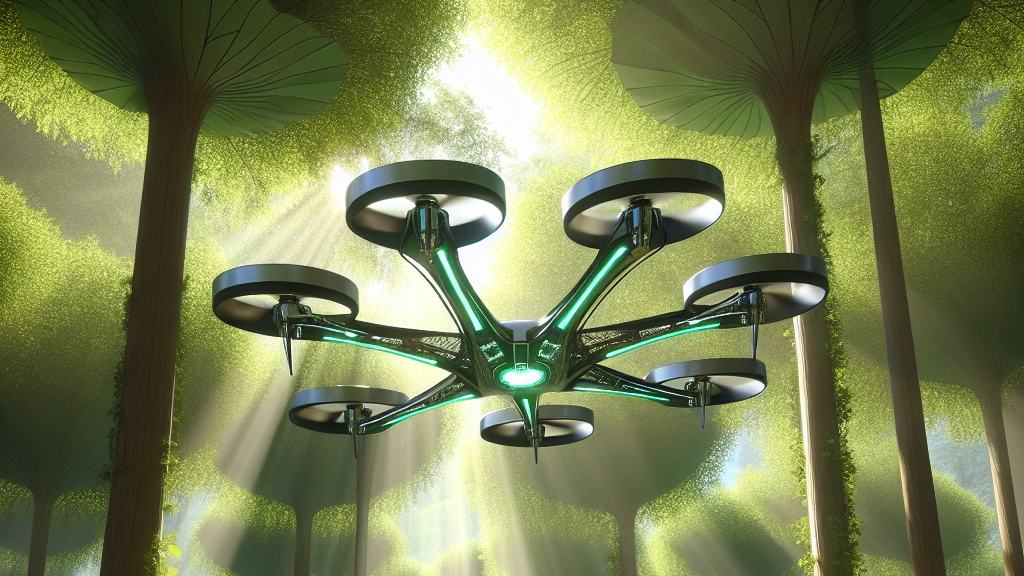
Ever watched a flying squirrel glide effortlessly between trees and wondered how it does that? Scientists have taken inspiration from these amazing creatures to develop a new kind of drone that is nimble and precise, perfect for dodging through tight spots where traditional drones struggle.
The secret lies in its innovative wing design, which is flexible like a flying squirrel’s. These wings can fold and expand, giving the drone a wide range of movements and remarkable stability. This is made possible by clever use of silicone membranes and advanced machine learning techniques. The team used human flight data to teach the drone to react to its environment, handling the kind of complex flying patterns you would expect from such an agile creature.
This breakthrough could revolutionize how drones are used in the real world. Imagine search and rescue missions where drones could swiftly navigate through collapsed buildings to find survivors, or delivery drones that could seamlessly weave through crowded cityscapes. With such potential, it’s clear that drawing inspiration from nature can lead to incredible technological advancements.
Flying squirrels can glide over 150 feet between trees, and now drones can mimic this agile action!
FAQs
What makes squirrel-inspired drones different from normal drones?
Unlike typical drones that have fixed rotors, squirrel-inspired drones have foldable wings, which allows them to move more freely and efficiently in tight spaces.
How do squirrel-inspired drones control their wings?
These drones use silicone membranes and clever machine learning techniques to tailor their wing movements based on recorded human flight data for precision maneuvers.
Why use machine learning in squirrel-inspired drones?
Machine learning helps the drones learn to handle complex flying patterns and environmental changes, making them more adaptable and efficient.
Can squirrel-inspired drones be used in search and rescue?
Yes, due to their agility, they can navigate through tight and dangerous spaces, making them perfect for search and rescue operations.
Is biomimicry the future of drone technology?
Biomimicry offers innovative design solutions by drawing from nature, potentially revolutionizing drone technology by improving maneuverability and efficiency.
Background
Traditional drones usually have fixed propellers that allow them to hover and move in straightforward directions. However, they can struggle in complex environments. Engineers are exploring how the natural world, specifically animals like flying squirrels, can inspire new designs that enhance agility and efficiency through biomimicry. The flying squirrel drone incorporates foldable wings that mimic the animal’s gliding ability, offering improved navigation in tight spaces.
History
The idea of biomimetic drones is relatively new, but it has roots in the broader field of biomimicry, which has been around for decades. Earlier developments focused on fixed-wing flight, while more recent advances have been exploring dynamic, flexible designs inspired by the movements of birds and insects. This study on squirrel-inspired drones represents a breakthrough by integrating machine learning into biomimicry, allowing for more complex maneuverability than previously possible.
Based on “A highly maneuverable flying squirrel drone with controllable foldable wings” by Jun-Gill Kang, Dohyeon Lee, Soohee Han, available on arXiv (arxiv.org/abs/2504.09478), used under CC BY 4.0 (creativecommons.org/licenses/by/4.0/).