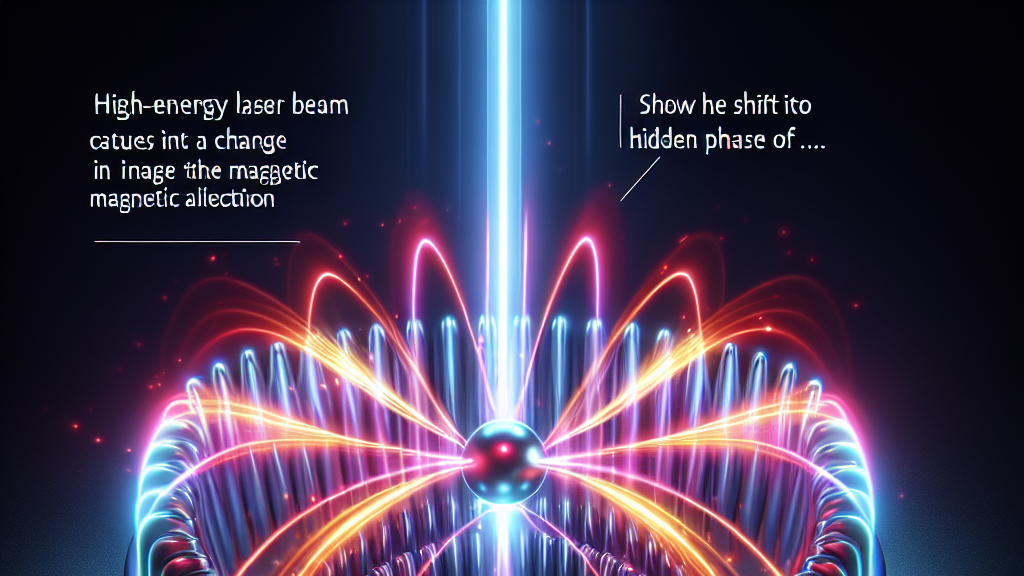
Imagine you could change the properties of a material just by illuminating it with light. That’s what new research on magnetic materials is promising. By using lasers, scientists are able to create new ‘hidden’ phases that can alter the magnetic arrangement in ways never seen before.
This study explored how a laser can induce fast transitions in a magnetic material called Fe3BO6, which is known for its unique antiferromagnetic properties. The researchers found that by shining a laser, a hidden phase can be induced, changing the way magnetic spins interact within the material. This is achieved through something called the Dzyaloshinskii-Moriya interaction. It’s a bit like rearranging a jigsaw puzzle, where suddenly all the pieces fit in new ways, revealing a different picture.
The practical effects of this could be huge. Imagine being able to use lasers to control magnetic properties in electronic devices. This could lead to faster, more efficient data storage or even innovative new technologies that rely on precision magnetic manipulations. So next time you think about lasers, remember they could be the key to unlocking hidden potentials in everyday materials.
Did you know that lasers can actually create brand-new phases in materials that don’t exist naturally and change their magnetic properties?
FAQs
How do lasers create hidden phases in magnetic materials?
Lasers affect magnetic materials by influencing the interactions between magnetic spins, such as the Dzyaloshinskii-Moriya interaction, leading to new hidden phases that aren’t accessible through other means.
What is a hidden phase in the context of magnetism?
A hidden phase refers to a state of a material where its magnetic order is altered in a way that isn’t possible under normal conditions, unveiling new magnetic interactions.
Why is the ability to control spin transitions with lasers important?
This ability could lead to advancements in magnetic data storage and electronic devices, allowing for faster, more efficient technologies by precisely controlling magnetic properties.
What role does the Dzyaloshinskii-Moriya interaction play in this research?
The Dzyaloshinskii-Moriya interaction is a key effect that helps control the canting between magnetic sublattices, enabling the transition to hidden phases when influenced by laser light.
Can this research lead to new technologies?
Yes, by controlling magnetic properties through laser-induced hidden phases, this research could inspire innovations in data storage and electronics, making them more efficient and versatile.
Background
The study focuses on magnetic materials where spins, or internal magnetic moments, of electrons, create a magnetic field. The Dzyaloshinskii-Moriya interaction is a fundamental concept that influences the orientation of these spins. This research looks at how laser light can cause rapid changes in these spin orientations, leading to new ‘hidden’ phases that change the behavior and properties of the material.
History
Magnetic materials have long been a focus of research, with early studies centered on how heat could change magnetic properties. However, lasers have opened up a new field of study by showing how light can cause rapid and drastic changes in spin configurations in ways heat cannot, leading to hidden phases and new magnetic behaviors.
Based on “Switching of an antiferromagnet controlled by spin canting in a laser-induced hidden phase” by A. V. Kuzikova, N. A. Liubachko, S. N. Barilo, A. V. Sadovnikov, R. V. Pisarev, A. M. Kalashnikova, available on arXiv (arxiv.org/abs/2504.12929), used under CC BY 4.0 (creativecommons.org/licenses/by/4.0/).