Connect with us

Search by keyword

Nuclear Theory

How Cosmic Crashes Unlock the Secrets of the Universe

Discover how smashing ions together at incredible speeds helps scientists unlock the mysteries of the universe by creating and studying a new, exotic form of matter called quark-gluon plasma.

How Cosmic Crashes Unlock the Secrets of the Universe
✨Researched by humans. Explained by robots. Learn more.

Ever imagined what happens when particles crash into each other at nearly the speed of light? Welcome to the world of heavy-ion collisions, where scientists explore the universe’s most thrilling mysteries. By using gigantic machines called accelerators, they discover new states of matter, like the quark-gluon plasma, which might just hold the keys to understanding the very makeup of our universe.

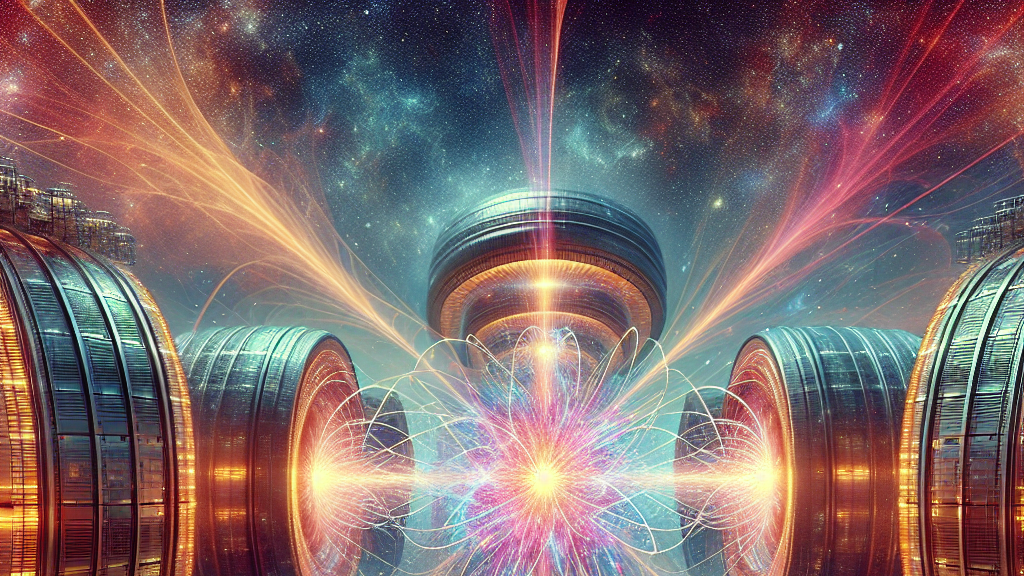
Heavy-ion collisions are like cosmic car crashes in particle labs. Scientists accelerate ions—tiny charged particles—to mind-boggling speeds and then make them collide. These high-energy collisions create an intense environment similar to the conditions just after the Big Bang. Out of this chaos emerges the quark-gluon plasma, a form of matter where particles called quarks and gluons are no longer confined inside protons and neutrons.

Imagine being able to recreate a slice of the early universe to understand how the world around us came to be. As we delve deeper into the properties of quark-gluon plasma, it opens doors to numerous possibilities, such as advancements in energy production or even the development of new materials. The insights from these high-energy particle smashes could one day revolutionize technology, offering us cleaner energy sources and more stable materials.

Did you know that quark-gluon plasma is believed to have existed just microseconds after the Big Bang?

FAQs

What are heavy-ion collisions?

Heavy-ion collisions involve accelerating and crashing ions, which are charged atoms, at high speeds to study new states of matter and the fundamental forces of nature.

Why are scientists interested in quark-gluon plasma?

Quark-gluon plasma is believed to provide insights into the early universe and the fundamental building blocks of matter, helping us understand how the universe evolved.

How do particle accelerators work in the study of heavy-ion collisions?

Particle accelerators are massive machines that use electromagnetic fields to propel charged ions to high speeds, allowing them to collide and create high-energy environments similar to those just after the Big Bang.

Could this research affect future technology?

Yes, understanding quark-gluon plasma could lead to advancements in energy production and new material technologies, offering cleaner energy sources and more durable materials.

Is quark-gluon plasma found naturally?

No, quark-gluon plasma occurs under extreme conditions, such as those created in heavy-ion collisions, and is not naturally found on Earth.

Background

Heavy-ion collisions are experiments where ions, usually of heavy elements like gold or lead, are accelerated to near the speed of light and made to collide. This process creates conditions of extreme energy and temperature, similar to those just after the universe began with the Big Bang. In these collisions, researchers hope to study the quark-gluon plasma, a state of matter where quarks and gluons, the fundamental particles inside protons and neutrons, are free from confinement.

History

The study of heavy-ion collisions began around the 1980s with the advent of large particle accelerators. Over the decades, facilities like CERN’s Large Hadron Collider have allowed physicists to observe and study the properties of quark-gluon plasma. This research builds on the foundational work in quantum chromodynamics, a theory describing how quarks and gluons interact, which has been pivotal in understanding strong nuclear forces that hold atomic nuclei together.

Based on “The quest for the quark-gluon plasma from the perspective of dynamical models of relativistic heavy-ion collisions” by Marcus Bleicher, Elena Bratkovskaya, available on arXiv (arxiv.org/abs/2504.14740), used under CC BY 4.0 (creativecommons.org/licenses/by/4.0/).

Trending

Latest

Can AI Save Water Discover How

Computers

AI is transforming the tech world, but it uses lots of water! A new tool, SCARF, helps us measure and reduce AI's water footprint,...

Whats a Forbush Decrease and Why Should We Care Whats a Forbush Decrease and Why Should We Care

Space

Scientists just observed the biggest solar storm event in years, revealing unexpected cosmic ray patterns. Understanding these changes could help us protect our technology...

Can Cars Spot Danger Faster Than Humans Can Cars Spot Danger Faster Than Humans

Computers

Think about how quickly you react when something unexpected happens on the road. This research brings us closer to creating self-driving cars that can...

Can Fear of the Other Stop Social Harmony Can Fear of the Other Stop Social Harmony

Physics

Fear of the unknown might make it harder for people to agree and get along. This study shows that when people have strong xenophobic...

Can AI Revolutionize Breast Cancer Diagnosis Can AI Revolutionize Breast Cancer Diagnosis

Electricity

This research introduces a groundbreaking AI model that can accurately assess HER2-positive breast cancer using widely accessible staining methods, potentially revolutionizing how we diagnose...

Can AI Transform Your Singing into a Choir Can AI Transform Your Singing into a Choir

Computers

Imagine singing solo and having AI turn you into a choir. This research unveils a groundbreaking AI tool that transforms your voice into rich...

You May Also Like

Space

This research is changing the game for how we see the universe using radio waves! It enlists the help of regular people and smart...

General Relativity and Quantum Cosmology

This study explores the possible fate of our universe—revealing that under certain conditions, it might one day collapse into a Big Bang-like singularity or...

Physics

Scientists are on a mission to discover if ghost-like particles called neutrinos could reveal astonishing insights about the universe. Using cutting-edge technology, they searched...

Space

Scientists are puzzled by the universe's changing speed, as it seems to be accelerating quickly at some points and slowing down at others. This...

Physics

Imagine a hidden universe in our own, where particles act like a spaghetti soup, in-between two known states of matter. Scientists are discovering this...

Space

Our understanding of the universe's uniformity faces a serious challenge, as new findings suggest our cosmos might not be as smooth and even as...

Space

Tiny blue galaxies, like the one studied, may hold clues to the early universe, but there's a puzzling twist: their high-energy emissions hint at...

Physics

Scientists explore the fascinating possibility that our entire universe may have originated as a 'baby' universe. This intriguing idea not only aligns with existing...

Space

Some galaxy groups might be cosmic 'thieves,' picking up extra stars as they pass through clusters of galaxies. This discovery could change how we...

Copyright © 2024 8ig8rain.

Disclaimer: The content on 8ig8rain.com consists of AI-generated summaries of scientific abstracts from arXiv. Please note that most arXiv abstracts are preprints and may not have undergone formal peer review. While these summaries aim to convey key ideas and potential applications, they are provided for informational purposes only and should not be interpreted as validated scientific findings or professional advice. The summaries are intended to educate, spark curiosity, and inspire further exploration of science.