Ever wondered if stars can give us clues about their explosive end? Well, scientists just discovered a star behaving in a way that suggests it might know its fate! They’ve found this star’s brightness and colors fluctuating, acting a bit like how you might rearrange furniture before a big event. This finding is the first of its kind and gives us a sneak peek into what might happen before a star goes supernova, a dramatic cosmic event where a star explodes at the end of its life cycle. Isn’t it mind-blowing to think a star could be sending out signals about its impending demise?
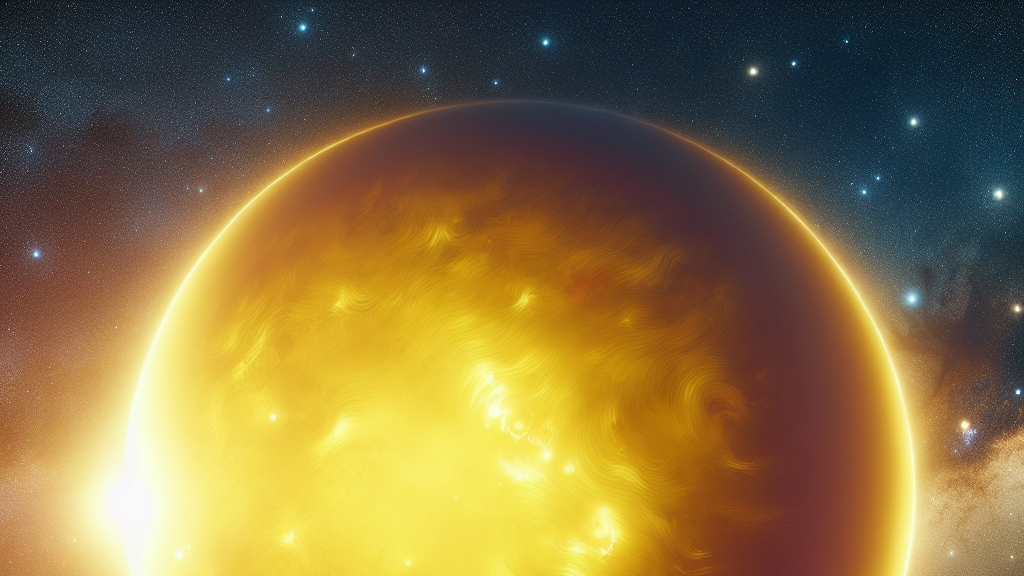
This research was no small feat, involving years of images captured by the Hubble Space Telescope and the Dark Energy Camera Legacy Survey. Scientists pieced together the changes in brightness over years—from 2001 to 2013—and found that variability wasn’t due to dust clouds blocking our view, but the star itself changing. They identified the star as a yellow supergiant with mass estimates ranging from 12 to 18 times that of our sun. By understanding these stellar fluctuations, scientists gain a critical tool for predicting and studying supernovae, helping demystify the life cycles of stars.
So, how might this discovery affect us back on Earth? Well, imagine being able to predict when a massive firework show might happen in the night sky—scientists could use this knowledge to anticipate stunning cosmic displays. Plus, studying these events might lead to new insights about the building blocks of our universe. The next time you gaze up at the stars, you might wonder, is that star preparing for its cosmic grand finale?
A supernova can outshine an entire galaxy for a short period, releasing as much energy as the sun would in its entire lifetime.
FAQs
What is the significance of finding a variable star before a supernova?
Detecting a variable star before it goes supernova gives scientists valuable data to understand the star’s behaviors and life cycle leading up to its explosive finale. This is a unique chance to study and predict such cosmic events in advance.
How do researchers determine changes in star brightness?
Researchers use images taken over time from advanced telescopes like the Hubble Space Telescope to measure and compare the brightness of stars. These images reveal fluctuations and patterns in brightness, indicating potential changes in the star itself.
What is a yellow supergiant star?
Yellow supergiant stars are massive stars that have expanded and cooled, giving off a yellow hue. They are larger and much more massive than our sun and are some of the final stages in a star’s life before possibly exploding as a supernova.
How could this discovery impact future astronomy research?
This discovery will help astronomers refine their models of stellar evolution and supernova prediction, contributing to our understanding of the universe’s life cycles. It could also assist in identifying upcoming cosmic events for observation.
What makes supernovae important to study?
Supernovae play a crucial role in spreading elements throughout the universe, which are essential for forming planets and even life. Studying them helps us understand the origins and evolution of matter in the universe.
Background
A supernova is a powerful explosion that occurs during the last evolutionary stages of a massive star or when a white dwarf is triggered into runaway nuclear fusion. Stars often end their life cycles in this spectacular fashion, releasing vast amounts of energy. Researchers are keen to understand the changes a star undergoes right before a supernova, such as brightness and color variations, as these signals can reveal much about the star’s composition and future events.
History
Supernova research has evolved significantly over the past decades. Early studies focused on observing these events post-explosion, but advancements in technology, such as powerful space telescopes, now allow scientists to observe stars long before they explode. Discoveries of varying star brightness and color changes before a supernova event represent a new frontier in astrophysics, offering insights that were previously unattainable.
Based on “Discovery of a variable yellow supergiant progenitor for the Type IIb SN 2024abfo” by Zexi Niu, Ning-Chen Sun, Justyn R. Maund, Zhen Guo, Wenxiong Li, Meng Sun, Jifeng Liu, available on arXiv (arxiv.org/abs/2504.20407), used under CC BY 4.0 (creativecommons.org/licenses/by/4.0/).