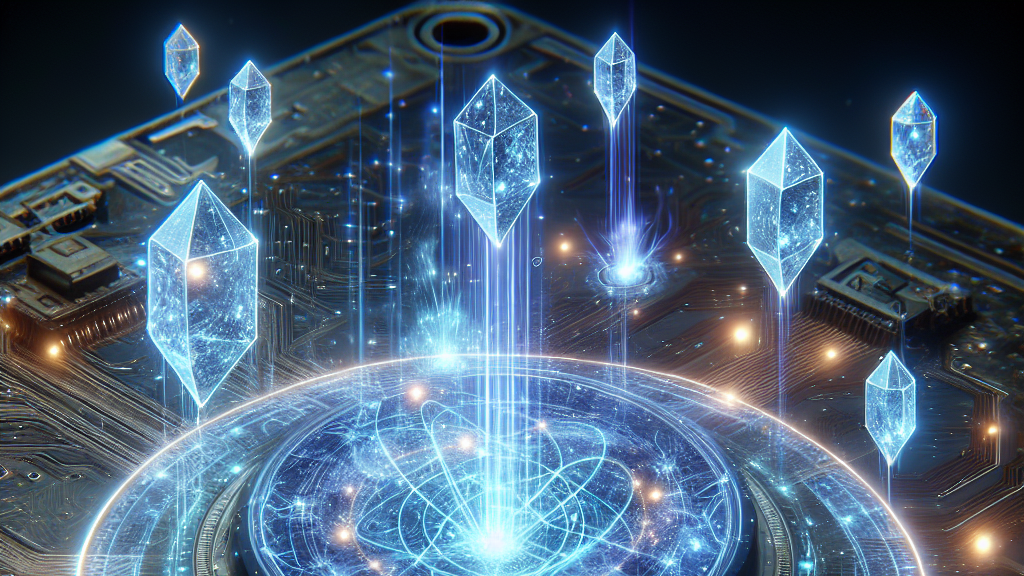
What if technology didn’t just unfold in space, but also in time? Imagine gadgets and devices that don’t just occupy physical space but also incorporate the rhythm of time itself. This isn’t science fiction—it’s the fascinating world of time crystals, a new frontier in physics that could revolutionize how we build and use devices.
Time crystalline structures are like invisible clocks within materials, creating unique patterns that unfold over time. This research is exploring how these structures can be built and manipulated to allow entirely new types of electronic and quantum devices. With time-tronics, we could design gadgets with dynamic temporal elements, akin to tiny circuit boards made of time. It’s as if engineers could rearrange time to create devices that are more flexible and powerful than anything possible in the physical world.
Imagine having a smartphone that never becomes outdated because its core functions can reconfigure over time, adapting to new uses or applications. Or consider a quantum computer that can perform calculations faster by leveraging these temporal structures to connect its components in infinite ways. By harnessing time crystals, we move closer to a future where our technology isn’t just cutting-edge—it’s literally time-bending!
Did you know? Time crystals aren’t just a theory—they can actually exist, defying the traditional laws of physics by maintaining movement without energy!
FAQs
What are time crystals and why do they matter?
Time crystals are structures that repeat in time, much like traditional crystals repeat in space. They could revolutionize technology by enabling dynamic devices that harness the unique properties of these temporal structures.
How could time crystals change everyday technology?
By integrating time crystals, electronic devices could become more adaptable, offering extended lifespans and new functionalities by reconfiguring their operations over time.
What are time-tronics?
Time-tronics is a concept where temporal lattices, or time arrangements, act like circuit boards, forming the basis of futuristic devices that operate based on time crystals.
How do time crystals relate to quantum computing?
Time crystals could enable new designs for quantum computers, allowing for more flexible and powerful quantum gate operations by connecting qubits in novel ways through time.
What makes time crystals different from regular crystals?
Unlike regular crystals, which are static and repeat in space, time crystals are dynamic and repeat over time, potentially enabling novel device functionalities.
Background
Traditional crystals have a structure that repeats in space, creating a regular pattern that’s used in everything from electronic circuits to jewelry. Time crystals, on the other hand, have a repeating structure in time, maintaining an order that unfolds in a temporal sequence, much like a dance that repeats its steps with perfect precision. This strange behavior defies normal physics, where movement typically requires energy.
History
The concept of time crystals was first proposed by Nobel laureate Frank Wilczek in 2012. Initial skepticism gave way to validation when researchers demonstrated time crystalline properties in controlled environments. Since then, time crystals have become a hot topic in condensed matter physics, with scientists investigating their properties and potential applications in areas such as quantum computing and technology.
Based on “Time-tronics: from temporal printed circuit board to quantum computer” by Krzysztof Giergiel, Peter Hannaford, Krzysztof Sacha, available on arXiv (arxiv.org/abs/2406.06387), used under CC BY 4.0 (creativecommons.org/licenses/by/4.0/).