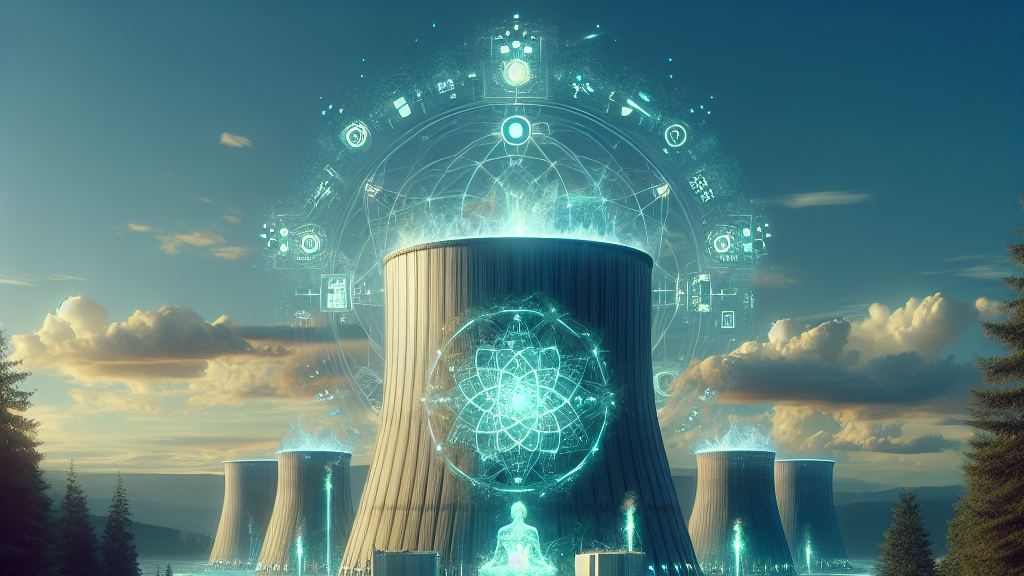
Imagine a world where nuclear reactors operate safely and autonomously, potentially from thousands of miles away. This isn’t a sci-fi fantasy, but a future made possible by quantum key distribution, a new cryptographic technique that promises unparalleled security based on the laws of quantum mechanics, not just clever math tricks. The potential here is massive, especially for places where human presence is risky or impossible.
This research showcases a groundbreaking demonstration of using this quantum tech at a fully digital nuclear reactor. The team successfully installed a QKD system that safeguards information over long distances—up to 140 km. During their testing, they achieved real-time encryption and decryption of thousands of signals with almost no errors, demonstrating the viability of this system in real-world conditions.
The implications for future nuclear technologies are profound. By integrating quantum-based secure communications, we could see the rise of microreactors and fission batteries operating autonomously in remote or dangerous areas. Not only would this boost safety and efficiency, but it would also open the door to sustainable and secure energy solutions in previously inaccessible locations.
Did you know? The technology behind quantum key distribution relies on the laws of physics to ensure absolute data security, making it a game-changer for protecting sensitive information.
FAQs
What is quantum key distribution and how does it work?
Quantum key distribution is a secure communication method that uses the principles of quantum mechanics to encrypt and decrypt messages. Unlike traditional systems that rely on mathematical difficulty, QKD’s security is based on physical laws, making it extremely difficult to hack.
How will quantum key distribution impact nuclear reactor operations?
Quantum key distribution can significantly enhance the security of nuclear reactor operations by ensuring data is communicated securely over vast distances. This could allow reactors to operate autonomously and safely, even in remote areas, reducing human risk and increasing efficiency.
What are the challenges of implementing quantum key distribution in nuclear systems?
One of the main challenges is ensuring that the QKD systems meet strict requirements for latency, compatibility, stability, and performance under operational transients. However, this research demonstrates that these challenges can be overcome, paving the way for secure, advanced nuclear technologies.
Background
Quantum key distribution is a cutting-edge technology that uses the unique properties of quantum mechanics to create a secure communication channel. Unlike traditional cryptography, which can potentially be broken with better algorithms or more computing power, QKD relies on the fundamental principles of quantum physics, such as the uncertainty principle, to guarantee security.
History
The development of QKD stems from early theoretical works in the 1980s, where scientists explored using quantum mechanics for secure communication. The BB84 protocol was one of the first QKD protocols introduced and has since evolved with various improvements and implementations to enhance its practical applications and address real-world challenges.
Based on “Demonstration of Quantum-Secure Communications in a Nuclear Reactor” by Konstantinos Gkouliaras, Vasileios Theos, True Miller, Brian Jowers, George Kennedy, Andy Grant, Terry Cronin, Philip G. Evans, Stylianos Chatzidakis, available on arXiv (arxiv.org/abs/2505.17502), used under CC BY 4.0 (creativecommons.org/licenses/by/4.0/).