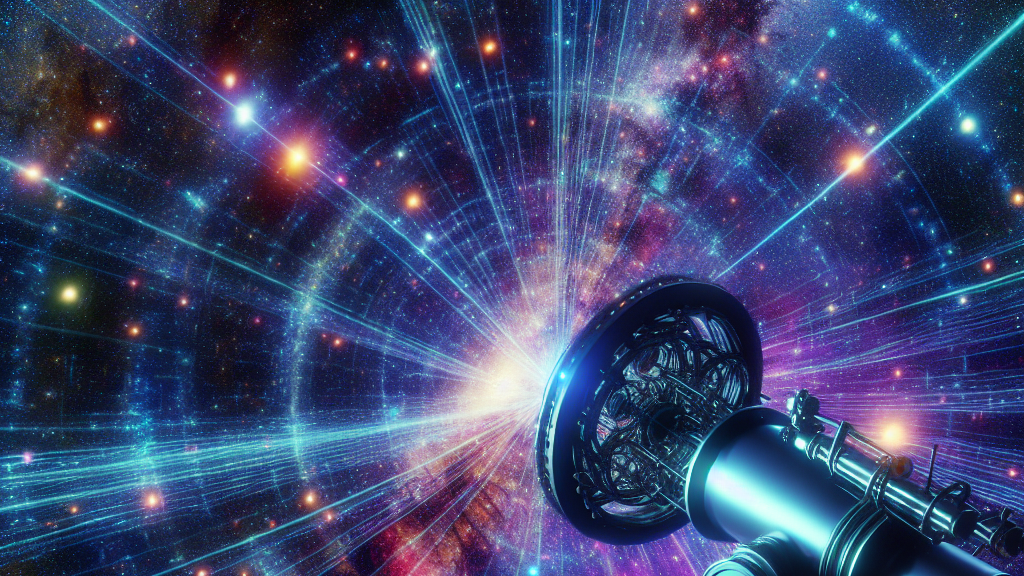
Have you ever wondered if there’s more to the universe than meets the eye? Scientists believe there’s an invisible entity called dark matter affecting the cosmos, and they are on a mission to understand it. Imagine if we could detect signals from outer space that hint at this mysterious substance. That’s exactly what the Cherenkov Telescope Array Observatory aims to do, by observing gamma rays – extremely high-energy beams of light – and how they correlate with galaxies distributed across the universe.
The new research focuses on how these gamma rays can interact with visible galaxy formations to potentially reveal signals from dark matter. By using a ground-based Cherenkov telescope and analyzing data from galaxy catalogs like 2MASS, scientists are setting up an astronomical detective work. They aim to find the cross-correlation signals that might be left by annihilating or decaying dark matter. In just 50 hours, the telescope can achieve sensitivities similar to those from analyzing dwarf galaxies and clusters.
So, how could these observations change our lives? Well, understanding dark matter could lead to groundbreaking technological advances. Just like the discovery of electricity changed the world, revealing dark matter’s secrets could revolutionize not just science, but potentially energy sectors or materials used in everyday life. Imagine if in the future your gadgets relied on technology developed from understanding dark matter; the possibilities are out of this world!
Did you know? Dark matter makes up about 27% of the universe, yet it’s invisible and only detected through its gravitational effects!
FAQs
What is the Cherenkov Telescope Array Observatory?
The Cherenkov Telescope Array Observatory is a new ground-based device designed to study high-energy gamma rays from space, with the aim of understanding the universe’s structure and potentially discovering components of dark matter.
How can gamma rays help scientists understand dark matter?
Gamma rays are high-energy beams of light that can interact with galaxies in ways that might betray the presence of dark matter, making them a valuable tool for cosmic studies.
Why is studying dark matter important for everyday life?
Understanding dark matter can lead to technological breakthroughs, potentially providing new energy sources or advanced materials for everyday applications, much like how the discovery of electricity transformed the world.
What is 2MASS and why is it significant for the research?
2MASS is a detailed galaxy catalog that helps scientists observe how galaxies are distributed in the universe, providing crucial data for analyzing the interactions of gamma rays with cosmic structures.
How does this research differ from previous dark matter studies?
Unlike previous studies focusing on specific galaxy types like dwarfs, this research utilizes wide-sky surveys and ground-based telescopes to explore cosmic correlations over vast areas, potentially revealing new insights into dark matter.
Background
The Cherenkov Telescope Array Observatory is a cutting-edge instrument used by scientists to observe gamma rays, a type of high-energy light particle that can reveal hidden aspects of the universe like dark matter. Gamma rays are key to detecting cosmic phenomena because they can penetrate vast spaces and interact in ways other energy forms cannot. Studying these rays alongside galaxy distributions helps researchers identify potential signals from dark matter, an invisible component that is thought to make up a significant part of the universe.
History
The study of cosmic rays began in the early 20th century. Over time, scientists discovered that these high-energy particles offer insights into cosmic phenomena, leading to the development of advanced telescopes designed to detect gamma rays. The current research continues this legacy, refining methods to cross-correlate gamma rays with galaxy distributions, aiming to detect dark matter signals. This builds on the work of past astronomers who first hypothesized the existence of dark matter through galaxy movement studies.
Based on “Across the Universe: Dark Matter and Galaxy Cross-Correlations with the Cherenkov Telescope Array Observatory” by Elena Pinetti, Veronika Vodeb, Aurelio Amerio, Alessandro Cuoco, Stefano Camera, Nicolao Fornengo, Gabrijela Zaharijas, available on arXiv (arxiv.org/abs/2505.20383), used under CC BY 4.0 (creativecommons.org/licenses/by/4.0/).