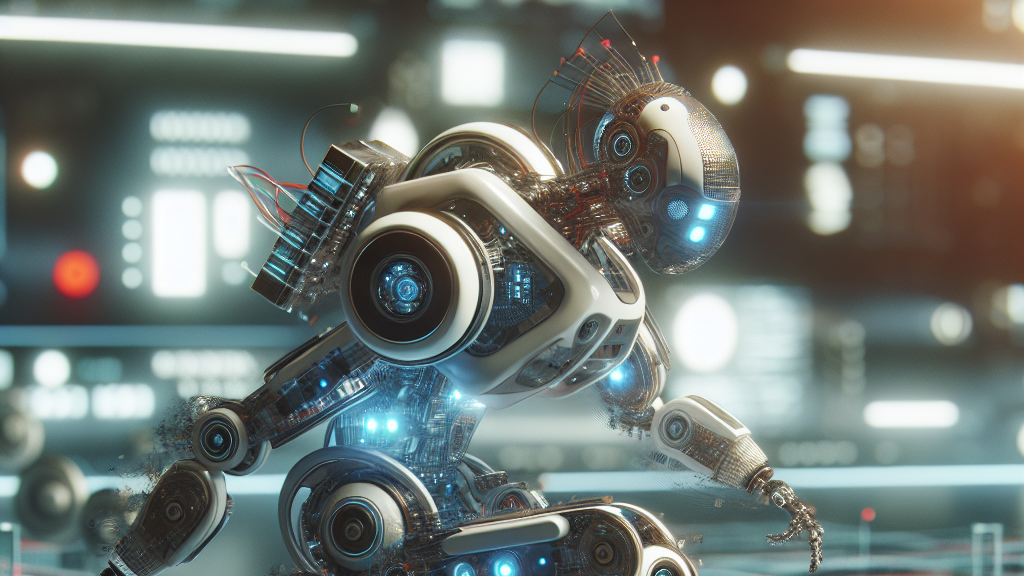
Imagine if robots could learn new skills as swiftly and efficiently as humans, transferring their knowledge across different tasks seamlessly. This has long been a dream for both scientists and developers working in artificial intelligence, and it’s finally beginning to take shape with an approach called neuroevolution. This cutting-edge method is gaining traction because it allows robots to learn in a more robust and adaptable way by evolving neural networks to solve complex problems.
Neuroevolution, different from the more common reinforcement learning, focuses on evolving AI systems to perform better over time. To test its capabilities, researchers designed two intriguing benchmarks: one where neural networks emulate stepping gates of logic circuits and another, called ecorobot, which challenges robots with varied physical environments filled with walls and obstacles. The key was to see if these AI systems could successfully transfer skills from simpler to more complex tasks, much like a student advancing in school.
So, why does this matter to you? Well, imagine having robots at home or in the workplace that can adapt to new tasks without needing constant reprogramming. They could help with everything from household chores to complex medical procedures, always learning and getting better without much human intervention. This research represents a significant step towards making that a reality, potentially transforming how we interact with technology on a daily basis.
Neuroevolution can help robots and AI systems ‘forget’ less and adapt faster by evolving through steps similar to biological evolution.
FAQs
What is neuroevolution and how does it differ from reinforcement learning?
Neuroevolution is a method where AI systems evolve over time to improve their problem-solving abilities, unlike reinforcement learning that focuses on trial and error to learn tasks. Neuroevolution is seen as more adaptable and robust, making it a promising path for skill transfer in robots.
How does neuroevolution help in skill transfer across tasks?
Neuroevolution allows robots and AI to evolve and adapt their neural networks, enabling them to switch from simpler to more complex tasks without losing learned skills, much like human learning.
Why is the ability to transfer skills important for robots?
Skill transfer is crucial for creating adaptable robots that can handle a variety of tasks with minimal reprogramming, similar to how humans apply learned skills in new situations, making robots more useful in real-world applications.
What are stepping gates and ecorobot benchmarks?
Stepping gates are tasks where neural networks mimic logic circuits, focusing on modular design. Ecorobot extends the physics engine with varied robotic challenges, assessing the AI’s ability to handle different physical tasks and environments.
What is the future potential of neuroevolution in real-world applications?
Neuroevolution holds the promise of developing flexible, smarter robots capable of learning and adapting to new environments and tasks without constant programming changes, revolutionizing industries from home automation to healthcare.
Background
Neuroevolution is a type of artificial intelligence that mimics natural evolution to create systems that can solve complex problems. By evolving neural networks, neuroevolution generates solutions that are adaptable and scalable, providing an innovative way for AI to learn and transfer skills. It contrasts with reinforcement learning, which relies on repeated trials and rewards to train systems.
History
The idea of using evolution-inspired methods to improve AI has roots in the early exploration of genetic algorithms. Over time, as computational power increased, researchers began developing more sophisticated neuroevolutionary approaches. This study builds on such history by focusing on skill transfer and testing in realistic environments, setting the stage for more adaptable AI systems.
Based on “When Does Neuroevolution Outcompete Reinforcement Learning in Transfer Learning Tasks?” by Eleni Nisioti, Joachim Winther Pedersen, Erwan Plantec, Milton L. Montero, Sebastian Risi, available on arXiv (arxiv.org/abs/2505.22696), used under CC BY 4.0 (creativecommons.org/licenses/by/4.0/).