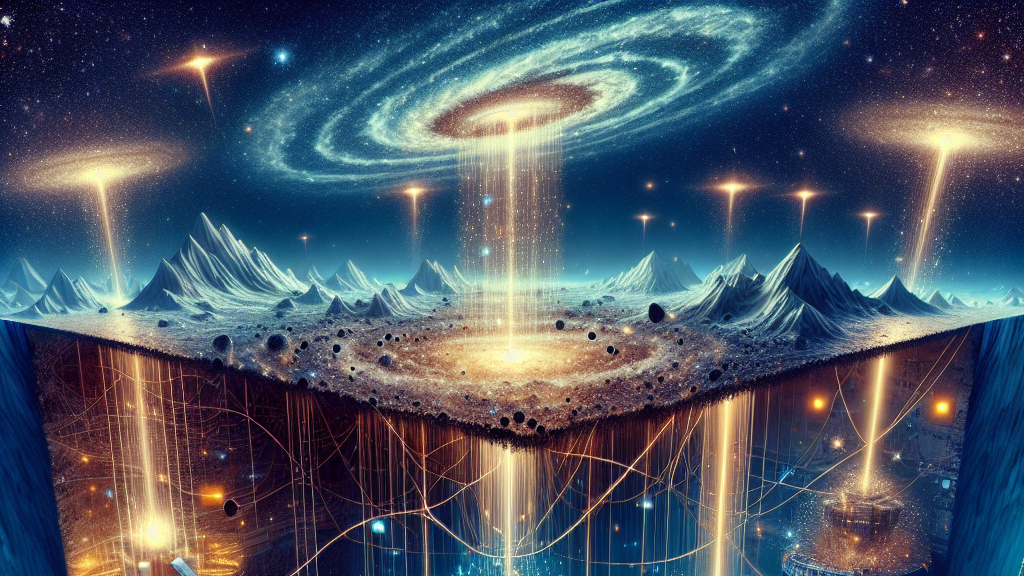
Did you know that the universe might be keeping massive secrets right under our feet? Recently, scientists made a jaw-dropping observation of a high-energy cosmic event by KM3NeT, a special detector situated under the sea. But here’s the twist—another detector, IceCube, located in Antarctica, should have also caught sight of this event, yet it saw none. Could dark matter be the missing piece to this cosmic jigsaw puzzle?
Researchers believe dark matter, a mysterious substance that doesn’t emit light and is invisible to our eyes, might scatter in Earth’s crust. When these high-energy dark matter particles zoom through the Earth, they might interact with invisible particles to produce muons—particles similar to electrons. These muons are what KM3NeT detected. Scientists think that these dark matter interactions might be linked to a bright object in space called a blazar, which shoots out an extreme energy that’s helping create this unusual phenomenon.
The implications of this are enormous! If correct, this could mean that dark matter is more interactive and widespread than we thought. Imagine detecting dark matter particles directly or even using this understanding to develop new technologies. Future experiments and observations could use this knowledge to enhance our exploration of the universe and maybe uncover secrets of how the cosmos was formed!
Dark matter makes up about 27% of the universe, yet it remains invisible to all current astronomical tools!
FAQs
What is dark matter and why is it important to this research?
Dark matter is an invisible substance that doesn’t emit, absorb, or reflect light, making it undetectable by regular telescopes. It plays a crucial role in this research as scientists think interactions of dark matter in the Earth’s crust might explain a mysterious high-energy event.
How does KM3NeT differ from IceCube, and what did it detect?
KM3NeT and IceCube are both massive detectors designed to capture signals from high-energy cosmic particles. KM3NeT observed a rare event thought to be related to dark matter interactions in the Earth’s crust, which IceCube hasn’t detected yet.
Why are muons significant in understanding the dark matter interactions?
Muons are particles similar to electrons but much heavier. They can be produced when dark matter particles interact in the Earth’s crust, serving as potential evidence of such interactions and offering clues about the nature of dark matter.
Could this research lead to new discoveries in physics?
Absolutely! If validated, it could radically change our understanding of dark matter and open the door to new physics, potentially revealing how the universe is structured and behaves at fundamental levels.
How might future studies build upon these findings?
Future studies could leverage larger-scale experiments or new technologies to detect more events like these, refine our models of dark matter, and even guide the development of direct detection methods for dark matter particles.
Background
Dark matter is a hypothetical form of matter only seen through its gravitational effects on visible matter in the universe, such as galaxies. It doesn’t interact with the electromagnetic force, which means it doesn’t emit, absorb, or reflect light. This research focuses on interactions of dark matter particles with ordinary matter in Earth’s crust, potentially producing detectable particles like muons.
History
The idea of dark matter originated in the 1930s when scientists noticed galaxies were spinning faster than their visible mass could account for. Since then, dark matter has been a key focus in astrophysics. The recent observation by KM3NeT is part of ongoing efforts to directly detect dark matter or its effects, building on breakthroughs provided by large detectors like IceCube.
Based on “’Dark’ Matter Effect as a Novel Solution to the KM3-230213A Puzzle” by P. S. Bhupal Dev, Bhaskar Dutta, Aparajitha Karthikeyan, Writasree Maitra, Louis E. Strigari, Ankur Verma, available on arXiv (arxiv.org/abs/2505.22754), used under CC BY 4.0 (creativecommons.org/licenses/by/4.0/).