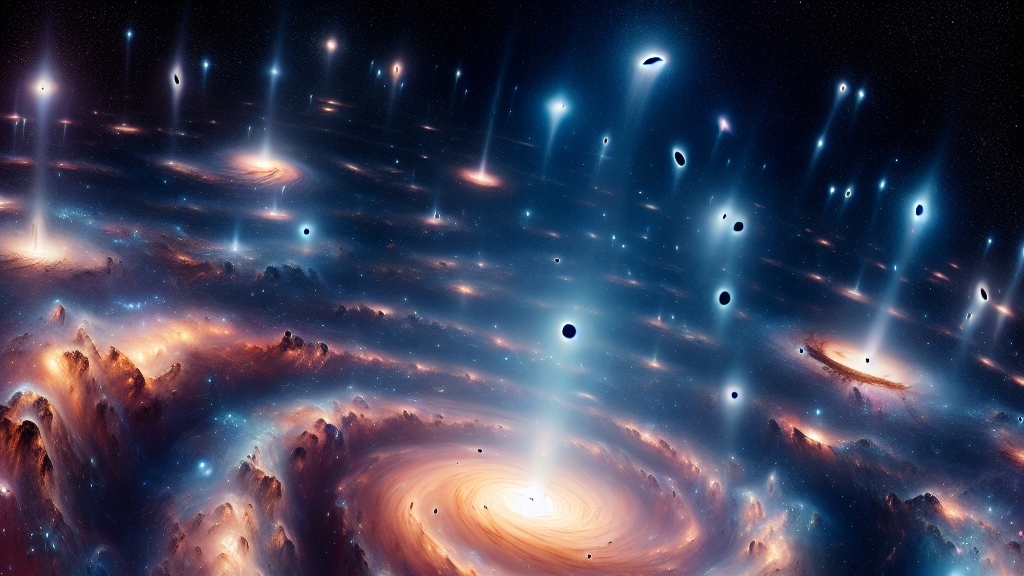
What if we told you that the universe is more mysterious than you ever imagined, possibly shaped by countless tiny black holes? That’s what this mind-boggling research suggests about the cosmos. Scientists are baffled by the puzzling abundance of low-mass galaxies and clusters, and primordial black holes could be the key to solving this cosmic riddle.
You might think of black holes as enormous and terrifying celestial bodies, but what about ones that are tiny and formed just moments after the Big Bang? These primordial black holes could have a sneaky influence on the universe’s low-mass structures. By analyzing how clusters of galaxies bend light, researchers are getting closer to understanding these elusive objects’ role in the grand scheme of things.
Imagine being able to pinpoint how much of the universe’s ‘missing’ matter is hiding in the form of these tiny black holes. If true, this discovery could transform our understanding of dark matter and the invisible scaffolding of the universe. Soon, we might even develop new technology to detect these cosmic ghosts, changing the way we observe the night sky forever.
Primordial black holes could be tiny relics from the Big Bang that help shape the universe.
FAQs
What are primordial black holes and how do they form?
Primordial black holes are hypothetical tiny black holes formed just moments after the Big Bang, possibly from density fluctuations in the early universe. Unlike the massive black holes formed from collapsing stars, these are thought to be much smaller.
How do primordial black holes impact the universe’s structure?
Primordial black holes might affect the universe by increasing the number of low-mass structures, like small galaxies and star clusters, in contrast to other dark matter models that predict fewer such objects.
How can scientists detect primordial black holes?
Scientists detect potential signs of primordial black holes by observing the gravitational effects they have on light and other celestial bodies, using techniques like strong lensing to study brightness fluctuations in galaxy clusters.
What makes this research on primordial black holes unique?
This research uniquely proposes that primordial black holes might be responsible for the unexpected abundance of low-mass cosmic structures, offering a new way to study dark matter and the early universe.
Why is it important to understand primordial black holes?
Understanding primordial black holes could revolutionize our knowledge of dark matter, the Big Bang, and the fundamental structures of the universe, leading to groundbreaking advances in cosmology.
Background
Primordial black holes are theoretical objects formed from density fluctuations seconds after the Big Bang, distinct from typical black holes formed by stellar collapse. Their impact on the universe, particularly their potential role as dark matter, is studied through observational cosmology techniques such as gravitational lensing and brightness fluctuations in galaxy clusters.
History
The concept of primordial black holes dates back to the 1970s when scientists first suggested that extremely small black holes could emerge from high-density regions shortly after the universe was born. Over the years, the hypothesis has gained traction as a possible explanation for dark matter, a mysterious component that makes up a significant part of the universe’s total mass but remains invisible. This particular study builds on previous research by using cosmic simulations and lensing perturbations to explore the implications of primordial black holes further.
Based on “Excess of substructure due to primordial black holes” by Patricio Colazo, Nelson Padilla, Federico Stasyszyn, available on arXiv (arxiv.org/abs/2505.23896), used under CC BY 4.0 (creativecommons.org/licenses/by/4.0/).