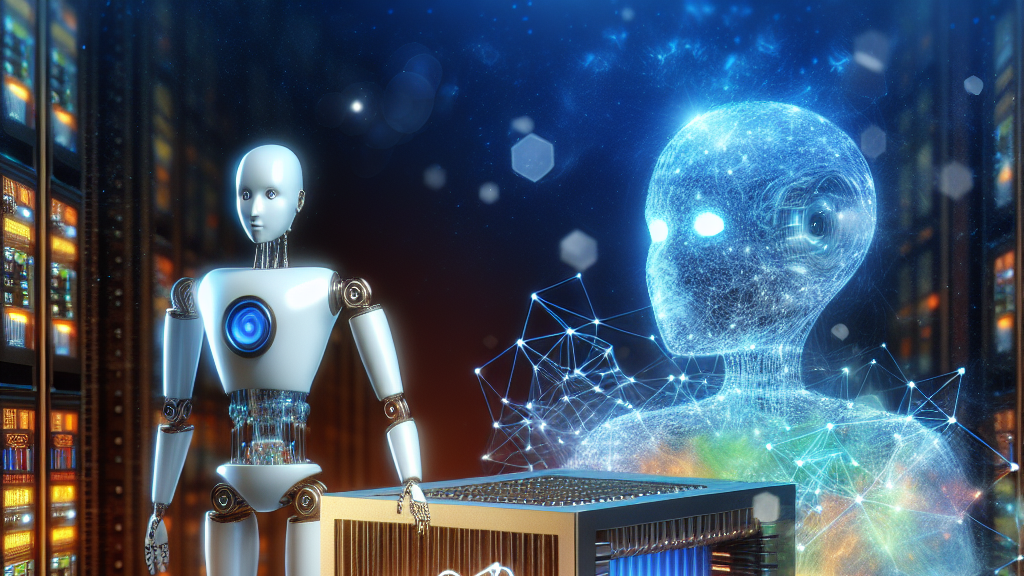
**Imagine if your phone could think like a super-genius mathematician, solving problems faster than you can blink!** That’s what the combination of quantum computing and agentic AI promises us. These two cutting-edge technologies are coming together to create systems that make super-smart decisions, opening up possibilities we’ve only dreamed of until now. Just like how a superhero team-up beats the bad guys by joining their unique powers, these quantum-agentic platforms could revolutionize problem-solving across the globe, tackling everything from climate change to traffic jams like never before.
**So what exactly are quantum computing and agentic AI?** Quantum computing is like a super-powered calculator that can process information at lightning speed, thanks to the quirky nature of quantum mechanics. Meanwhile, agentic AI refers to AI systems that can think and act like humans, making decisions based on given tasks. By linking these two, researchers are creating quantum agents—digital beings with the brains of a genius and the speed of a racing car. This study shows how these agents can handle smart decision-making, planning, and optimization, and even manage complex workflows with more efficiency than traditional methods.
**But why does this matter to you?** Imagine ultra-fast healthcare diagnoses or self-driving cars navigating complex routes instantly. These applications could profoundly change our daily lives. For instance, in healthcare, quantum agentic systems could analyze vast amounts of medical data in seconds, providing faster and more accurate diagnoses. In transportation, they might optimize traffic flow to make your commute a breeze. By combining quantum computing with AI, scientists are laying the groundwork for a future where technology not only thinks and learns but also does so with unprecedented speed and precision.
Quantum computers use qubits that can be in multiple states at once, unlike regular computers that use bits in a single state!
FAQs
What makes quantum computing different from regular computing?
Quantum computing utilizes qubits, which can exist in multiple states simultaneously, enabling faster data processing than traditional bits that are either 0 or 1.
How can agentic AI benefit from quantum technologies?
Agentic AI can leverage the computational power of quantum systems to enhance decision-making, optimize complex tasks, and manage intricate workflows much more efficiently.
Will quantum-agentic platforms affect everyday life?
Yes, they have the potential to transform industries like healthcare and transportation by providing faster diagnostics and optimized traffic management, improving our daily experiences.
What is a quantum agent?
A quantum agent is a digital system that combines quantum computing with AI, allowing it to make sophisticated decisions faster and more efficiently than traditional computing methods.
Are there practical examples of quantum-agentic systems?
Yes, researchers have developed prototypes demonstrating their potential in fields such as quantum-enhanced decision-making and optimization in various applications.
Background
Quantum computing harnesses the principles of quantum mechanics, allowing it to compute at extremely high speeds using qubits. Unlike traditional bits, qubits can exist in multiple states at once, enabling simultaneous computations. Agentic AI involves autonomous, intelligent systems capable of decision-making and task completion. By integrating these technologies, researchers aim to develop systems that are both smart and fast, capable of tackling complex problems more efficiently.
History
Quantum computing and AI have been separate fields until recently. Quantum computing began gaining traction in the late 20th century, with foundational work like Shor’s algorithm. AI, on the other hand, has been developing since the mid-20th century, initially focusing on rule-based reasoning. The rise of neural networks and machine learning has advanced AI significantly. This new research merges these technologies, proposing platforms that utilize their strengths collaboratively.
Based on “Quantum Agents” by Eldar Sultanow, Madjid Tehrani, Siddhant Dutta, William J Buchanan, Muhammad Shahbaz Khan, available on arXiv (arxiv.org/abs/2506.01536), used under CC BY 4.0 (creativecommons.org/licenses/by/4.0/).