Imagine being at the edge of a mystery that could rewrite the rules of the universe! That’s exactly where scientists are, as they dive deep into the puzzling world of quantum mechanics, aiming to resolve the long-standing question of how particles behave at their tiniest levels. By using a high-tech dark matter detector, they’re looking for elusive X-ray signals that could confirm groundbreaking theories.
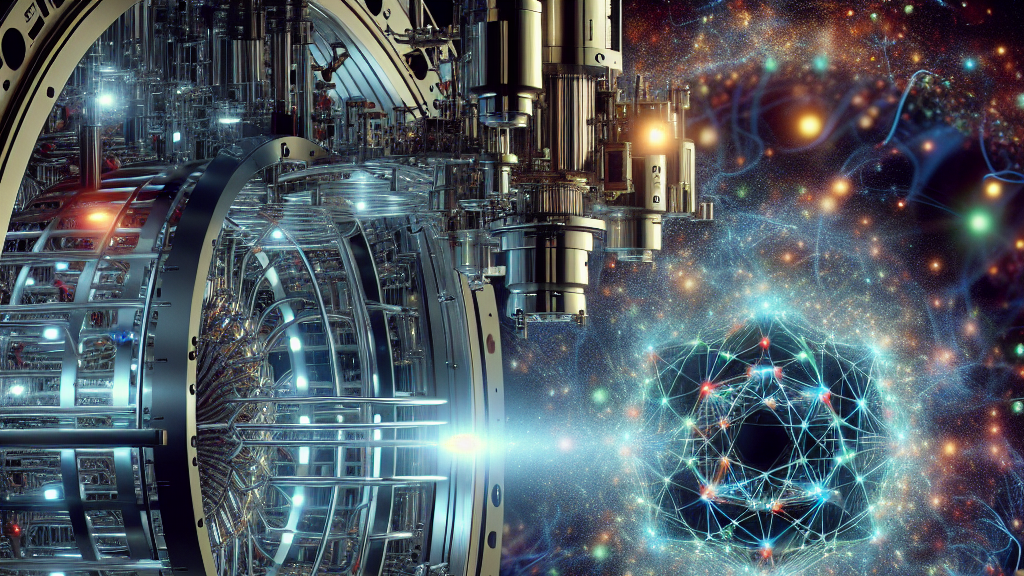
In this thrilling quest, scientists used the XENONnT detector to hunt for special kinds of X-ray radiation. This radiation is predicted to occur due to a phenomenon called ‘dynamical quantum collapse,’ a concept thought to solve why particles don’t just magically appear in multiple places at once. By looking in this way, researchers have set new limits and constraints on what these collapses might look like, making huge leaps in our understanding of the cosmos.
But how does this relate to our everyday world? Well, imagine if these findings could pave the way for new technologies or even energy sources, radically changing everything from how we power our devices to potentially unearthing new dimensions of reality. This research isn’t just about tiny particles; it’s about uncovering secrets of the universe that could transform life as we know it!
Did you know that quantum particles can exist in multiple states at once, a concept known as superposition?
FAQs
What is the focus of the research on dynamical quantum collapse?
The research focuses on detecting X-ray radiation as predicted by dynamical quantum collapse models, aiming to solve the measurement problem in quantum mechanics.
How does X-ray detection relate to dark matter research?
Scientists utilize advanced dark matter detectors like XENONnT to detect X-ray radiation, offering insights into quantum behavior with potential implications for understanding dark matter.
What is the measurement problem in quantum mechanics?
The measurement problem in quantum mechanics questions how and why particles in superposition randomly settle into a single state when measured. Dynamical collapse models offer a potential solution to this dilemma.
How groundbreaking are the new limits set by this research?
The new limits are world-leading, improving on previous constraints by significant factors, and they exclude original values proposed for certain models for the first time, marking a historic advancement in quantum research.
Background
The measurement problem in quantum mechanics is a core question about the nature of particles and their behavior. Unlike classical objects, quantum particles can exist in multiple states simultaneously, a phenomenon called superposition. However, when measured, these particles ‘collapse’ into a singular state. Dynamical quantum collapse theories propose a way to explain this mysterious process.
Dynamical collapse theories, such as the Markovian continuous spontaneous localization and Diòsi-Penrose models, attempt to explain why and how particles transition from multiple states to a single state. Detecting the X-ray radiation predicted by these models could provide evidence supporting these theories, helping to resolve one of the most perplexing issues in quantum physics.
History
The journey to understanding quantum behavior dates back to the early 20th century with the discovery of quantum mechanics. Over the years, researchers like Schrödinger and Heisenberg developed foundational principles. As quantum mechanics evolved, it became clear that some phenomena, like superposition, defied classical explanations. This led to the development of various interpretations and theories, including the dynamical collapse models, which seek to address the ‘collapse’ of the wave function. The current research builds on this foundation by using advanced detectors to search for experimental evidence supporting these theories.
Based on “Challenging Spontaneous Quantum Collapse with XENONnT” by E. Aprile, J. Aalbers, K. Abe, S. Ahmed Maouloud, L. Althueser, B. Andrieu, E. Angelino, D. Antón Martin, S. R. Armbruster, F. Arneodo, L. Baudis, M. Bazyk, L. Bellagamba, R. Biondi, A. Bismark, K. Boese, A. Brown, G. Bruno, R. Budnik, C. Cai, C. Capelli, J. M. R. Cardoso, A. P. Cimental Chávez, A. P. Colijn, J. Conrad, J. J. Cuenca-García, C. Curceanu, V. D’Andrea, L. C. Daniel Garcia, M. P. Decowski, A. Deisting, C. Di Donato, P. Di Gangi, S. Diglio, K. Eitel, S. el Morabit, A. Elykov, A. D. Ferella, C. Ferrari, H. Fischer, T. Flehmke, M. Flierman, W. Fulgione, C. Fuselli, P. Gaemers, R. Gaior, F. Gao, S. Ghosh, R. Giacomobono, F. Girard, R. Glade-Beucke, L. Grandi, J. Grigat, H. Guan, M. Guida, P. Gyorgy, R. Hammann, A. Higuera, C. Hils, L. Hoetzsch, N. F. Hood, M. Iacovacci, Y. Itow, J. Jakob, F. Joerg, Y. Kaminaga, M. Kara, P. Kavrigin, S. Kazama, P. Kharbanda, M. Kobayashi, D. Koke, A. Kopec, H. Landsman, R. F. Lang, L. Levinson, I. Li, S. Li, S. Liang, Z. Liang, Y. -T. Lin, S. Lindemann, K. Liu, M. Liu, J. Loizeau, F. Lombardi, J. Long, J. A. M. Lopes, G. M. Lucchetti, T. Luce, Y. Ma, C. Macolino, J. Mahlstedt, A. Mancuso, L. Manenti, S. Manti, F. Marignetti, T. Marrodán Undagoitia, K. Martens, J. Masbou, S. Mastroianni, A. Melchiorre, J. Merz, M. Messina, A. Michael, K. Miuchi, A. Molinario, S. Moriyama, K. Morå, Y. Mosbacher, M. Murra, J. Müller, K. Ni, U. Oberlack, B. Paetsch, Y. Pan, Q. Pellegrini, R. Peres, C. Peters, J. Pienaar, M. Pierre, K. Piscicchia, G. Plante, T. R. Pollmann, L. Principe, J. Qi, J. Qin, D. Ramírez García, M. Rajado, A. Ravindran, A. Razeto, L. Redard-Jacot, R. Singh, L. Sanchez, J. M. F. dos Santos, I. Sarnoff, G. Sartorelli, J. Schreiner, P. Schulte, H. Schulze Eißing, M. Schumann, L. Scotto Lavina, M. Selvi, F. Semeria, P. Shagin, S. Shi, J. Shi, M. Silva, H. Simgen, A. Stevens, C. Szyszka, A. Takeda, Y. Takeuchi, P. -L. Tan, D. Thers, G. Trinchero, C. D. Tunnell, F. Tönnies, K. Valerius, S. Vecchi, S. Vetter, F. I. Villazon Solar, G. Volta, C. Weinheimer, M. Weiss, D. Wenz, C. Wittweg, V. H. S. Wu, Y. Xing, D. Xu, Z. Xu, M. Yamashita, L. Yang, J. Ye, L. Yuan, G. Zavattini, M. Zhong, available on arXiv (arxiv.org/abs/2506.05507), used under CC BY 4.0 (creativecommons.org/licenses/by/4.0/).