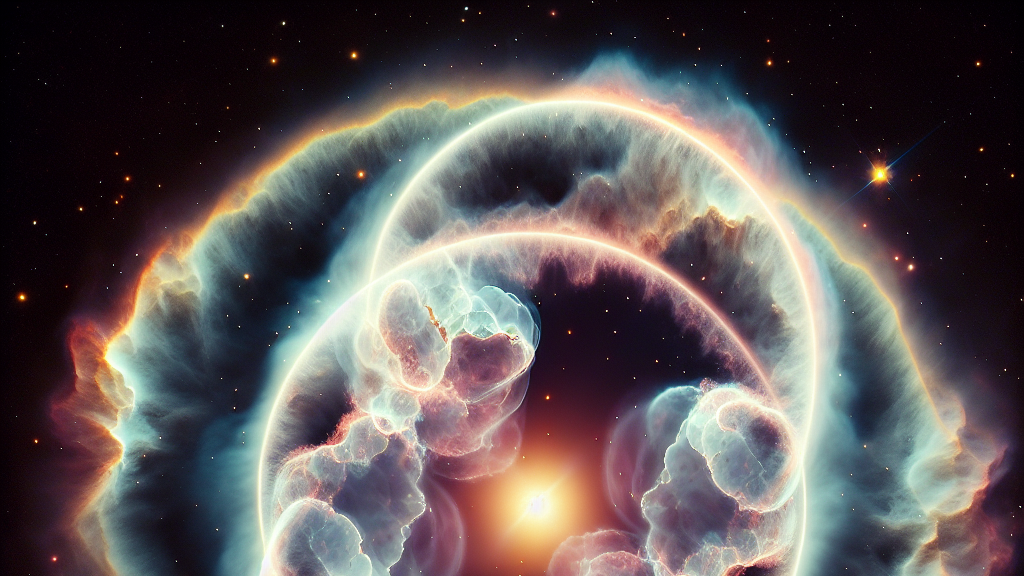
Imagine a massive, mysterious circle in the sky that only special radio telescopes can see. These Odd Radio Circles, or ORCs, are rare and puzzling, often appearing as glowing rings surrounding unknown distant galaxies. They’re like cosmic donuts, captured by cutting-edge radio surveys like the Evolutionary Map of the Universe.
Scientists are using smart detection methods to find these hidden treasures. By combining computer-powered searches with good old-fashioned human eyeballing, they’ve managed to add five new ORCs and two candidates to the collection. Alongside these, they’ve spotted unique radio shapes called GLAREs, possibly related to ORCs but at different life stages. These discoveries might help us dig deeper into understanding galactic mysteries.
What if these ORCs and other radio shapes are the keys to unlocking the universe’s secrets? They could tell us stories about how galaxies evolve or even reveal unknown links between cosmic events. By studying them further, we might not only learn more about our galaxy neighborhoods but also provide clues about our cosmic origins.
Odd Radio Circles are so rare that only a handful have been discovered since their first sighting in 2019!
FAQs
What are Odd Radio Circles?
Odd Radio Circles, or ORCs, are mysterious ring-shaped radio emissions often surrounding distant galaxies, first discovered in 2019. They are rare cosmic phenomena visible only at radio wavelengths.
Why are Odd Radio Circles important?
Studying ORCs can provide insights into galaxy evolution, cosmic events, and the universe’s structure. They can unlock secrets about distant galaxies and their development.
How do scientists find these Odd Radio Circles?
Researchers use a mix of advanced technology and human analysis. They combine computer algorithms with manual inspection to identify ORCs from large radio survey data.
What are GLAREs, and how are they related to ORCs?
GLAREs are diffuse radio emissions with irregular shapes, possibly representing different stages of ORCs. Studying them helps scientists understand the lifecycle of these radio structures.
Can regular telescopes see Odd Radio Circles?
No, ORCs are not visible to regular optical telescopes. They require specialized radio telescopes to detect their unique radio signatures.
Background
Odd Radio Circles are a type of radio emission detected around distant galaxies. The concept revolves around radio astronomy, which involves observing the universe at radio wavelengths. This study combines data analysis techniques and manual inspections to identify these unique cosmic objects.
History
The first Odd Radio Circle was discovered in 2019. Since then, findings have sparked excitement in the scientific community. Astronomers have used various surveys and refined methodologies to expand our understanding of these enigmatic space phenomena and their potential links to galaxy evolution.
Based on “Discovery of Odd Radio Circles and Other Peculiars in the First Year of the EMU Survey using Object Detection” by Nikhel Gupta, Ray P. Norris, Zeeshan Hayder, Minh Huynh, Heinz Andernach, Andrew M. Hopkins, Stanislav Shabala, Lawrence Rudnick, Miroslav D. Filipović, Bärbel S. Koribalski, Lars Petersson, X. Rosalind Wang, available on arXiv (arxiv.org/abs/2506.08439), used under CC BY 4.0 (creativecommons.org/licenses/by/4.0/).