Connect with us

Search by keyword

Space

What’s Hiding in Cosmic Rings of Fire?

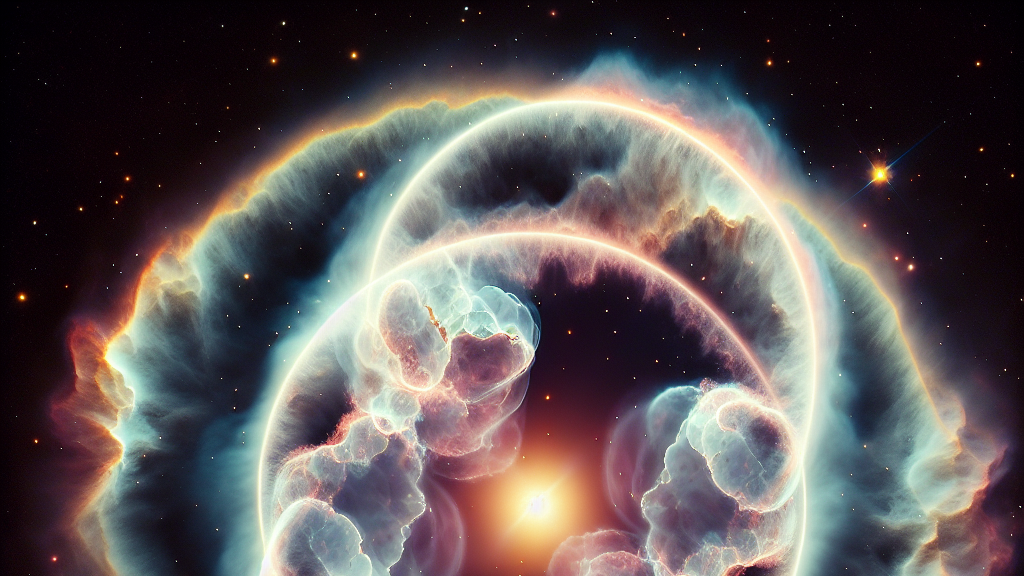
Scientists have used the James Webb Space Telescope to examine a mysterious pair of bright, infrared rings surrounding a distant nebula, giving us an unprecedented look at how stars shed material in space.

Whats Hiding in Cosmic Rings of Fire
✨Researched by humans. Explained by robots. Learn more.

Ever looked up at the night sky and wondered what cosmic secrets are hidden beyond the stars? Well, scientists have just used the James Webb Space Telescope to peek into a planetary nebula called NGC 1514, and what they found was quite surprising: a pair of glowing, infrared ‘rings of fire’ circling its faint outer shell. This nebula, a stellar ghost, is giving us clues about how stars like our Sun shed parts of themselves over time.

In a recent study, scientists used special filters on the telescope to capture different wavelengths of infrared light from these fascinating rings. The intricate structures revealed themselves to be made of tiny, hot dust grains rather than the usual atomic or molecular gases we might expect. This means that these rings could be the remnants of a massive period of shedding from the star that originally formed the nebula, sculpted by high-speed winds from a hidden pair of stars at the core.

Now, why does this matter to us back home on Earth? Well, these kinds of cosmic events help scientists understand the life cycle of stars, including the one that powers our solar system. By learning more about how stars evolve and eventually die, we can better understand the history and future of the universe, including our own tiny place within it. Imagine future space missions focusing on these enigmatic rings to unlock even more starry secrets.

Did you know? The mysterious rings of NGC 1514 were only discovered during an all-sky infrared survey—a space project that essentially maps out the heavens in heat vision!

FAQs

What did scientists discover about NGC 1514’s infrared rings?

Scientists observed that the rings are made up of tiny, hot dust grains and they are products of older star material, sculpted by fast winds from a central star system.

Why are the rings in the nebula so bright in infrared light?

The brightness in infrared light is due to the thermal emission from the small dust grains, rather than gas emissions like hydrogen or molecular hydrogen.

How do these infrared rings help us understand star life cycles?

The infrared rings offer insight into the processes of stellar mass loss and the shaping effects of stellar winds, key to understanding the life and death of stars.

What tools did the scientists use to study the nebula?

Scientists used the James Webb Space Telescope’s mid-infrared imaging and spectroscopy capabilities, specifically the MIRI Imager and Medium Resolution Spectrometer, to study the nebula’s rings.

How could this research impact our view of the universe?

This research enhances our understanding of stellar evolution and mass loss, contributing to a broader comprehension of the cosmos and our place in it.

Background

Planetary nebulas are fascinating celestial objects that form when a star, like our Sun, reaches the end of its life and expels its outer layers. This shedding process releases clouds of gas and dust, creating spectacular shapes and colors as they interact with surrounding space. The structure and composition of these nebulas provide valuable information about how stars evolve and die.

History

The study of planetary nebulas has come a long way; early astronomers mistook them for planets due to their round shapes. Over time, scientists have used increasingly advanced telescopes to reveal these objects as remnants of dying stars. Discoveries, such as the infrared rings around NGC 1514, build on this rich history and help refine our understanding of stellar life cycles.

Based on “JWST/MIRI Study of the Enigmatic Mid-Infrared Rings in the Planetary Nebula NGC 1514” by Michael E. Ressler, Alba Aller, David Jones, Ryan M. Lau, Luis F. Miranda, Karen Willacy, available on arXiv (arxiv.org/abs/2502.21281), used under CC BY 4.0 (creativecommons.org/licenses/by/4.0/).

Trending

Latest

Can AI Save Water Discover How

Computers

AI is transforming the tech world, but it uses lots of water! A new tool, SCARF, helps us measure and reduce AI's water footprint,...

Whats a Forbush Decrease and Why Should We Care Whats a Forbush Decrease and Why Should We Care

Space

Scientists just observed the biggest solar storm event in years, revealing unexpected cosmic ray patterns. Understanding these changes could help us protect our technology...

Can Cars Spot Danger Faster Than Humans Can Cars Spot Danger Faster Than Humans

Computers

Think about how quickly you react when something unexpected happens on the road. This research brings us closer to creating self-driving cars that can...

Can Fear of the Other Stop Social Harmony Can Fear of the Other Stop Social Harmony

Physics

Fear of the unknown might make it harder for people to agree and get along. This study shows that when people have strong xenophobic...

Can AI Revolutionize Breast Cancer Diagnosis Can AI Revolutionize Breast Cancer Diagnosis

Electricity

This research introduces a groundbreaking AI model that can accurately assess HER2-positive breast cancer using widely accessible staining methods, potentially revolutionizing how we diagnose...

Can AI Transform Your Singing into a Choir Can AI Transform Your Singing into a Choir

Computers

Imagine singing solo and having AI turn you into a choir. This research unveils a groundbreaking AI tool that transforms your voice into rich...

You May Also Like

Space

Scientists have discovered a new way that tiny early-universe structures might grow into massive black holes, potentially changing our understanding of cosmic evolution! This...

Physics

Recent research suggests that supernova explosions in our galaxy might be key to discovering new, elusive forms of dark matter. These cosmic events could...

Space

Scientists have found mysterious space circles called Odd Radio Circles using advanced radio surveys. These rings could unlock secrets about distant galaxies and our...

Space

AI is stepping up its game in the hunt for dark matter, using pulsars to decode mysterious cosmic signals that could change how we...

Space

This research has unlocked a faster way to explore the universe using gravitational lensing, an astronomical phenomenon that could reveal hidden secrets of quasars...

Math

Scientists have harnessed AI to model shockwaves around black holes, which could revolutionize our understanding of extreme space environments, potentially impacting future space exploration...

Space

Our understanding of the universe's uniformity faces a serious challenge, as new findings suggest our cosmos might not be as smooth and even as...

Space

Scientists have found mysterious little red dots in space that hint at supermassive black holes growing faster than ever before seen. Understanding these could...

Space

This study explores how smashing a space rock into a giant planet makes it ring like a bell, creating waves that could last millions...

Copyright © 2024 8ig8rain.

Disclaimer: The content on 8ig8rain.com consists of AI-generated summaries of scientific abstracts from arXiv. Please note that most arXiv abstracts are preprints and may not have undergone formal peer review. While these summaries aim to convey key ideas and potential applications, they are provided for informational purposes only and should not be interpreted as validated scientific findings or professional advice. The summaries are intended to educate, spark curiosity, and inspire further exploration of science.