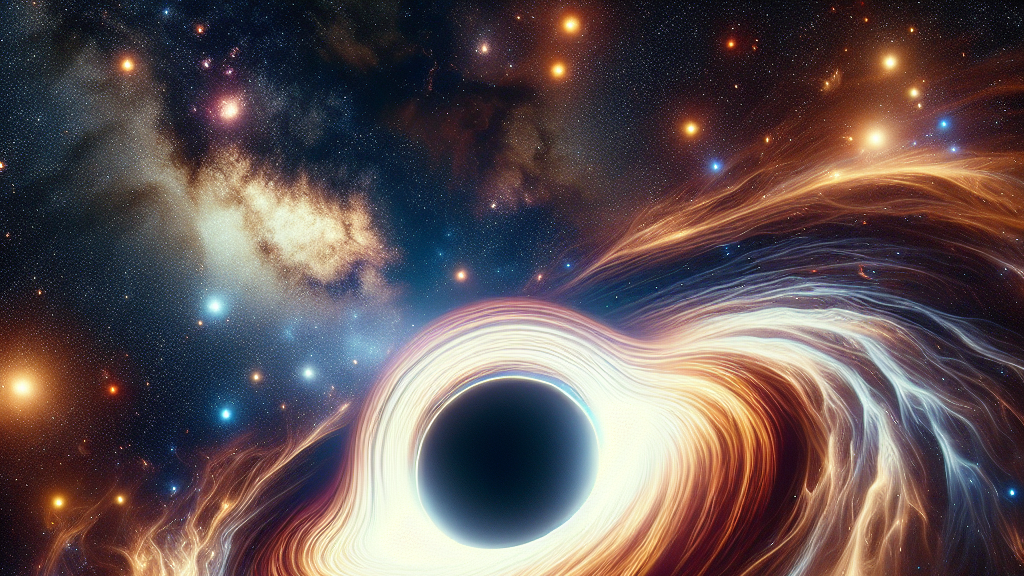
Imagine a universe teeming with invisible giants—vast clouds of dark matter that hold the secrets of our universe. Even though we can’t see dark matter directly, scientists believe it’s out there, hidden within galaxies and galaxy clusters, shaping their very structure by its sheer gravitational pull.
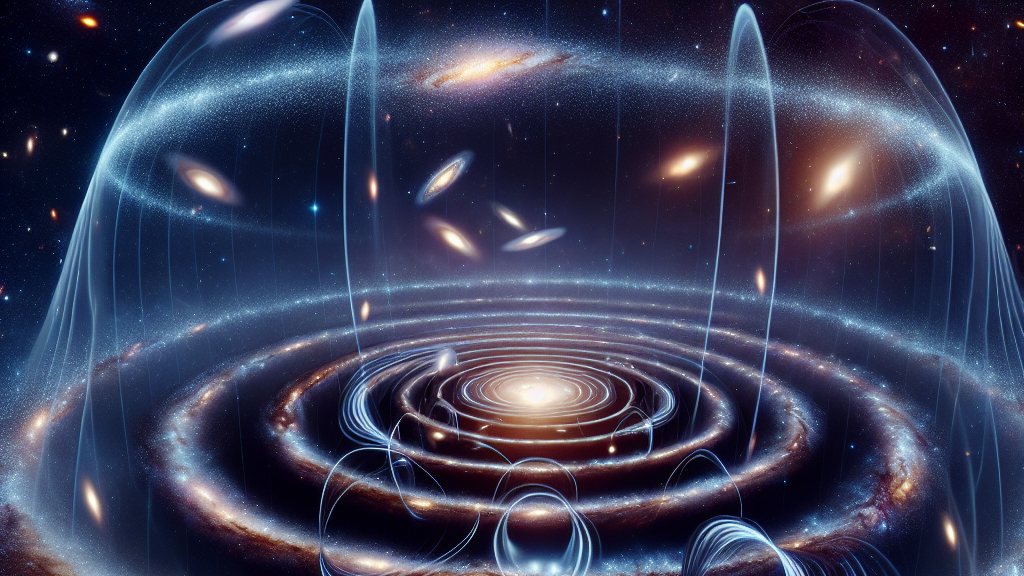
Researchers have been using state-of-the-art simulations to peer into these elusive dark matter haloes. One such simulation, known as TNG50 from the IllustrisTNG project, suggests that while some of these haloes might not glow like stars, they do exist in abundance around galaxy groups and clusters. Specifically, these simulations show that the largest dark haloes tend to sit on the outskirts, staying away from the bustling centers of galaxies.
Why does this matter? Because understanding these dark matter haloes could unlock the secrets of how galaxies evolve over billions of years. Imagine if we could map these invisible giants; it would be like unveiling a hidden layer of the universe, allowing us to see our galaxy’s history and future in a whole new light. Next time you look up at the stars, remember that there might be more than meets the eye—an entire dark, unseen force silently sculpting the cosmos.
Did you know? Dark matter makes up about 85% of the universe’s mass, yet it remains invisible to our most powerful telescopes!
FAQs
What are dark matter haloes and subhaloes in space?
Dark matter haloes and subhaloes are invisible clumps of dark matter surrounding galaxies or within galaxy groups. They don’t emit light or energy but exert gravitational forces that help shape galaxies.
How do scientists detect dark matter if it’s invisible?
Scientists use gravitational lensing, where a massive object like a galaxy bends the light from objects behind it, revealing the presence of dark matter through its gravitational effects.
Why don’t dark matter haloes have luminous counterparts?
Although dark matter itself doesn’t emit light, it helps form the structure of galaxies. Some may have no visible stars or gas associated, remaining completely dark.
What role do dark matter haloes play in galaxy formation?
Dark matter haloes provide the gravitational ‘glue’ that holds galaxies together, influencing their formation and evolution over time.
Could dark matter be hiding far from galaxy centers?
Yes, recent research using simulations suggests massive dark matter haloes may prefer the outskirts of galaxy clusters, where they stealthily reside away from the core regions.
Background
Dark matter is a mysterious form of matter that doesn’t emit, absorb, or reflect light, making it invisible and detectable only through its gravitational interactions. It’s like the cosmic scaffolding that holds galaxies together, accounting for a significant part of the universe’s mass. Gravitational lensing is a technique scientists use to detect dark matter by observing how it bends the light from distant objects.
History
The concept of dark matter dates back to the 1930s when astronomers like Fritz Zwicky first noticed that galaxies were spinning too fast to be held together by visible matter alone. Since then, the search for dark matter has advanced with technologies like gravitational lensing and simulations, like the TNG50 project, which help us visualize and understand these invisible structures.
Based on “Tiny galaxies and dark substructures: exploring the ‘dark’ subhaloes in TNG50” by Jessica E. Doppel, Mathilde Jauzac, David J. Lagattuta, Azadeh Fattahi, Guillaume Mahler, available on arXiv (arxiv.org/abs/2506.09122), used under CC BY 4.0 (creativecommons.org/licenses/by/4.0/).