Ever thought about robots understanding and feeling emotions just like humans? Researchers are diving into this thought-provoking idea by teaching AI to ‘care.’ They use a fascinating approach called homeostatic regulation, which is a fancy way of saying ‘keeping things balanced,’ similar to how our bodies maintain a steady temperature. By making these autonomous agents mimic human empathy, they can better connect with us emotionally.
Here’s how it works: imagine each AI agent as a little machine with feelings, trying to keep its ‘happiness level’ balanced. These agents learn empathy by connecting to their partners, understanding their emotional state, and letting it affect their own state. Two types of empathy are involved: cognitive, where the agent observes and understands, and affective, where the agent actually shares emotions. In simple environments, agents act more kindly to one another when they can feel their partner’s emotions affecting their own.
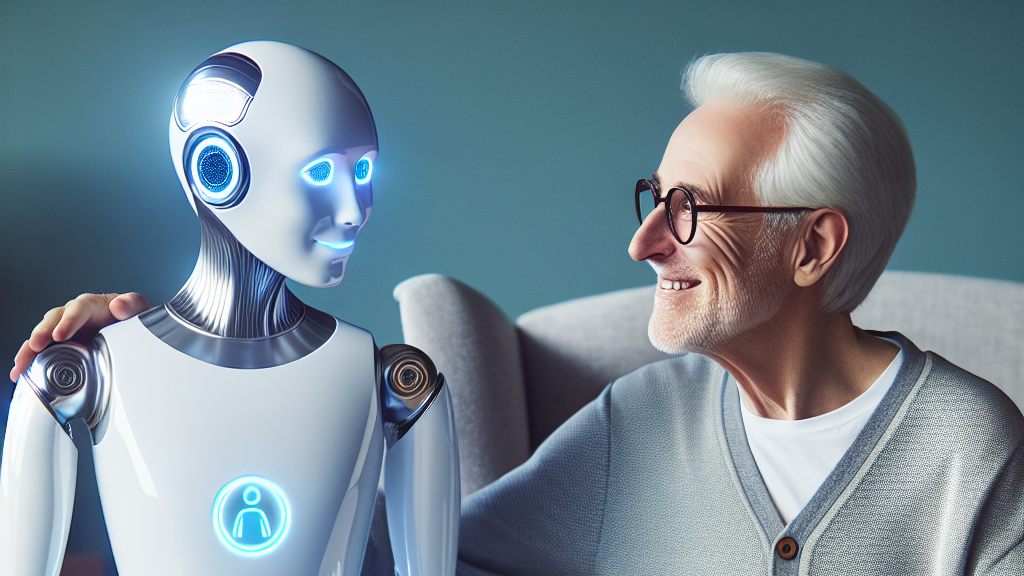
How incredible is it that AI could one day be our emotional companions! Picture robots in hospitals that not only provide medical assistance but also comfort to patients by understanding their anxiety and addressing it with a soothing presence. This research might be a step towards AI that can genuinely relate to and support us emotionally in everyday life.
Did you know that with enough training, AI can start to ‘feel’ like the people around it? This groundbreaking idea could transform how robots interact with humans.
FAQs
How can AI learn empathy from this research?
This research involves AI agents learning empathy by mimicking the way humans maintain a balance in their emotional and physiological states. By understanding and sharing the emotional states of those around them, AI can act in a more emotionally intelligent way.
What is homeostatic self-regulation in AI?
Homeostatic self-regulation is the concept where AI agents strive to maintain their own internal balance, similar to how our bodies regulate temperature. This principle helps the AI to act in a stable and prosocial manner, responding to changes in emotional states of others.
In which areas could AI empathy be applied?
AI empathy could revolutionize areas like healthcare, customer service, and personal digital assistants, providing responsive and emotionally intelligent interactions to solve problems, offer support, and improve user experiences.
What are cognitive and affective empathy in AI?
Cognitive empathy in AI refers to the ability of agents to observe and understand their partner’s emotions. Affective empathy means the AI shares and feels those emotions, impacting its own emotional state and prompting prosocial behavior.
Why is prosocial behavior important for AI?
Prosocial behavior encourages AI to act in ways that benefit and support humans, making AI more cooperative, understanding, and helpful in real-world scenarios.
Background
The crux of this research is about understanding how artificial intelligence can simulate empathy by recognizing and responding to emotions like humans do. The method used is inspired by homeostatic processes, which are how living beings maintain stability in their body’s internal environment. This balance is crucial for the agents to achieve prosocial behavior, allowing them to react to partner distress in meaningful ways.
History
Empathy in AI builds on long-standing research into artificial intelligence’s ability to mimic human behavior. Earlier studies have focused on teaching AI basic human interactions, but this research goes deeper, aiming for a more nuanced understanding by introducing a method where agents can feel and react emotionally like humans. This study stands out by exploring how AI can learn to decode and react to emotional states, paving the path for emotionally intelligent machines.
Based on “Homeostatic Coupling for Prosocial Behavior” by Naoto Yoshida, Kingson Man, available on arXiv (arxiv.org/abs/2506.12894), used under CC BY 4.0 (creativecommons.org/licenses/by/4.0/).