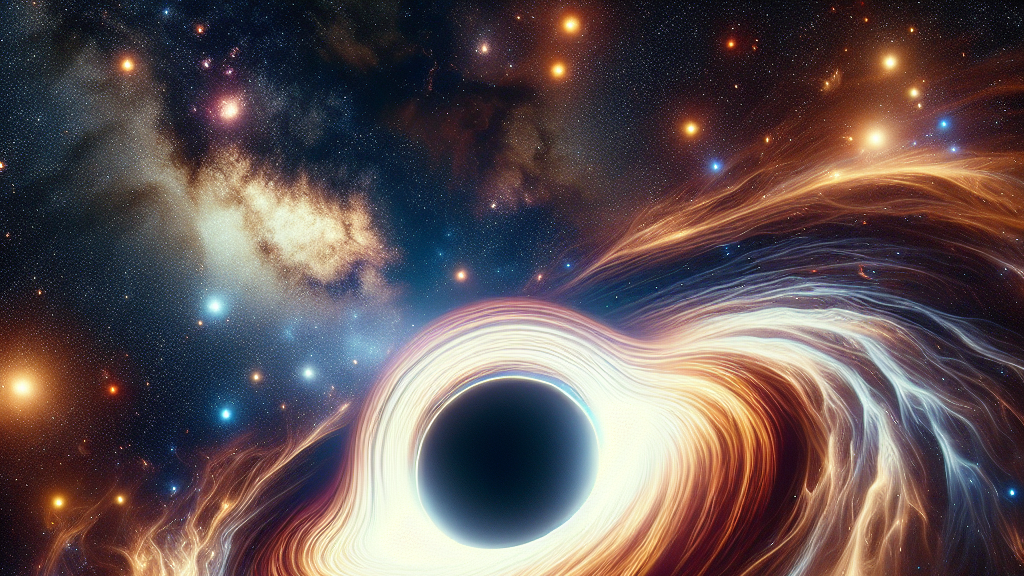
Imagine if the universe itself held a secret recipe for creating massive cosmic beasts known as supermassive black holes. These gigantic objects, found at the heart of galaxies, are still puzzling scientists because they seem to have already existed when the universe was just a baby. The big question is, how did they form so quickly?
Recent research offers a fascinating possibility. During the earliest times of the universe, there were small fluctuations in matter that led to the creation of dark matter halos. Without the cooling influence of molecular hydrogen, due to the powerful Cosmic Microwave Background, these halos couldn’t fragment and cool down, which forced the baryons at their core to collapse directly into black holes. This phenomenon could explain why we observe these immense black holes so early in cosmic history, consistent with our observations from telescopes like the James Webb.
Suddenly, the idea of understanding the universe becomes as thrilling as any mystery novel. If this process really happened, it might mean that the universe has ways of speeding up cosmic events, like black hole growth, earlier than we ever imagined. In practical terms, this discovery could revolutionize how we understand galaxy formation, potentially influencing future technology inspired by cosmic events. Seeing the universe’s timeline in this new light offers not just answers to old questions, but also new questions we’ve never thought to ask.
Supermassive black holes can be billions of times more massive than our Sun and are found in most large galaxies, including our own Milky Way.
FAQs
How do supermassive black holes form so early in the universe?
Recent studies suggest that density fluctuations in the early universe may lead to the formation of dark matter halos which, due to the Cosmic Microwave Background’s influence, can collapse directly into black holes.
What role does the Cosmic Microwave Background play in black hole formation?
The Cosmic Microwave Background provides enough energy to prevent the formation of molecular hydrogen, which is crucial for cooling. Without this cooling, baryons in dark matter halos are more likely to collapse directly into black holes.
How does this new understanding impact our view of cosmic history?
This discovery suggests that supermassive black holes could have formed much earlier than previously thought, giving new insights into the timeline of galaxy formation and the evolution of the universe.
What did the James Webb Space Telescope observe about black holes?
The James Webb Space Telescope has observed high-redshift black holes, indicating their presence in the universe earlier than previously expected, supporting theories of early formation processes.
Why are supermassive black holes important for cosmic exploration?
Understanding supermassive black holes is crucial because they influence the formation and evolution of galaxies and can help us unlock mysteries of the universe’s early history.
Background
Supermassive black holes are massive objects that form in the centers of galaxies. The Cosmic Microwave Background is the leftover radiation from the Big Bang, providing a thermal backdrop that affects the behavior of particles in space. The early universe was a dynamic environment where small fluctuations in density could lead to the formation of dark matter halos. These halos potentially became the seeds for the supermassive black holes we see today.
History
Research into black holes began with early theoretical predictions by scientists like Albert Einstein and Karl Schwarzschild. Over time, observations confirmed their existence, with significant contributions from the Hubble Space Telescope and now the James Webb Space Telescope. The discovery that supermassive black holes could form earlier than expected builds on decades of astrophysical research, challenging existing models of galaxy formation.
Based on “Not-quite-primordial black holes” by Wenzer Qin, Soubhik Kumar, Priyamvada Natarajan, Neal Weiner, available on arXiv (arxiv.org/abs/2506.13858), used under CC BY 4.0 (creativecommons.org/licenses/by/4.0/).