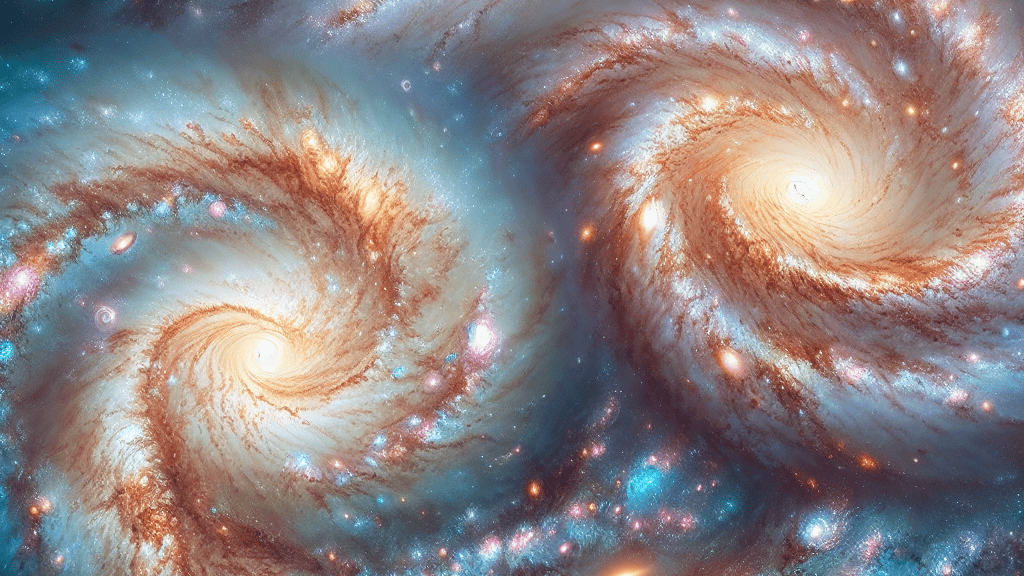
**Unveiling the Hidden Secrets of Spiral Galaxies with Light**. Discovering what’s inside spiral galaxies, like our own Milky Way, is like solving a cosmic mystery. Using a special method that involves observing light from telescopes, scientists have mapped out where stars and dust are in two nearby galaxies: M101 and NGC 3938.
This study not only helps us understand these galaxies but also adds to our knowledge of how galaxies work in general. It’s like using a treasure map to find hidden riches in the universe. By using this technique, we can peek into the lives of stars and the dust that surrounds them, which are crucial pieces of the cosmic puzzle. Scientists use information from different types of telescopes that catch light ranging from ultraviolet to infrared. This allows them to create a detailed map showing where stars and dust are located within these galaxies. When they apply this technique to M101 and NGC 3938, they can see how these galaxies compare to others like M33 and M51, and even our own Milky Way. This method allows them to measure star formation rates and how bright these areas are, helping us understand how galaxies grow and evolve.
**Impact on Our Understanding of the Cosmos**. As they map these galaxies, scientists notice that the way stars form and gather inside them is different than they expected. The connections between how stars form and where dust settles in these galaxies offer clues about why galaxies look the way they do and how they change over time. Understanding these patterns is important because it helps us learn about the origins of our own galaxy and the universe. Future research using this method could lead to more discoveries about distant galaxies, providing a clearer picture of the universe’s history and potentially revealing new insights into the creation of stars and planets.
Did you know that the Milky Way has a dust and light pattern similar to other nearby spiral galaxies?
FAQs
What unexpected discovery did scientists make about dust in these galaxies
Scientists found that the dust in these galaxies behaves like the dust in the Milky Way, with no need to alter their dust models.
How do scientists measure star formation in galaxies?
They use the light from stars, captured by telescopes, to determine where and how quickly stars are forming in galaxies.
Why does mapping stars and dust in galaxies matter?
Background
The study of spiral galaxies involves understanding their structure and composition, including stars and dust. Radiative transfer models help scientists decode this information by analyzing how light travels and gets absorbed by different materials. These models use data from space telescopes that observe the universe in various wavelengths, from ultraviolet to infrared, to map the structures within galaxies.
History
Astronomers have long studied spiral galaxies to understand their formation and evolution. Early studies relied on visible light observations, but advances in technology allowed for more detailed imaging using multiple wavelengths. This study builds on previous work by applying radiative transfer models to more galaxies, improving our understanding of how stars and dust are distributed within these cosmic structures.
Based on “Uncovering the truth about M101, NGC 3938, and their significant others through radiative transfer” by D. Pricopi, C. C. Popescu, M. T. Rushton, D. Murphy, C. J. Inman, R. Toma, available on arXiv (arxiv.org/abs/2412.18686), used under CC BY 4.0 (creativecommons.org/licenses/by/4.0/).