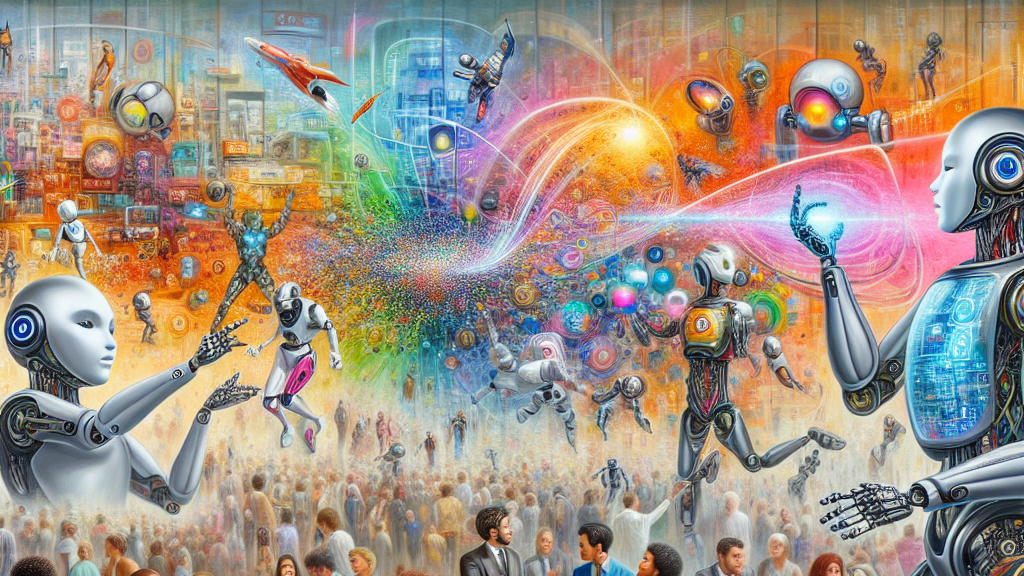
Have you noticed how quickly new trends and ideas catch on these days? It might not just be thanks to your friends and family! Recent research has shown that artificial agents—think advanced robots—are spreading ideas and behaviors faster and more broadly than humans can. It’s like having a super influencer in the mix, but powered by artificial intelligence.
This study took a closer look at how these artificial agents, using large language models, are participating in social experiments designed to test how quickly ideas spread. They found that these AI agents have lower ‘adoption thresholds’ compared to humans, meaning they’re quicker to jump on new trends and share them with others. This results in a much larger and faster spread of ideas, potentially changing how quickly new products or behaviors catch on.
Imagine a future where AI not only assists with tasks but also shapes the very social fabric by introducing and amplifying new concepts and behaviors. For instance, a smart device might suggest healthier lifestyle choices and, due to its influence, these ideas could catch on much faster than they would through traditional means. This could revolutionize everything from how we learn to how we invest our money.
Artificial agents use large language models, which are AI systems trained to understand and generate human-like text, making them surprisingly effective communicators.
FAQs
How do artificial agents influence social contagion?
Artificial agents use advanced AI to adopt and spread ideas and behaviors more quickly than humans. They have lower adoption thresholds, meaning they more readily embrace new trends and share them, leading to faster and broader societal shifts.
What was the experiment used to measure AI’s effect on idea spread?
The study replicated a choice experiment previously conducted with humans but this time used artificial agents powered by large language models. This allowed researchers to compare how quickly these agents spread ideas compared to human subjects.
Why is the rise of artificial agents significant?
The increasing presence of artificial agents in social networks could accelerate changes in behavior and culture, potentially leading to rapid shifts in society. Understanding this impact is crucial as it may influence various aspects of life, including education, social media, and financial markets.
Background
At the heart of this research are artificial agents that use large language models. These models are advanced AI systems trained on vast libraries of text to mimic human-like communication. By participating in social experiments, these agents help researchers understand how quickly ideas can spread through a network, comparing their pace to human interaction patterns.
History
The intersection of AI and social contexts has been a subject of curiosity and study over the past few decades. Robots and AI have traditionally been seen as tools or assistants, but as they develop more sophisticated communication abilities, researchers are increasingly interested in their social impact. This study moves beyond theoretical discussions, offering empirical evidence of how these agents might shape our society.
Based on “The amplifier effect of artificial agents in social contagion” by Eric Hitz, Mingmin Feng, Radu Tanase, René Algesheimer, Manuel S. Mariani, available on arXiv (arxiv.org/abs/2502.21037), used under CC BY 4.0 (creativecommons.org/licenses/by/4.0/).