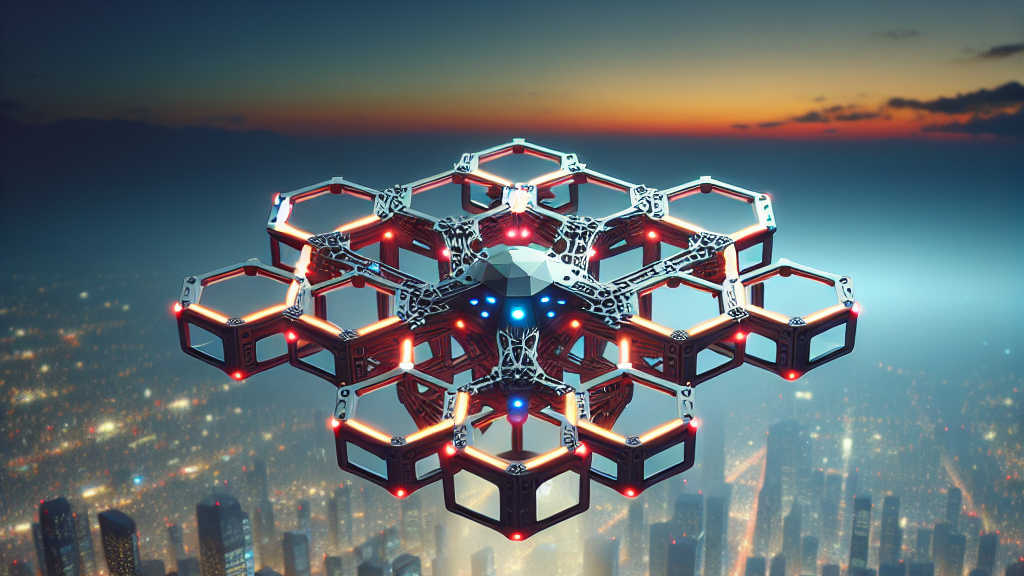
Think of a drone that can transform like a robot from your favorite sci-fi movie. This isn’t science fiction anymore! Researchers have unveiled the Dodecacopter, an innovative drone that can change its shape on the fly, quite literally. Imagine swapping out multiple drones for just one that can do it all, reducing clutter and increasing efficiency.
The magic lies in its modular design, where each part, or module, of the drone is shaped like a regular dodecahedron. This means it’s not stuck in a flat, two-dimensional shape; it can reconfigure itself into an almost endless number of three-dimensional designs. The Dodecacopter isn’t just about looking cool; it’s built for performance, too. This reconfiguration ability offers more control and stability in the air.
In the future, we could see these shape-shifting drones used in rescue operations, delivering packages in tricky terrains, or even replacing entire fleets of specialized drones. Imagine a world where one drone can handle a multitude of tasks just by changing its shape, saving time, resources, and energy. This isn’t just about drones—it’s about revolutionizing how we think of technology and adaptability.
Did you know? The Dodecacopter uses a shape called a dodecahedron, which has twelve flat faces!
FAQs
What is the Dodecacopter, and how is it different from regular drones?
The Dodecacopter is a modular drone designed with interlocking dodecahedron modules. Unlike regular drones that are typically fixed in shape, the Dodecacopter can change its configuration, offering more adaptability and functionality in various tasks.
Why are modular drones like the Dodecacopter important for the future of aviation?
Modular drones like the Dodecacopter present exciting possibilities for the future of aviation by replacing multiple types of specialized drones with one versatile platform. This innovation could lead to more efficient resource utilization and enhanced safety in various applications.
What practical applications could the Dodecacopter have in real life?
The Dodecacopter could be employed in a wide range of practical situations, such as search and rescue missions, delivering supplies across challenging landscapes, or performing multiple roles in a single flight, making operations more effective and flexible.
Background
Modular drones are designed to be reconfigurable, meaning they can change their structure depending on the task at hand. Traditionally, drones have been rigid and static, limited to a particular shape and function. The Dodecacopter introduces a new way of thinking by allowing the drone to shift and morph its shape using a modular design with interlocking parts, each shaped like a dodecahedron. This innovative approach enables it to perform a range of tasks more effectively.
History
The evolution of drones has seen rapid advancements from simple quadcopters to complex systems capable of performing multiple tasks. Initial designs were restricted by their structural rigidity. Over the years, engineers and researchers have explored the idea of modular designs that allow for reconfiguration. The Dodecacopter represents a breakthrough in this area by using a geometric design that enables three-dimensional shapeshifting capabilities, building on earlier concepts of modular technology.
Based on “The Dodecacopter: a Versatile Multirotor System of Dodecahedron-Shaped Modules” by Kévin Garanger, Thanakorn Khamvilai, Jeremy Epps, Eric Feron, available on arXiv (arxiv.org/abs/2504.16475), used under CC BY 4.0 (creativecommons.org/licenses/by/4.0/).