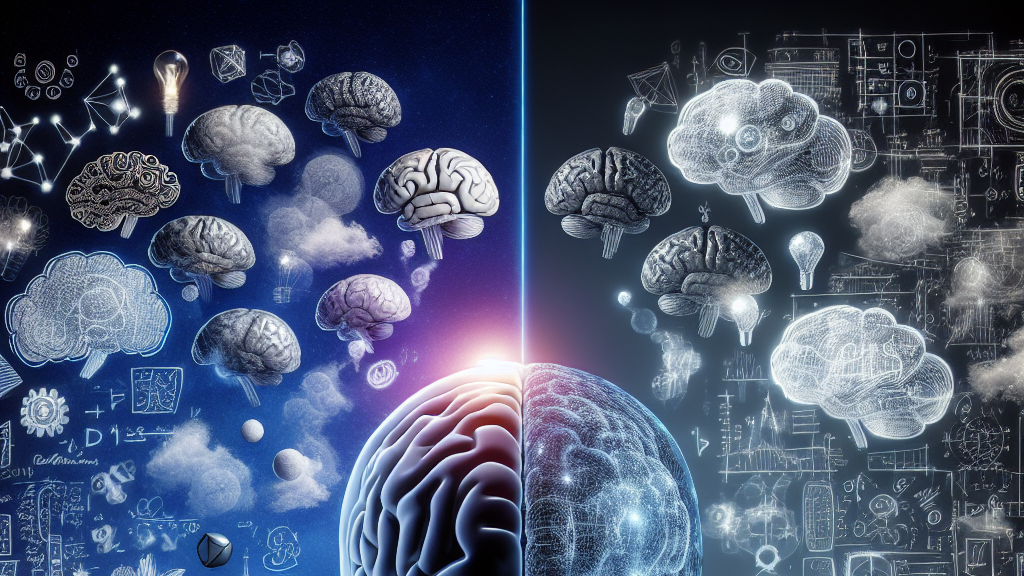
**Can machines judge human creativity better than we can?** That’s the intriguing question at the heart of a new study looking at how both people and artificial intelligence assess creativity in science and engineering. Imagine we’re at an art exhibit, and the work on display is a blend of our everyday imagination with some quirky, out-there ideas. How do we decide what’s groundbreaking or just plain unusual? Enter the realm of AI, which is now stepping into the role of a judge, alongside human experts, to grade creativity. But here’s the twist: the way they judge is not the same at all, stirring up a fascinating debate about the essence of creativity itself and the values we place on it. Is creativity about uncommon ideas, or is it the clever twist that takes something familiar and makes it new? The study shows that while people often rely on memories to make comparisons, AI looks for differences in the ideas’ remoteness and rarity. This difference in approach could have major implications for fields where innovation is key and where AI is becoming a bigger part of the process. Picture a world where AI isn’t just helping us with data but also participating in brainstorming sessions for new inventions or artistic projects. This brings us to how this research might directly touch our lives one day. If AI continues to improve its creativity evaluations, it could lead to smarter machines that help us become more innovative, whether by giving us suggestions for our next big project or helping to evaluate student projects in schools. This AI-human collaboration could open doors to creative ideas we haven’t even dreamed of yet, making our world a more inventive place.
Did you know AI models can score human creativity so accurately that they can almost predict the exact ratings given by professional experts?
FAQs
How do AI and humans differ in creativity evaluation?
AI tends to focus on the rarity and remoteness of ideas, while humans often use memory comparisons and emotional responses to judge originality, highlighting different priorities in creativity evaluation.
Why might AI’s creativity assessments matter to everyday life?
AI’s ability to evaluate creativity could lead to more innovative technology that helps people in daily tasks, like generating creative solutions or evaluating artistic projects, making everyday life more inventive.
What biases influence creativity evaluation in humans?
Humans might rely more on memory and personal experiences to assess creativity, which can introduce biases based on previous knowledge or emotional connections to an idea or solution.
Can AI models fully replace human creativity assessments?
While AI models are improving, they offer a different perspective on creativity that complements but does not replace the nuanced judgment humans provide, especially in areas involving emotions or cultural knowledge.
How does the inclusion of examples influence creativity scores?
Providing examples can standardize evaluations by giving a reference point, but it might also homogenize scores, as seen with AI’s increased correlation between creativity facets and originality scores.
Background
This research taps into how creativity is judged, whether by human experts or advanced AI models. Creativity is not just about having a unique idea; it’s about how remote or far from ordinary it is, how rare the idea might be, and how clever or smart it feels in solving a problem. To break it down, ‘remoteness’ refers to how much an idea deviates from everyday thoughts, ‘uncommonness’ deals with how rare or novel the idea is, and ‘cleverness’ is about the smartness of an idea or solution. Understanding these criteria helps us grasp how judgments are formed, whether by us or machines.
History
The study of creativity has long intrigued both psychologists and scientists. In the past, creativity assessment was largely human-driven, relying on metrics like divergent thinking or innovation impact. With the rise of artificial intelligence, researchers have explored how computers can simulate human-like thought processes. This current research builds on decades of cognitive science exploring how ideas are formed and judged, but it shifts towards a cross-examination between AI’s capabilities and human cognitive biases, opening new dialogues on AI’s role in subjective fields.
Based on “How do Humans and Language Models Reason About Creativity? A Comparative Analysis” by Antonio Laverghetta Jr., Tuhin Chakrabarty, Tom Hope, Jimmy Pronchick, Krupa Bhawsar, Roger E. Beaty, available on arXiv (arxiv.org/abs/2502.03253), used under CC BY 4.0 (creativecommons.org/licenses/by/4.0/).