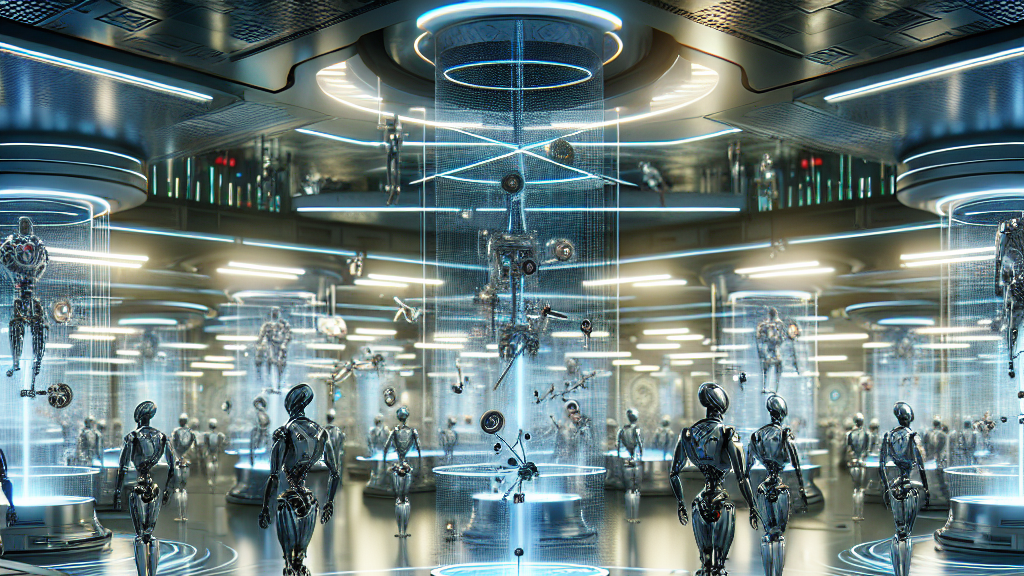
Imagine if you could create a detailed 3D model of anything you envision, from a futuristic car to an ancient castle, just by giving your computer a few cues. That’s the dream that new AI tools aim to make a reality, saving creators endless hours spent manually designing every detail. From video game developers to architects, anyone who needs digital models stands to benefit from this technological leap.
The process of creating 3D models traditionally involves a lot of time and painstaking attention to detail, using techniques like spline curves, meshes, and voxels. But these methods can be incredibly time-consuming and require a lot of expertise. Enter AI and its ability to generate these models automatically. By analyzing prompts and using generative design approaches, AI can whip up a model much faster, leaving designers more time for tweaking and refining rather than starting from scratch.
Imagine you’re an architect working on a new building. You input basic ideas and parameters into an AI tool, and it generates a variety of 3D models for you to choose from. This AI doesn’t just save time—it also might spark new creative ideas you hadn’t considered. The future could see AI as a collaborative partner in design, offering up a library of possibilities at the click of a button, transforming the way we create and innovate in countless fields.
The concept of digital twins, or virtual replicas of physical objects, is not just sci-fi—it’s actively used in industries like aerospace and healthcare today!
FAQs
What are digital twins, and why are they important?
Digital twins are virtual replicas of physical objects that allow for real-time monitoring and predictive analysis. They’re crucial for testing and improving designs in industries like aerospace and automotive engineering, where real-world testing can be challenging or costly.
How do AI tools improve the design of 3D models?
AI tools can automatically generate complex 3D models from simple prompts, saving designers time and effort. These tools use generative design approaches to create multiple variations quickly, giving designers more options to refine and enhance.
What industries could benefit most from AI-generated 3D models?
Industries such as gaming, architecture, virtual reality, and manufacturing can significantly benefit from AI-generated 3D models, as they streamline the design process and allow for more creativity and exploration of ideas.
Are AI-created models as good as those designed by humans?
AI-created models can be highly detailed and complex, often meeting or exceeding the quality of human-designed models. However, they still require human input and refinement to ensure that they meet specific design needs and aesthetic considerations.
Will AI tools replace human designers in the future?
AI tools are more likely to augment human designers rather than replace them. They offer new ways to innovate and create, serving as partners that enhance the creative process by taking over repetitive tasks and offering fresh design perspectives.
Background
Creating digital models involves complex steps like using spline curves and meshes to shape and detail objects. Digital twins are digital copies of real-world entities used extensively in simulations. With AI, these processes can be automated, allowing for rapid creation of high-quality models. Generative design, a method where AI creates various designs based on given parameters, is part of this technology.
History
The evolution of 3D modeling began with basic computer graphics and has grown into sophisticated software capable of creating highly detailed and photorealistic models. The concept of digital twins emerged as computers became powerful enough to simulate real-world conditions. Recent advances in AI have opened new possibilities for automating the creation of these models, building on past technologies to create a more efficient and creative process.
Based on “Generating Digital Models Using Text-to-3D and Image-to-3D Prompts: Critical Case Study” by Rushan Ziatdinov, Rifkat Nabiyev, available on arXiv (arxiv.org/abs/2505.11799), used under CC BY 4.0 (creativecommons.org/licenses/by/4.0/).