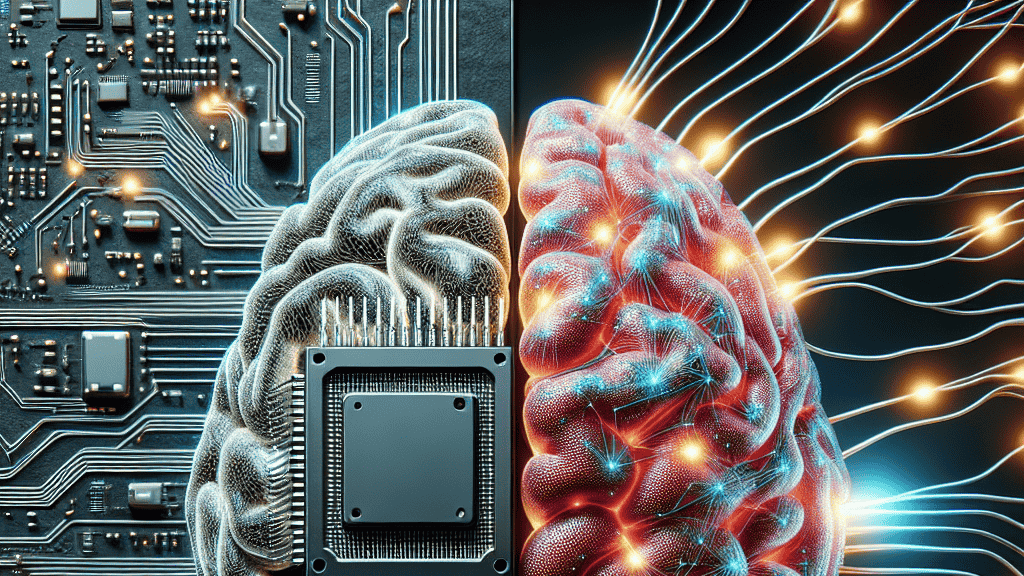
Imagine if your computer or phone could think like a brain, making it faster and using less battery. That’s what’s happening with a new approach inspired by the brain’s ability to send messages quickly and energy-efficiently across long distances. Scientists are taking cues from the way our brains communicate to tackle slow and power-hungry AI systems.
The research introduces a hybrid neural network architecture called SNAP, which cleverly combines elements of both spiking and traditional neural networks. These spiking neural networks are great at sending information across long distances without using much energy, much like the brain does. By placing these efficient pathways at bandwidth bottlenecks, like the edges of computer chips, and keeping high-power processing inside, SNAP creates a seamless flow of information that’s both fast and energy-efficient.
In real-world applications, this brainy approach means that AI systems could become significantly more powerful without the need for massive amounts of energy, making everything from your smartphone to AI language models much faster and more efficient. It’s like having the brain’s efficiency with the processing power of state-of-the-art technology, all working together to power the next generation of artificial intelligence.
Did you know the human brain uses about as much power as a 20-watt light bulb, yet it processes immense amounts of data faster than some of the largest supercomputers?
FAQs
What unexpected discovery did scientists make?
They found that combining spiking neural networks with traditional models can drastically improve energy efficiency and reduce processing time, directly inspired by the brain’s efficient communication.
How does SNAP change AI technology?
SNAP integrates brain-like spiking signals in AI systems to address energy and data processing bottlenecks, making them faster and more efficient.
Why are spiking neural networks important?
Spiking neural networks mimic the brain’s way of sending information efficiently, using less energy and speeding up data flow, crucial for improving AI scalability.
How might this affect my everyday tech?
Devices could become faster and more energy-efficient, leading to longer battery life and better performance in AI-driven applications like voice assistants and image recognition.
What’s the big deal about brain-inspired AI?
By learning from the brain’s energy efficiency, AI systems can be scaled up without the usual high energy costs, paving the way for more sustainable technology advancements.
Background
The brain communicates through sparse, spike-based signals which use very little energy. Spiking neural networks try to replicate this method for energy efficiency but have struggled with scaling and performance. By integrating them strategically within a broader architecture, they can provide significant benefits in overcoming communication bottlenecks in AI systems.
History
The journey of AI trying to mimic the brain dates back many decades. Early neural networks sought to replicate human thinking processes but were limited by computational power and energy demands. The development of spiking neural networks attempted to capture the brain’s efficiency but faced challenges in performance. SNAP represents a significant step forward by seamlessly blending these networks with traditional methods, optimizing both energy use and processing speed.
Based on “Learnable Sparsification of Die-to-Die Communication via Spike-Based Encoding” by Joshua Nardone, Ruijie Zhu, Joseph Callenes, Mohammed E. Elbtity, Ramtin Zand, Jason Eshraghian, available on arXiv (arxiv.org/abs/2501.08645), used under CC BY 4.0 (creativecommons.org/licenses/by/4.0/).