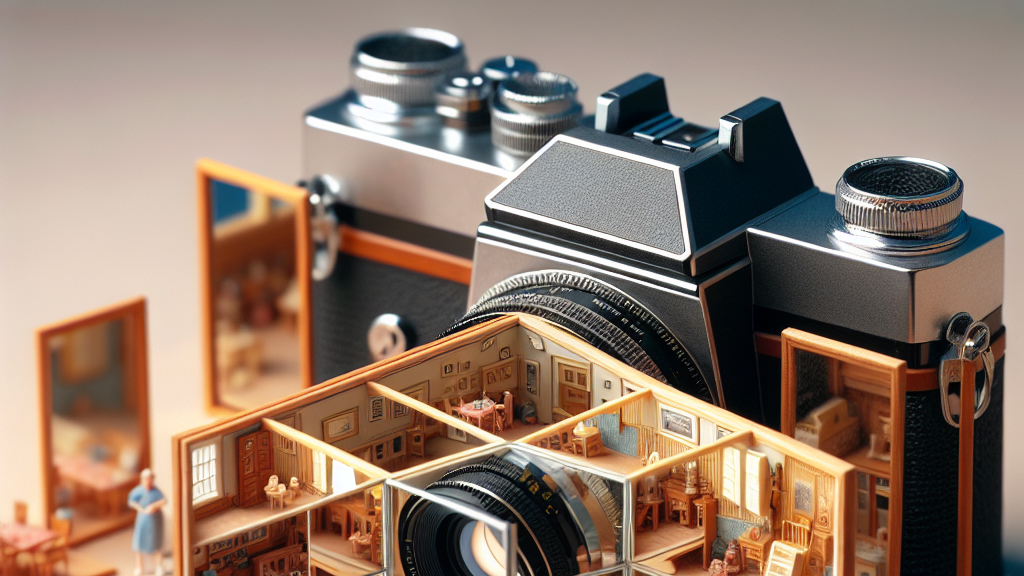
Imagine being able to step into your favorite tiny diorama or dollhouse—not just looking at it but actually experiencing it in full 3D on your screen. This isn’t some futuristic dream; scientists have invented a way to make this happen using an inventive setup of mirrors and cameras. This new technology could forever change how we interact with miniature worlds, from dollhouses to elaborate art pieces.
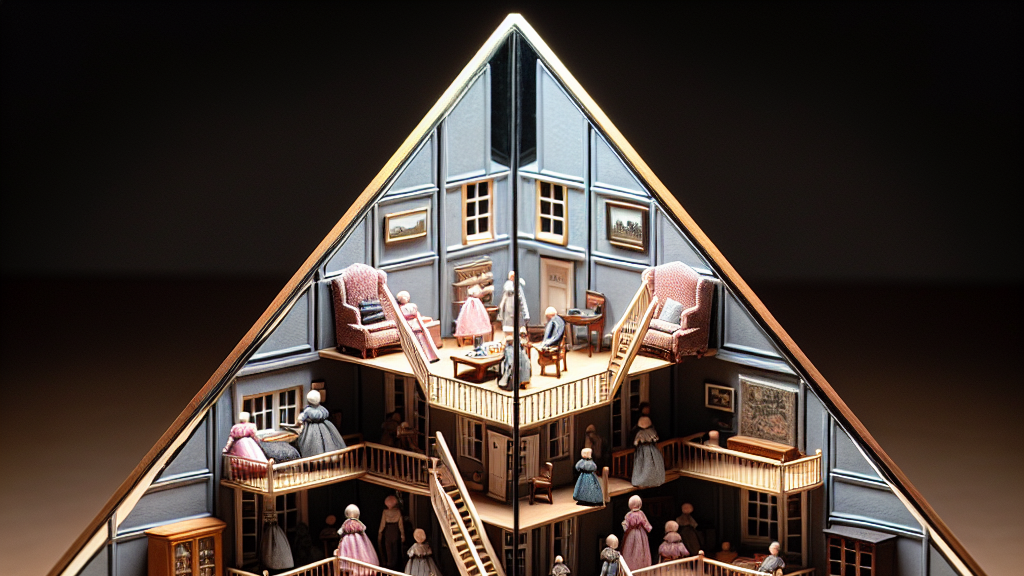
The magic behind this transformation is a clever use of mirrors arranged around a tiny scene. Using just one camera and eight pairs of mirrors set on pyramid surfaces, researchers can capture a full 3D view with a single snapshot, sort of like taking a family photo where everyone is perfectly in the frame. They then use a technique called 3D Gaussian Splatting to rebuild the miniature scene digitally, even crafting new angles that weren’t originally visible. It’s like Snapchat filters, but for entire dollhouses!
So why does this matter? Well, think about all those intricate model train sets, dollhouses, or even detailed cake decorations. With this technology, you could create a digital twin of these tiny marvels, preserving them forever, sharing them online, or even sending the model to a 3D printer to make exact replicas. The possibilities for preserving and sharing our tiny treasures are endless and could open up new worlds of creativity and fun.
Did you know some model train enthusiasts build tiny worlds so detailed, they even have working streetlights and miniature citizens—invisible to the naked eye but possible to explore with this 3D imaging technology!
FAQs
What makes 3D imaging of miniatures challenging?
Miniature scenes have intricate details that are hard to capture because objects are often very small, measured in millimeters, and require precise angles to view all aspects.
How does this imaging technique use mirrors?
The method uses eight pairs of mirrors arranged in concentric pyramids to capture various angles around a scene, allowing a single camera to create a comprehensive 3D representation with one snapshot.
What is 3D Gaussian Splatting in miniature reconstruction?
3D Gaussian Splatting is a technique used here to digitally reconstruct scenes by applying a mathematical representation that synthesizes new views, even filling in details not captured directly.
How can this technology be useful in everyday life?
It allows hobbyists, collectors, and creators to immortalize their tiny masterpieces digitally, share them with others online, or create physical copies using 3D printers, expanding interaction with these creations.
Can this technology be used in other fields besides artistic miniatures?
Yes, besides preserving art, it can assist in fields like archaeology for documenting artifacts, or in real estate for creating miniature models of buildings.
Background
This study focuses on 3D imaging, a process of capturing the depth, shape, and texture of an object in three dimensions. It applies catadioptric systems, which combine mirrors (catoptrics) and lenses (dioptrics) to obtain a comprehensive view of an object from different angles. The innovation lies in using mirrors arranged around a miniature to enable a camera to capture all views in one go—ideal for small, intricate scenes.
History
The evolution of imaging began with simple photography, progressing to more complex 3D systems like laser scanning and photogrammetry. This research expands on those ideas by simplifying the process to a single camera shot, propelled by advances in computational methods like 3D Gaussian Splatting, which were not possible until recently. This marks a new chapter in digital imaging by focusing on accessibility and ease of capturing 3D details.
Based on “Seeing A 3D World in A Grain of Sand” by Yufan Zhang, Yu Ji, Yu Guo, Jinwei Ye, available on arXiv (arxiv.org/abs/2503.00260), used under CC BY 4.0 (creativecommons.org/licenses/by/4.0/).