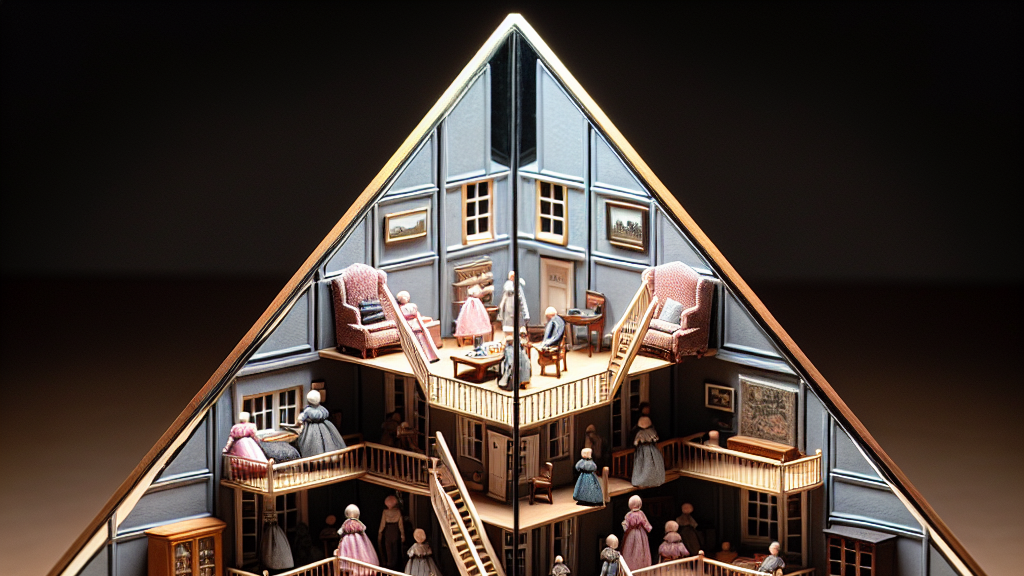
Imagine being able to capture an entire dollhouse in just one click, detailing every corner and cranny in 3D! That’s the magic of a new technique that uses a clever mirror setup and a single camera to take an all-around picture of tiny scenes. This technology can turn miniature worlds into lifelike digital models you can explore from any angle.
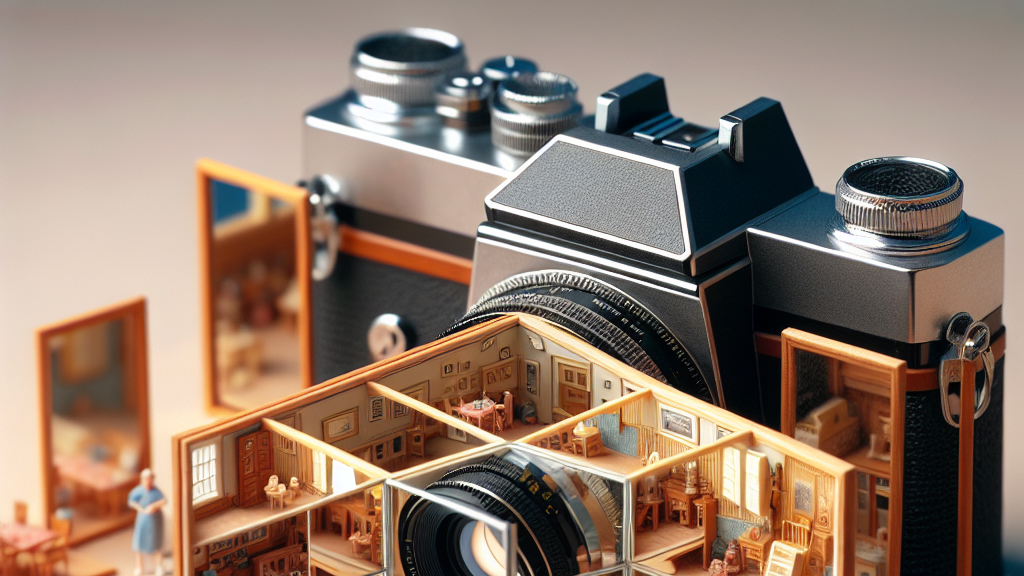
At the heart of this innovation is a smart mix of mirrors and cameras. Using something called a ‘catadioptric imaging system,’ it cleverly places pairs of mirrors to capture multiple views of a scene when you snap a photo. Think of it like having eyes all around the scene, giving you a complete 3D picture without having to move the camera around! The idea is to make it as easy as possible to digitize small and intricate scenes, which are tricky to capture with traditional methods.
The implications are exciting: imagine designers creating intricate virtual environments for video games, or historians preserving detailed models of ancient artifacts in their true forms. Even artists can use this to create stunning digital art. By simplifying the complex task of 3D reconstruction, this method is set to unlock creativity and innovation in countless fields. Imagine exploring a tiny palace on your computer with just as much detail as if you were a miniature person visiting it!
Did you know? This technique uses the same principle as a funhouse mirror room to create full 3D models!
FAQs
How does the catadioptric imaging system work in 3D reconstruction?
The catadioptric imaging system uses a combination of mirrors and a camera to capture multiple perspectives of a scene all at once. This setup allows for a comprehensive 3D picture by reflecting different angles of small objects, making it possible to see every detail in a single snapshot.
Why is 3D digitalization of miniatures important?
Digitizing miniatures is valuable because it allows for the preservation and exploration of small, intricate objects that can be hard to capture with detail in traditional 2D images. This technology enables detailed exploration, archiving, and even creative manipulation of these miniatures in digital formats.
What is 3D Gaussian Splatting and why is it used?
3D Gaussian Splatting is a method used to create smooth and realistic 3D models from captured images. It works by spreading out 3D data points in a way that fills in gaps and creates seamless surfaces, which is perfect for reconstructing detailed miniatures with precision.
How can this 3D imaging technology be applied in everyday life?
In everyday life, this technology could be used by artists to create virtual museum displays of their work, by educators to build virtual classrooms with models of historical sites, and by hobbyists and collectors to digitally archive their collections in 3D with ease.
Background
The technique leverages a blend of mirrors and optical lenses to capture a scene from multiple angles simultaneously. This is known as ‘catadioptric imaging,’ which uses reflective and refractive (lens) elements to enhance the field of view. This setup allows the entire environment to be captured in one image, crucial for creating detailed 3D models of objects that are too complex or small to capture in traditional ways. The 3D Gaussian Splatting technique smooths and refines these images into high-quality 3D models.
History
This research builds on foundational techniques in photogrammetry and computational photography, where images are used to measure the distance and dimension of objects. Early methods required multiple angles and significant manual input to reconstruct 3D images. However, advances in imaging technology and computational power have allowed for more automated and intricate reconstructions, especially for small or detailed subjects. This study refines these techniques, applying them specifically to miniaturized objects, a field that had previously been complex due to size and detail constraints.
Based on “Seeing A 3D World in A Grain of Sand” by Yufan Zhang, Yu Ji, Yu Guo, Jinwei Ye, available on arXiv (arxiv.org/abs/2503.00260), used under CC BY 4.0 (creativecommons.org/licenses/by/4.0/).