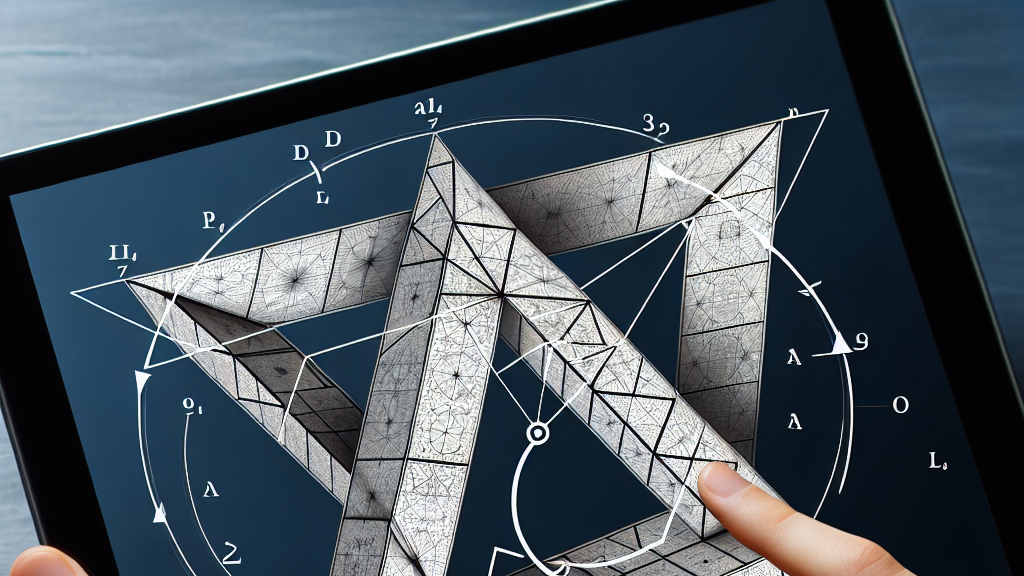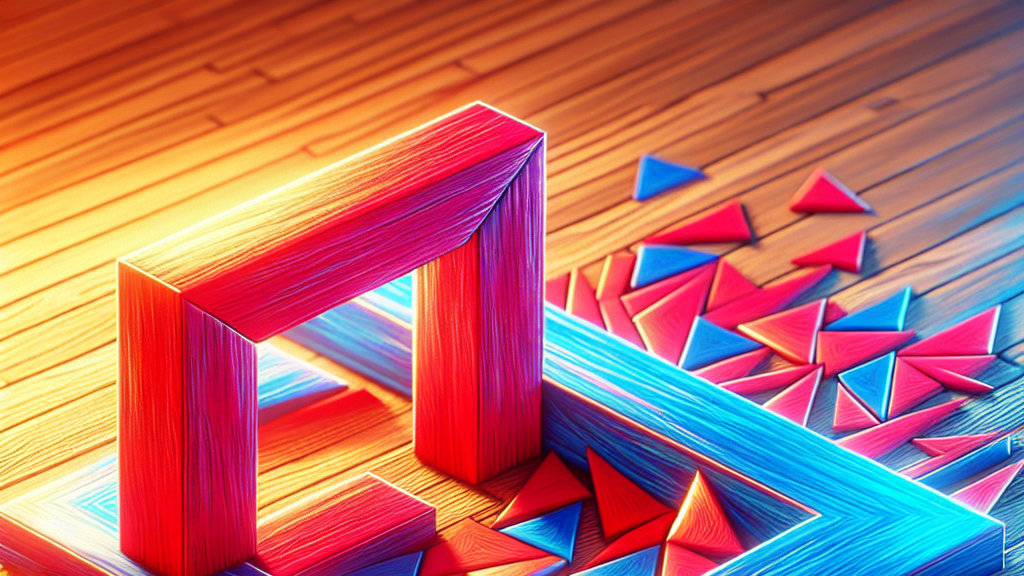
Ever wondered if you could cover your entire living room floor using just two shapes? Seems simple, right? Turns out, this seemingly easy task actually plunges us into the depths of math puzzles that are impossible to solve! This new study reveals that figuring out whether two shapes can fully tile a surface is an unsolvable problem. So, if you’ve ever tried to create a pattern with a couple of tiles and couldn’t get it right, there might be a deeper mathematical reason for your struggle!
At its core, this research dives into the world of tiling theory, exploring how shapes fit together without leaving gaps. The scientists have discovered a perplexing scenario: given two polygonal tiles, it’s undecidable—or just plain impossible to determine—if you can use them to cover a whole space. What’s even more intriguing is this improves upon previous findings where three tiles were needed to showcase this undecidability.
Imagine tiling as a giant jigsaw puzzle. However, for some puzzles, there’s no way to know if they’ll ever solve perfectly. This kind of research deepens our understanding of geometry and logic, potentially influencing how we approach computational problems. In the future, this could revolutionize how we design algorithms for computer graphics, architecture, and even art, showing that sometimes, the tools to complete a task are elusive, no matter how smart we get.
Did you know that the question of whether two simple shapes can entirely cover a floor can be as impossible to solve as predicting the weather years in advance?
FAQs
What makes tiling with two shapes undecidable?
It’s all about whether you can perfectly cover a space with just two shapes. This task is labeled ‘undecidable’ because, mathematically, there’s no surefire way to determine if it will work or not across all scenarios.
Why is this important in math and geometry?
This study pushes the boundaries of our understanding in geometry, revealing complexities and limitations in how we perceive spatial configurations and theories.
How does this research build upon previous work?
Previously, undecidability was shown using three tiles. This research takes it a step further, proving the phenomenon with just two, making the puzzle even more intriguing.
Can this research influence practical fields like architecture?
Yes, by exploring the limits of spatial coverage and pattern creation, architects and designers might rethink how they approach space optimization and pattern design.
How does local matching contribute to undecidability?
Local matching involves rules about how the edges of tiles align. It complicates the tiling puzzle by imposing constraints that don’t necessarily help predict an overall solution.
Background
In geometry, tiling refers to covering a surface using one or more shapes without overlaps or gaps. The notion of undecidability comes from mathematics and logic, implying that no algorithm will always lead us to a yes-or-no answer for every possible scenario. Discovering undecidability in tiling challenges preconceived notions about predictability and solvability in math.
History
This research builds on prior studies in the realm of tiling theory. Historically, tiling problems have fascinated mathematicians and artists alike, with the likes of M.C. Escher popularizing complex tiling artwork. Demaine and Langerman had previously demonstrated undecidability using three tiles, and this new work successfully narrows it down to just two, showcasing a breakthrough in the field.
Based on “Two Tiling is Undecidable” by Jack Stade, available on arXiv (arxiv.org/abs/2506.11628), used under CC BY 4.0 (creativecommons.org/licenses/by/4.0/).