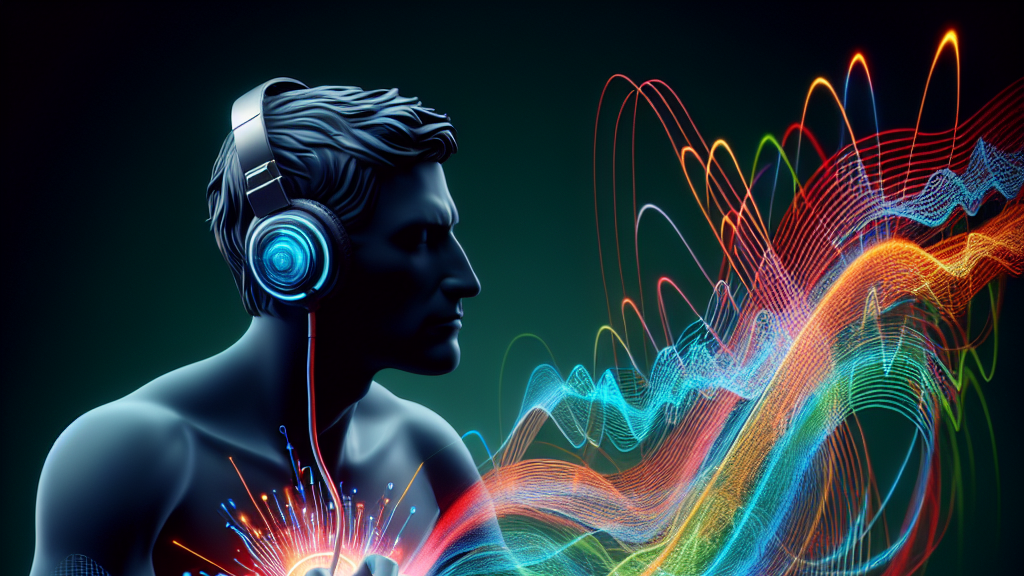
What if your heartbeat could control the music you hear? That’s exactly what cutting-edge research is exploring, allowing your own pulse to change the melodies and rhythms around you. This isn’t just a wild concept – it’s rooted in the intimate relationship between our heartbeats and our perception of time and music. This research taps into this connection to create immersive musical experiences.
Here’s how it works: By using a technology called a photoplethysmogram (PPG), your heartbeat can be detected and used as a control for music. The PPG measures your heart rate and sends this info wirelessly to a device that can modify sound in real-time. As your heart beats faster or slower, the music’s tempo and rhythm adjust, creating a unique biofeedback loop where the music and your body are in sync.
This type of innovation could open up new ways to think about music and its interaction with our bodies. Imagine a concert where the music flows and changes not just with the instruments but with the audience’s heartbeats, creating a shared, living soundscape. Such technology could make performances more interactive and personalized, changing the way we experience music in the future.
Humans have used their breath to control music for centuries—now, your heartbeat could be the next big thing!
FAQs
How does heart rate control music in the biofeedback system?
The heart rate is detected using a wearable sensor known as a photoplethysmogram which sends the data wirelessly to a device that can modify the music’s sound based on the heartbeat’s rhythm, creating a synchronized audio experience.
Why would controlling music with your heartbeat be useful?
Using your heartbeat to control music can make musical experiences more immersive and interactive, allowing for personalized soundscapes that respond to your body’s natural rhythms, potentially enhancing relaxation, focus, or excitement.
What is a photoplethysmogram and how does it work?
A photoplethysmogram, or PPG, is a sensor that uses light to measure your heart rate by detecting blood volume changes in your skin, translating these into data that can be used to influence music or other media in real-time.
How does biofeedback change the way we experience music?
Biofeedback allows music to become a dynamic, interactive experience, where sound is transformed based on our body’s signals, making music performances more engaging and personal, reflecting our own inner states.
Are there other uses for biofeedback in music beyond entertainment?
Yes, biofeedback can be used in therapeutic settings to promote relaxation or focus by aligning music with the user’s physiological state, as well as in education to demonstrate the link between our bodies and the world around us.
Background
Biofeedback involves measuring physiological functions and using this data to provide real-time feedback to the user. Photoplethysmogram (PPG) sensors detect blood volume changes by shining light into the skin and reading how much light is reflected back, which varies as the heart pumps blood. This application turns the pulse into a control parameter for music, allowing the tempo and other sound characteristics to shift with the heart’s natural rhythm.
History
The concept of controlling music through biomechanical feedback isn’t new—breath control has been utilized for musical expression for years, especially in wind instruments. However, integrating heart rate data into music interfaces is a recent development. Earlier works focused on breath-driven biofeedback, but with advancements in wearable technology and wireless data transmission, heart rate music controllers are gaining attention, potentially offering a more nuanced control over musical parameters.
Based on “Coupling the Heart to Musical Machines” by Eric Easthope, available on arXiv (arxiv.org/abs/2505.03073), used under CC BY 4.0 (creativecommons.org/licenses/by/4.0/).