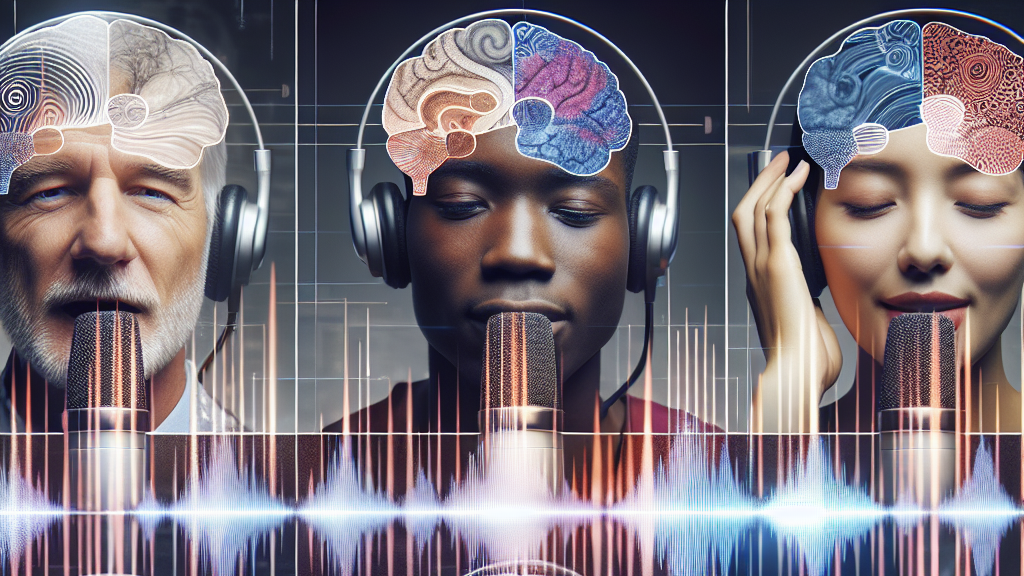
**Did you know that your voice might hold the key to understanding your brain’s health?** Imagine a future where a simple snippet of your speech could reveal the state of your cognitive health, potentially catching issues early on and paving the way for intervention. Forget about invasive tests or long waits for specialist appointments; this is like a health check-up done through a chat over coffee. This is the promise held by new research into using speech as a biomarker for cognitive decline. By exploring how our speech patterns relate to brain function, scientists are moving towards a world where our words are not only a means of communication but also a window into our mental well-being. Traditional methods of detecting cognitive impairment have relied heavily on manual processes that are tedious and often fall short when tested across different languages and datasets. But here’s the exciting twist: researchers have developed a method that skips the bulk of this laborious process. Using something called Qwen2-Audio AudioLLM, a kind of smart technology that can understand both what you say and how you say it, they’ve found a way to assess cognitive health without needing a crystal ball or a doctorate in brain science. This approach uses creative prompts to determine if a person’s speech is normal or indicative of cognitive issues. And it works in multiple languages, which is a huge breakthrough. Imagine this: in the future, after listening to a voicemail or during a casual chat, a mobile app could alert you to potential cognitive issues before they become serious. This breakthrough isn’t just about fancy algorithms or cutting-edge science; it’s about making mental health checks as common and easy as checking your heart rate or counting your steps. A world where an app can bridge language barriers and cultural differences to keep an eye on our mental health is closer than ever, potentially revolutionizing how we approach brain health across the globe.
Your voice carries unique acoustic signatures that can act like fingerprints for your brain’s health!
FAQs
How can the sound of my voice indicate cognitive impairment?
Your speech has unique patterns and features, like tone and pace, that can subtly change with cognitive impairment. By analyzing these patterns, researchers can detect signs of cognitive decline without traditional invasive tests.
What makes zero-shot speech analysis different from traditional methods?
The zero-shot approach doesn’t rely on pre-training with labeled data, meaning it can work across different languages and tasks without needing specific customization for each. This allows it to be more flexible and widely applicable than traditional methods, which require extensive manual setup.
Why is multilingual capability important for cognitive impairment detection?
Multilingual capability ensures that detection tools are accessible to a wider audience, cutting across language barriers. This inclusivity means more people can benefit from timely cognitive health assessments, regardless of their language or background.
How soon could this technology become available for everyday use?
While this research shows promising results, widespread use will depend on further development, testing, and regulatory approval. It holds great potential for becoming part of routine check-ups in the near future, especially as technology becomes more integrated with healthcare.
What are the potential real-world benefits of using speech for cognitive health monitoring?
This technology could enable early detection and intervention, reducing the impact of cognitive diseases. By making cognitive health monitoring easy and accessible, it could lead to better outcomes and quality of life for many individuals.
Background
Cognitive impairment refers to the decline in memory and thinking skills, which can significantly impact daily life. Traditional methods for detecting such impairments often involve clinical assessments that can be difficult to access or conduct. By focusing on how speech patterns reflect cognitive health, researchers aim to create non-invasive, easily accessible tools that can cross language barriers and provide early warnings of cognitive decline.
History
Research into cognitive health using speech analysis has evolved significantly over recent decades, moving from basic acoustic analysis to complex computational models that can interpret speech patterns. Earlier studies focused on supervised learning methods, which required extensive manual input. The introduction of models like Qwen2-Audio AudioLLM marks a shift towards more adaptive, zero-shot learning techniques that promise greater flexibility and applicability across diverse datasets and languages.
Based on “Zero-Shot Cognitive Impairment Detection from Speech Using AudioLLM” by Mostafa Shahin, Beena Ahmed, Julien Epps, available on arXiv (arxiv.org/abs/2506.17351), used under CC BY 4.0 (creativecommons.org/licenses/by/4.0/).