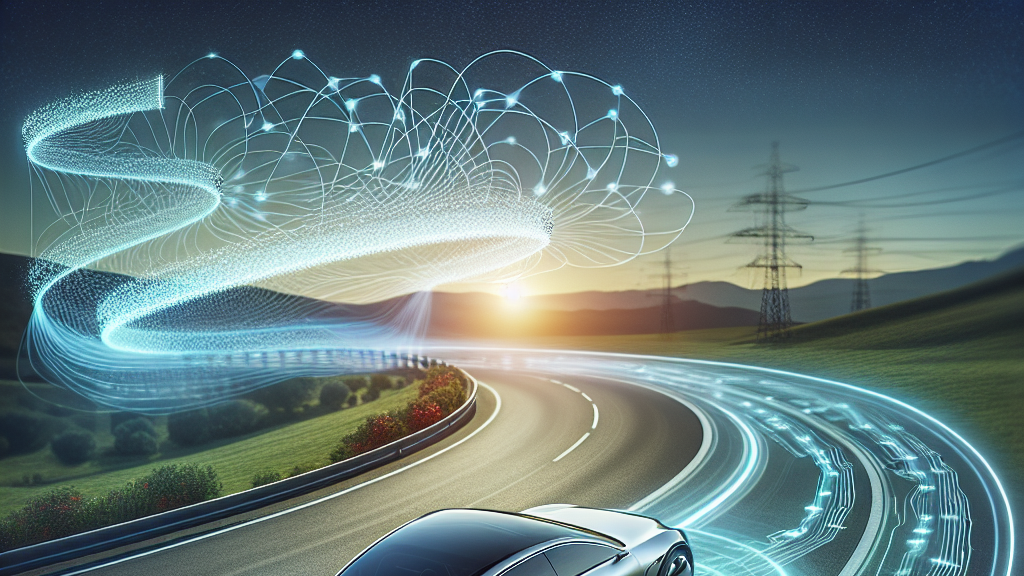
Imagine a world where your car can drive so smoothly that you barely notice the bumps and turns. That’s not just science fiction anymore. Researchers are diving into AI and control systems to create game-changing technology that promises to keep things stable and smooth, ensuring your ride is always on point, even when the road ahead gets rough.
The heart of this research lies in using powerful AI algorithms, specifically neural networks, that work like the brain of your car. They can learn from previous experiences and adapt in real-time to maintain stability. This is achieved by a method called the Youla-Kucera parameterization married with robust neural networks. This means the AI can continuously adjust itself to keep the car on track, handling unexpected disturbances like sudden stops or sharp turns with ease.
In practice, this kind of research could mean your home thermostat intelligently adjusting for optimal comfort, or industrial robots performing tasks with precision, adapting smoothly to changes in their environment. Essentially, it opens up a world where machines operate more like living organisms, capable of learning and adapting continuously to keep performing at their best.
Did you know? The principles used in this AI research can help machines learn how to stay balanced, just like how cats always land on their feet!
FAQs
What is the main goal of stabilizing nonlinear policies in AI control systems?
The main goal is to ensure that AI systems, like self-driving cars, remain stable and efficient, even when facing complex and unpredictable scenarios. This stability is crucial for safety and reliability.
How do neural networks play a role in maintaining control system stability?
Neural networks act like the brains of these control systems. They learn from experiences and continuously adapt to changing conditions, ensuring the system remains stable and performs optimally.
What are the real-world applications of this research in AI control systems?
Real-world applications include enhancing the safety and performance of self-driving vehicles, optimizing industrial automation, and even improving the efficiency of household smart devices like thermostats and cleaning robots.
How does the Youla-Kucera parameterization contribute to this research?
The Youla-Kucera parameterization is a mathematical framework that helps in designing control systems that are both stable and flexible. It allows the AI to adjust its parameters dynamically in response to different conditions.
What challenges do researchers face when ensuring incremental stability in AI control systems?
One major challenge is maintaining stability when dealing with the complexities of nonlinear dynamics, partial observations, and external disturbances. Researchers must find a balance to keep systems stable under these conditions.
Background
The study revolves around creating AI systems that can maintain stability even in unpredictable environments. This involves the use of advanced neural networks that adapt like a brain, combined with mathematical frameworks that guide these networks in how to adjust to keep everything running smoothly. It’s like teaching a robot to stay balanced on a wobbling surface.
History
This research builds on decades of work in control theory and neural networks. The Youla-Kucera parameterization has been known in engineering to design stable systems. Recent advances in AI have enabled these concepts to be applied to smarter, more flexible systems like self-driving cars or intelligent robots, bringing about a new era of autonomy.
Based on “React to Surprises: Stable-by-Design Neural Feedback Control and the Youla-REN” by Nicholas H. Barbara, Ruigang Wang, Alexandre Megretski, Ian R. Manchester, available on arXiv (arxiv.org/abs/2506.01226), used under CC BY 4.0 (creativecommons.org/licenses/by/4.0/).