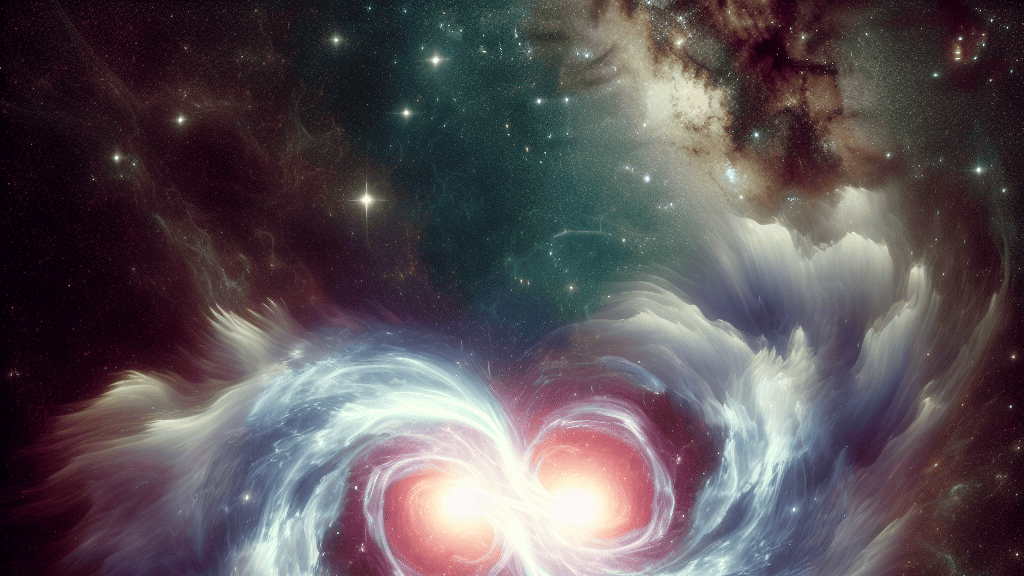
Imagine if the universe holds a secret ingredient, an invisible force that makes up most of the cosmos. That’s our dark matter puzzle, and scientists are on a quest to solve it using cosmic clouds known as self-gravitating condensates. Picture these as gigantic, glowing clouds in space that, when they clash, create a spectacular light show of turbulence and swirling patterns.
Recent research has taken a closer look at these merging clouds using models to understand how they move and interact. When these cosmic giants collide, they enter a stage of turmoil that might just mimic the dark matter’s elusive dance in the universe. The intricate patterns formed by their interaction could help us decode the mysterious behavior of dark matter, potentially changing everything we know about the cosmos.
Think about it: if we can understand these cosmic collisions better, it might even open new doors to predicting stellar events like binary star mergers. This could mean new technologies to harness forces we can’t yet imagine or even reshape our understanding of cosmic forces entirely. Imagine the potential of tapping into this cosmic energy or gaining a new perspective on gravity itself!
Did you know that the universe is believed to be made up of about 85% dark matter, a mysterious substance we can’t even see?
FAQs
What are self-gravitating condensates in the context of dark matter?
Self-gravitating condensates are theoretical formations that scientists hypothesize could help model the dynamics of dark matter by simulating how these cosmic clouds merge and interact.
How does turbulence relate to the merging of self-gravitating condensates?
Turbulence occurs when the merging of self-gravitating condensates creates complex and swirling patterns that can help scientists understand the hidden forces of dark matter through their energy distribution.
What role does quantum pressure energy play in these cosmic activities?
Quantum pressure energy becomes significant when the merging condensates’ kinetic energy transitions, highlighting how forces dissipate and re-organize energy during cosmic events.
Why is studying the merging of binary stars significant to dark matter research?
Studying the merging of binary stars can provide new insights into cosmic forces and energy transfer patterns, offering fresh clues about the nature and behavior of dark matter.
How might this research impact our understanding of the universe?
This research could fundamentally alter our grasp of cosmic events and forces, potentially revolutionizing technology and scientific approaches to harnessing cosmic energies.
Background
In space, enormous clouds of gas and dust sometimes come together due to their own gravitational pull—these are self-gravitating condensates. Scientists believe these formations might mimic the properties of dark matter, a mysterious force that doesn’t emit, absorb, or reflect light, making it invisible and one of the big mysteries of modern astrophysics. By studying how these condensates merge and the turbulence that results, researchers can draw parallels to the elusive behavior of dark matter. The Gross-Pitaevskii-Poisson model helps in simulating these complex interactions.
History
The quest to understand dark matter started decades ago when astronomers noticed that galaxies were behaving as though they were heavier than their visible mass suggested. Over time, theoretical models like the self-gravitating condensate have evolved to explain these anomalies in cosmic behavior. Scientists have used studies of atomic condensates as a starting point and progressively adapted these ideas to cosmic scales. This current research builds on those foundations by introducing new dynamics of turbulence and energy transfer, advancing our comprehension of the universe’s hidden mass.
Based on “Revealing turbulent Dark Matter via merging of self-Gravitating condensates” by Anirudh Sivakumar, Pankaj Kumar Mishra, Ahmad A. Hujeirat, Paulsamy Muruganandam, available on arXiv (arxiv.org/abs/2501.13689), used under CC BY 4.0 (creativecommons.org/licenses/by/4.0/).